
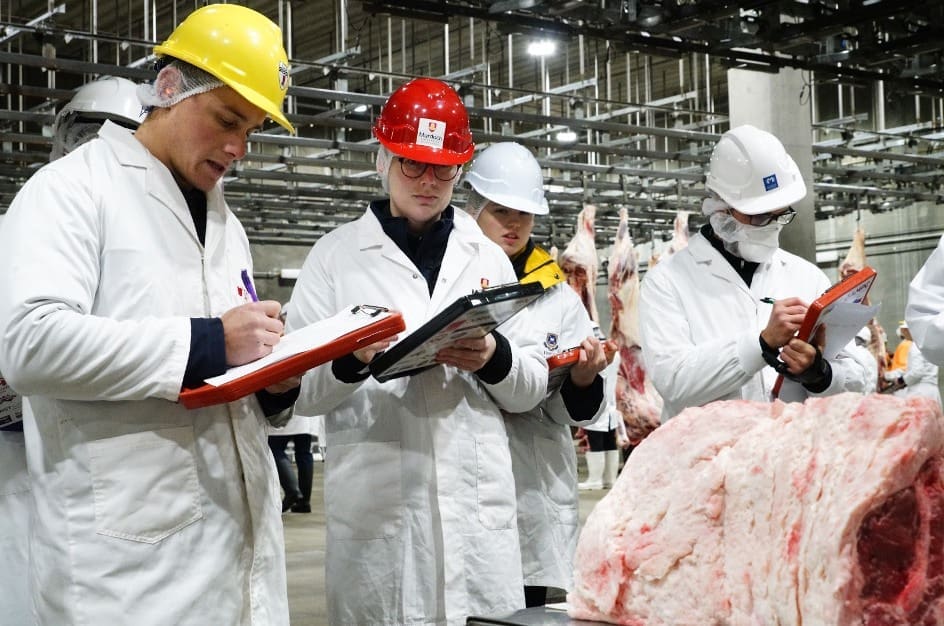
Students judging during this year’s ICMJ competition
A SURVEY of 158,000 tertiary education students across Australia has found that agriculture students are among the happiest with the quality of their degrees.
Despite this high satisfaction, Australia still faces a major shortfall in ag graduates compared to the number of jobs available.
New data from the 2024 Student Experience Survey, conducted by the Australian Government program QILT (Quality Indicators for Learning and Teaching), revealed that undergraduate students studying Agriculture and Forestry reported the highest satisfaction levels of 45 study areas surveyed.
Agriculture and Forestry recorded an 84.8% positive rating for overall educational experience among responding undergraduate students.
Veterinary Science also rated highly at 82.5%, ranking seventh overall.
At the other end of the scale, the lowest positive ratings were recorded for:
-
Dentistry – 72.0%
-
Engineering (Aerospace) – 71.4%
-
Management & Commerce (Other) – 68.9%
-
Engineering (Electrical & Electronic) – 68.4%
-
Computing and Information Systems – 67.3%
Overall educational experience of all undergraduate students for year 2024 by 45 study areas, % positive rating


Source: 2025 QILT Student Experience Survey
What’s driving ag’s strong satisfaction scores?
In response to that question from Beef Central, leading agricultural educator Professor Jim Pratley of Charles Sturt University suggested it comes down to the enormous and unique scope of opportunities that careers in agriculture can provide.

Professor Jim Pratley
“My immediate reaction is that many students who come into agriculture do not realise the scope and opportunities that an agricultural qualification and career can provide,” Professor Pratley said.
“It is only when they start their degrees that students really understand that agriculture is not only about on-farm production but it involves a very strong service sector, a research scientist pathway, international trade and finance.”
He said recent research by an Honours student at Charles Sturt University found that many students changed their career aspirations once they understood the full range of roles available in agriculture.
“The striking finding was that many of the students who chose agriculture had changed their views on what job they would be seeking afterwards because they suddenly discovered all the job types and opportunities that were open to them that they had not realised existed.”
City schools sparking interest in agriculture
He also pointed to Barker College on Sydney’s North Shore as a model for how agricultural studies can appeal to students from urban backgrounds.
“We see from the great agricultural education performance at Barker College that city kids, who normally would not consider agriculture as a career choice, are provided with a clear understanding of the opportunities, even for a career in the city and elect to do agriculture.
“This one school has up to 400 students elect agriculture from year 9 to year 12 in total with about 100 sitting for HSC agriculture.
“Of these students up to 30 percent go on to agricultural studies at university.
“Similar stories abound in some schools around the country like Ulladulla HS, Kinross Wolaroi College at Orange, Yanco Ag HS, Farrer Ag HS at Tamworth, Boonah High School Qld, Ballarat Grammar School Vic, Urrbrae HS in Adelaide, and the list goes on.”
Professor Pratley said many students are drawn to study agriculture because they are interested in technology – “agriculture is at the leading edge of technology adoption”- and they want to make a difference in their careers.
“Ensuring global food and fibre supply and managing the production landscape really make that possible,” he said.
Ag graduate shortfall still major challenge

Source: 2025 QILT Student Experience Survey
Despite the high levels of satisfaction among students studying agriculture at university, Australia is still not producing enough graduates to satisfy the professional market in agriculture.
In a recent interview with Beef Central’s The Weekly Grill podcast, Professor Pratley told host Kerry Lonergan that the 14 Australian universities teaching agriculture collectively produce just under 1000 graduates a year, while the job market wants 5000 to 6000.
He pointed to Barker College as a case-study for introducing more children from non-agricultural backgrounds to the opportunities that a career in agriculture offers.
“Going back to say the 1950s there were more people in the country than in the city, but now we’re down to about 15 percent in the country relative to populations in the city,” he said.
“So we’re trying to preach to the converted there, that 15 percent, when in fact the majority of students would obviously be the other 85 percent.
“So we have to look at ways we can sell the great opportunities in agriculture to these city based kids.”
- To listen to Professor Pratley’s full Weekly Grill podcast interview with Kerry Lonergan click here
- More details on the 2025 QILT report’s findings can be found at this link