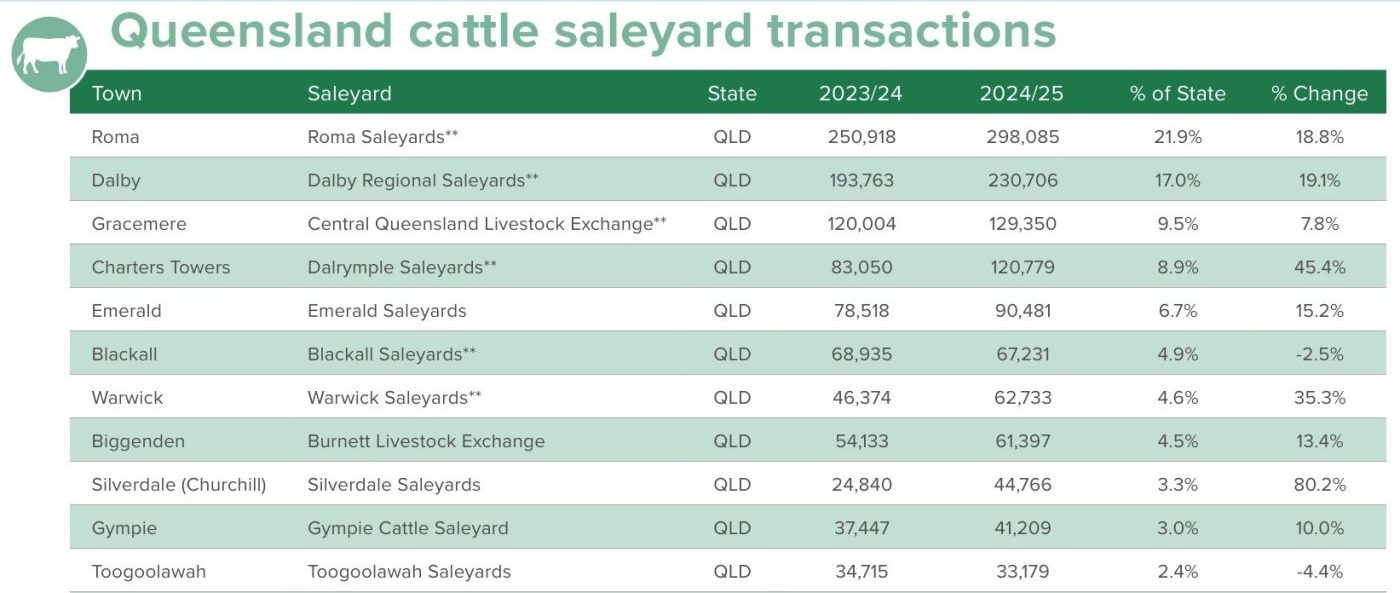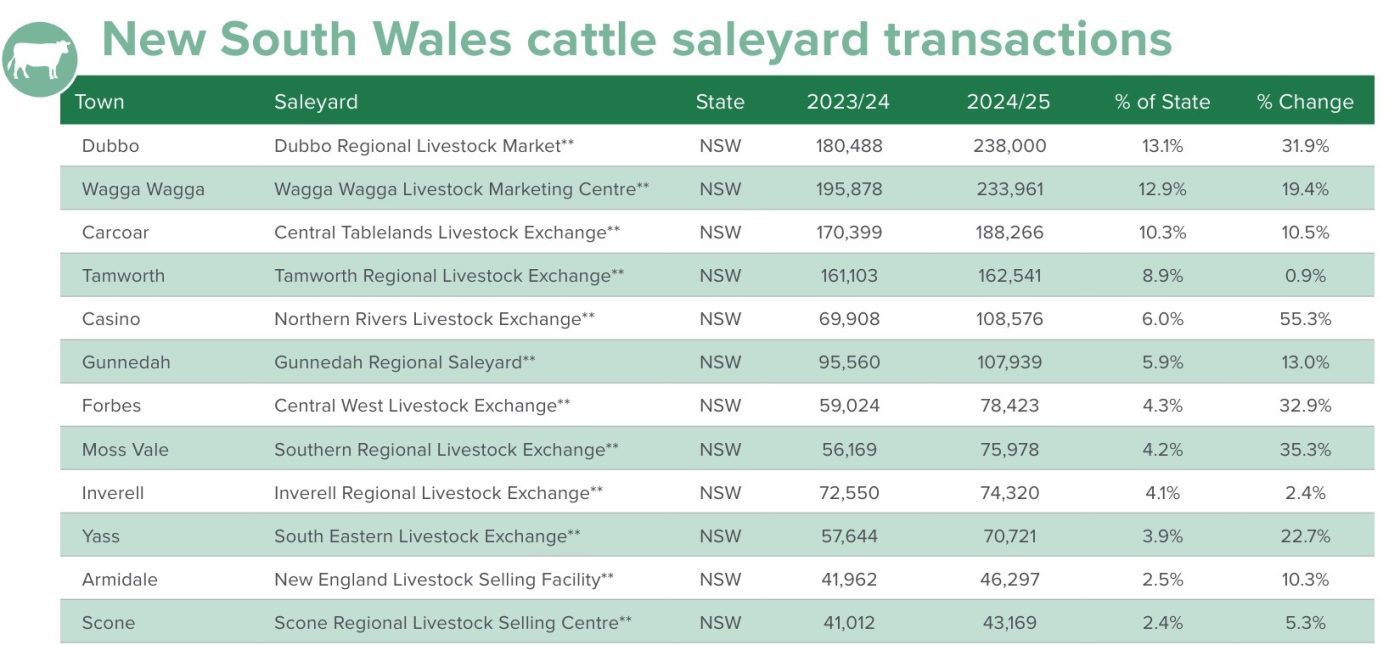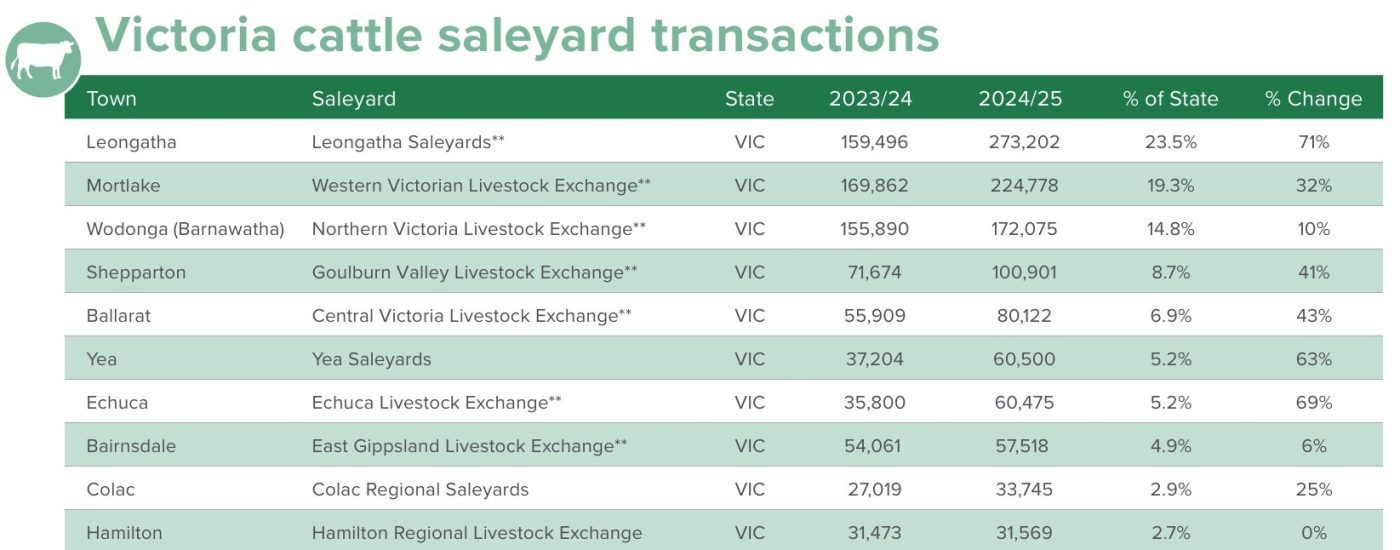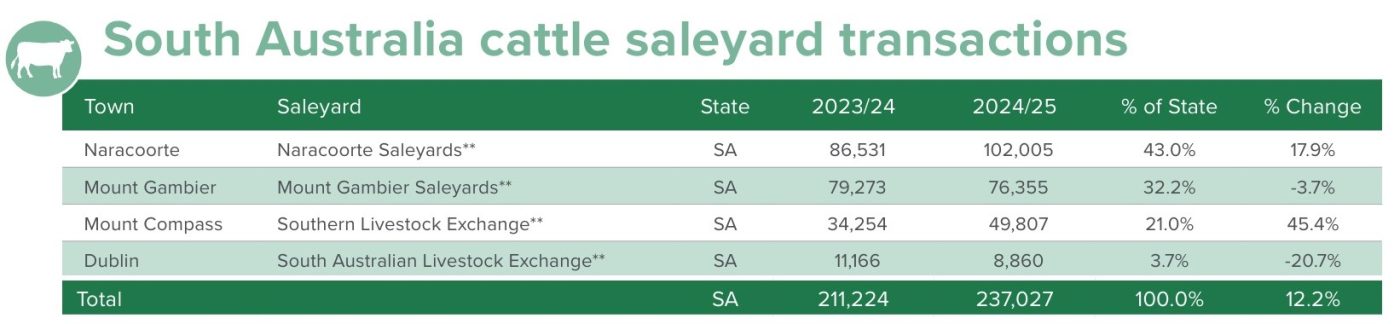
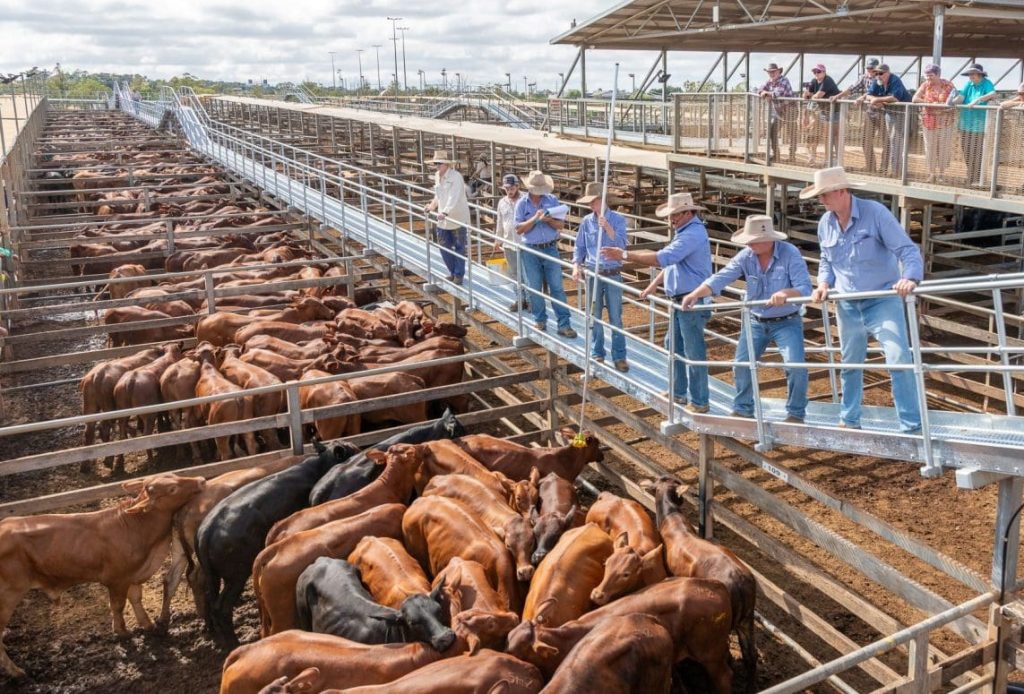
Roma remained the largest saleyards in Australia by turnover last financial year, accounting for just short of 300,000 head of cattle
THE 2024–25 National Saleyard Survey has shown a significant increase in livestock transactions across Australian saleyards during the last financial year ended 30 June, with notable growth in both cattle and sheep consignments.
Meat & Livestock Australia’s annual survey, conducted through the National Livestock Reporting Service, provides a comprehensive snapshot of saleyard activity for the financial year, capturing data from 73 cattle and 35 sheep facilities across Australia.
The statistics cover livestock transacted through saleyard auctions only (both NLRS reported yards and non-reported), and do not cover ‘transit’ cattle, live export cattle, or cattle being spelled or weighed over the scales passing through yards.
National saleyards cattle transactions for the year rose to 4.84 million head, up from 4.18m in 2023-24.
 Sheep transactions increased to 16.39 million head, up from 14.09m a year earlier.
NLRS Operations Manager Stephanie Pitt said the results reflected a strong recovery in livestock movement and market confidence across the country.
“This year’s survey highlights the resilience of Australia’s livestock sector, with most states recording year-on-year growth in saleyard throughput,” Ms Pitt said.
“The data also underscores the importance of regional saleyards in supporting producers, agents and buyers in a dynamic market environment.”
Largest national cattle turnover
Nationally, Queensland’s Roma saleyards maintained its mantle as the largest cattle turnover yards in the country, accounting for 298,085 head last financial year, up 18.8pc on the previous year.
Fuelled in part buy the region’s drought turnoff, Victoria’s Leongatha yards became the nation’s second largest last year, accounting for 273,202 head of cattle, up 71pc on the previous year. The closure of Pakenham also helped lift Leongatha throughput.
Next largest was the Dubbo yards in NSW, with 238,000 head, a rise of 31.9pc, followed by Wagga NSW (233,961 head, +19.4pc) and Dalby, Queensland (230,706 head, +19.1pc).
Another Victorian yard showing dramatic rise in turnover due to drought impact was Mortlake, next largest on the national list with 224,778 head, up 32pc.
State highlights:
New South Wales led the nation with 1.82 million cattle and 9.24m sheep transacted, marking a 22.2pc and 13.4pc increase respectively.
Although less reliant on saleyards than southern states, Queensland saw a 20.9pc rise in cattle transactions, with Roma, Dalby and Charters Towers among the top-performing saleyards.
Victoria transacted 1.16 million cattle and 4.84 million sheep, with strong growth in Ballarat, Bendigo and Leongatha.
Western Australia posted the largest percentage increase in sheep transactions at 60.2%, driven by activity at Katanning and Muchea.
Tasmania experienced a 23.1pc rise in sheep transactions, while cattle numbers dipped slightly by 5.2pc.
Top-performing livestock saleyards in terms of percentage increase were:
- Dubbo Regional Livestock Market (NSW) saw a 31.9pc increase in cattle throughput.
- Forbes Central West Livestock Exchange (NSW) recorded a 33.5pc rise in sheep transactions.
- Katanning Regional Sheep Saleyard (WA) doubled its throughput, up 100.3pc year-on-year.
Largest yards by state
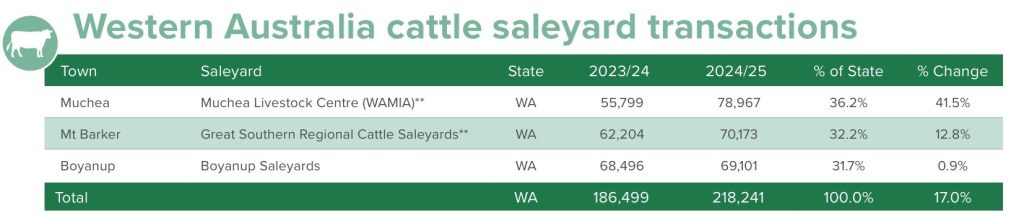
Published below is a summary of the largest yards by cattle turnover in each state. Click on tables for a larger view: