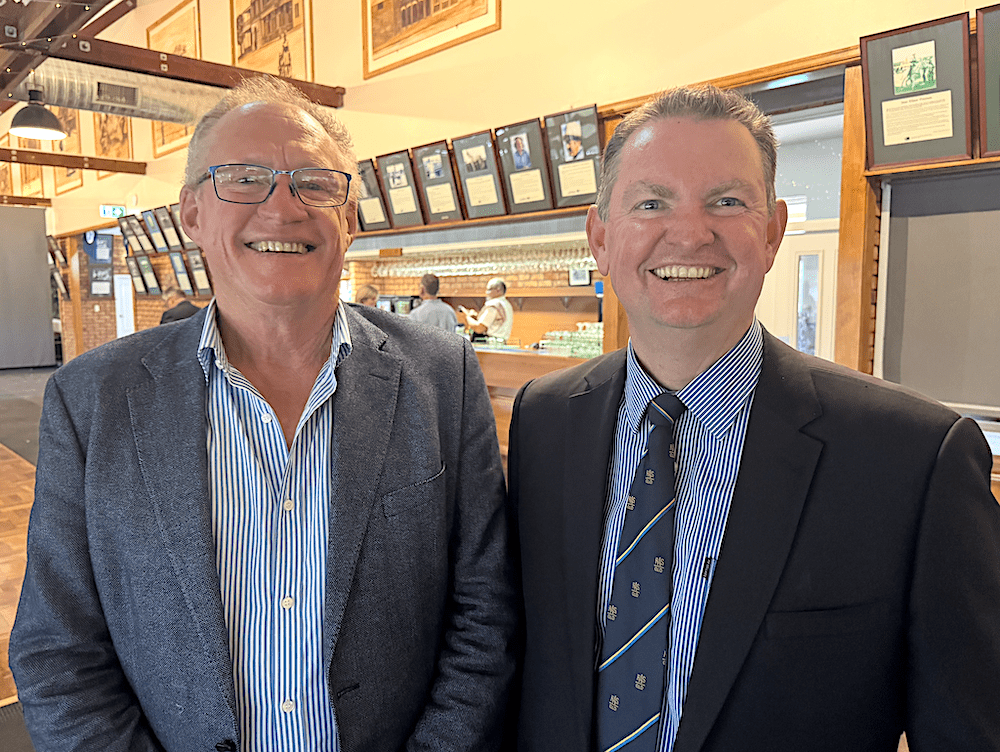
Ken Cameron, Cameron Pastoral Company and co-founder of the SunPork group, and Shane Charles, President of the Royal Agricultural Society of Queensland at the Toowoomba Showgrounds last Friday.
KEN Cameron has built one of Queensland’s largest and most successful agribusiness enterprises, but it’s clear when he speaks in public that he is still very much a laid-back, down-to-earth pig farmer who loves what he does.
What started with the construction of a small 210 sow piggery on his family’s cattle and dryland cropping property near Goondiwindi in the 1980s has grown into the SunPork Group today, Australia’s largest pork production enterprise, with operations from genetics to retail including 48 farms across eastern Australia raising 53,000 sows and progeny.
The business has grown as a partnership between the Cameron Pastoral Company and two other Downs farming families, the Halls and McLeans, co-owners of Sunny Queen eggs, on the old fashioned values of trust and deals agreed to on the shake of a hand.
After an extraordinarily successful 40 year partnership, Cameron Pastoral Company became the 100 percent owner of SunPork in March of this year.
By his own admission Ken does not seek out the spotlight, and rarely talks in public.
But he agreed to share his story after receiving two recent invitations to speak, one to a Nuffield Australia Dinner last month and the other to a lunch held last Friday by the Royal Agricultural Society of Queensland which runs the Toowoomba Show.
Despite normally avoiding public speaking “like the plague”, Ken said decided to accept the invitations to speak on his wife Julie’s advice.
“She said it is an opportunity for you to give back, and I think it’s right. So I couldn’t duck around this one. I tried, but I won’t,” he said with a laugh.
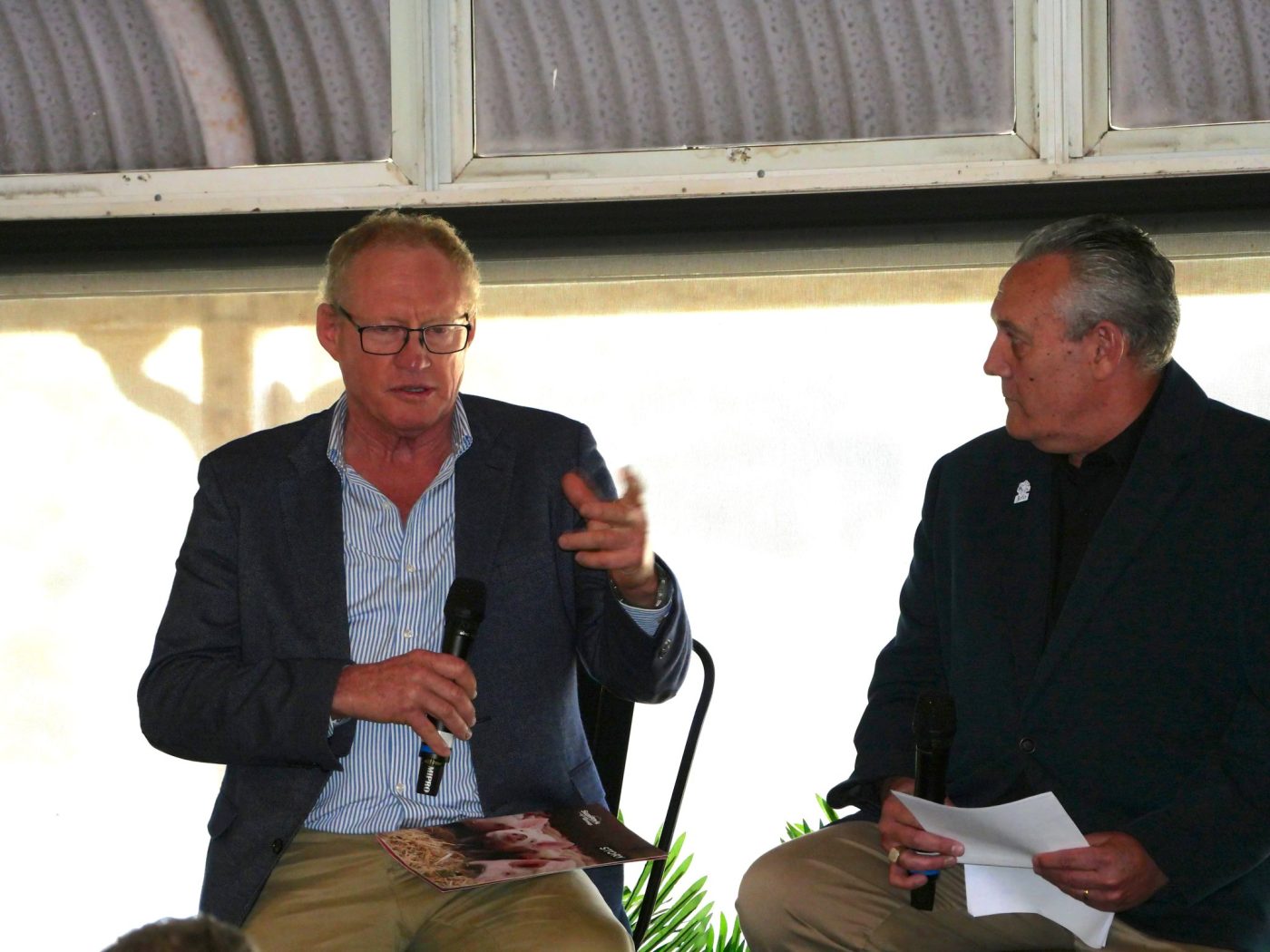 Ken shared his story last Friday in a candid Q&A session with MC Wayne Bradshaw from animal nutrition company JEFO, and what unfolded was an engaging and illuminating discussion that revealed the deeply fundamental role that trust in business partners, managers and teams has played in helping to drive the success of Cameron Pastoral Company over the past forty years.
As a boy who grew up on a beef and grain property, Ken’s entry into pig farming came about as much through chance as it did through choice.
After leaving school he spent a year breaking horses, before heading to Orange Agricultural College to study farm management.
He chose pig production as an elective subject, and began spending time on a new friend’s family pig farm.
“I’d find myself visiting their property and I just fell in love with pigs really, and I could see the synergies between a pork business and our dryland farming at Goondiwindi.”
Ken said it was obvious early on that his brother John was going to be running the dryland farming part of the family business, while a close friend of his father Rod’s was very capably running the beef cattle enterprise.
“I thought there is nowhere for me to fit, so if we get into this pig caper, I might have a job and be able to make a difference.”
At that point, he added, he had never built so much as a “dog kennel”.
“So I realise now looking back, what a leap of faith my father made by backing me.
“He backed me to build a piggery and a feed mill and run it when I had no experience.
“So I look back, it was pretty amazing what a leap of faith that was.”
An early visit to the Hayward Piggery at Warra – the largest piggery in Queensland at the time – inspired Ken to aspire to achieving greater scale.
“I’ll never forget how much I was in awe of their operation. About 3000 sows producing 1000 pigs a week. I think our budget was 112 pigs a week,” he said.
“So I was just in awe of this show that Haywards’ had, and I did see it as a stretch target.
“I thought, ‘I wonder if I can get there one day?’. So I always wanted to produce that 1000 pigs a week. Anyway, we finally got there.”
Tragedy, resilience, and the birth of a partnership
Tragedy forced great responsibility onto Ken and his brother John’s shoulders at a very young age.
Construction of the piggery was still underway when their father Rod died in a plane crash on the property.
“So yeah, Dad loved his airplane and had a brain fade I guess, forgot about the new powerline going to the piggery. Collided with it, and was fatally injured.
“So I was 23 and my brother John was 27.
“And it was pretty tough because we hadn’t established ourselves in the business at all, so no one had any respect for us and doubted everything we said.
“It was pretty tough gig at the start, trying to get everyone to follow along and believe in the dream.”
A new partnership with the Hall and McLean families soon followed, after Ken noticed the newly constructed DA Hall and Co feed mill on the highway near Millmerran.
Needing to secure a reliable feed source for his own piggery prior to building his own mill, Ken contacted Simon Hall and struck a deal to buy feed.
They struck up an instant connection, Ken recalls, and quite coincidentally, he learned at the same time the Hall and McLean families were also both expanding into pig production for themselves.
Trust as the foundation of growth
The three families began working closely to share genetics and husbandry practices, and were soon collectively producing about 500 pigs per week, at a time when the average size of most piggeries was 50 to 70 sows.
“So that was the beginning of a long partnership that was so rewarding,” Ken said.
“A lot of people have asked over the years, how do you make that work?
“And I think it was just trust. We all trusted one another and had confidence in one another that we’d all be there when the whips were cracking and supporting one another through it.”
Their ability to uniformly produce large numbers of pigs all effectively from the one genetic line, with very little variation, meant they were also able to secure an attractive deal with the executive of the large KR Cooperative Abattoir to buy their pigs at a premium rate, given the value to an abattoir of being able to secure a large and consistent supply of quality pigs.
“That was all well and good until, being a co-operative, the shareholder directors got on to it and said ‘you’re paying someone more than we get?’, and that was the end of it.
“So we went off and did a deal with someone else and continued on, just working collaboratively and starting on the journey.”
Bold investments and counter-cyclical decisions
In 1993 when Australia’s largest pig genetics company, the Pig Improvement Company (or PIC Australia), became available for sale, the families decided to purchase the business to gain full control over their genetics and herd development.
More milestones soon followed including the purchase of the Nippon Meats-built Tong Park piggery – on the site of the former Hayward piggery that had so impressed and inspired Ken a few decades earlier.
As MC Wayne Bradshaw pointed out, it looked like a bold decision at the time given that pig prices were very low.
 “Reflecting on this over the last little while, I think what we managed to get right was we had the courage to back our team, and the confidence in our team to make those sort of decisions to make the counter-cyclical investments,” Ken said.
“And that was one of them, Tong Park, I think, the week we signed the sale agreement, the price did kick.
“So a bit lucky, but we backed ourselves, we backed our management, and we did that a few times.”
The growing business then began expanding into downstream processing with the purchase of the Swickers abattoir at Kingaroy followed by an abattoir in South Australia.
While there was a sense of “putting our head on the block” when taking on major new purchases, Ken said they always backed their management and team and had the confidence they could do what needed to be done.
Just as Ken’s father showed great faith and trust in him, he has mirrored that faith and trust in his own teams.
“Trust is everything. There’s nothing else to it. That in itself is I think the great success, showing your team that you trust them, giving them the autonomy to do what needs to be done, and letting them do it, leave them alone.
“Most people want to win, most people like a challenge, the right people do anyway, and they just want to prove that they can do it and do it spades, and that is what they do and what they have done all their life.”
Challenges faced and lessons learned
There have been countless challenges along the way, not least of which being a major fire at SunPork’s Kingaroy abattoir in 2016.
But when asked if in those moments of adversity ‘he ever sat back and asked himself why?’, Ken took a philosophical approach.
“The ‘why’ question never lasts long,” he said.
“It’s always exciting.
“I well remember the morning Rob (Sunpork CEO Rob van Barneveld) told me about the fire at Swickers.
“I had not long bought a helicopter. I think it was Sunday morning. I was off flying around Northern New South Wales somewhere thinking what a beautiful day it was, flying around in the helicopter.
“Phone rings…. Why’s Rob calling me on a Sunday? Bloody factory is on fire.
“So I won’t forget that in a hurry.
“But, no look, you just punch away at those challenges as they present themselves. That’s got to be done doesn’t it.”
Another recent challenge that did bring Ken into the public sphere to vocally oppose, along with many other landholders on the western Downs, was a plan by mining giant Glencore to pump industrial waste into an aquifer of the Great Artesian Basin.
The controversial “carbon capture and storage” plan triggered a groundswell of opposition led by many in the agriculture sector including Ken and AgForce Queensland, which led to the proposal being defeated.
“AgForce just stopped at nothing to fight the good fight, which they did, and we won. And Stephen Miles (then Queensland premier) to his credit canned it, and said that’s not happening in Queensland, so that was a hell of a success.
“We’ve just got to get the Federal Government to do the same thing.”
Ken has recently stepped down as chairman of Cameron Pastoral Company, with his nephew Mitchell appointed to the role.
Successfully managing succession planning was probably the single biggest issue for agricultural businesses to manage, he said, but too many were not doing it well, and largely because the older generation was not prepared to give up the reins and get out of the way.
“I think consistent with what we’ve done in the business all along is you find the best people for the job, and that’s critical.
“Mitch was the best person for the job to continue on three generations of work.
“So, it was really fairly straightforward.
“But it’s interesting, since I was asked to speak at the Nuffield dinner, and here today, succession just keeps coming up.
“Everybody’s having battles with succession, and they shouldn’t be.
“I think one of the big enemies is people my age being really selfish and not letting go, and not passing through to the next generation, and they’ve got to.
“They’ve just got to let go and give the next generation their chance, we’ve had our turn, and if we haven’t done it by my age, well it’s not happening, let someone else now have their opportunity.
“John and I got our opportunity through unfortunate circumstances really early, so we had 40 years ripping into it, and it’s now time to pass it on to the next generation and give other people a go.”
Ken’s advice to young farmers
In response to a question from the floor about what advice he would now give to other young starters in agriculture 40 years after he set out on his own journey, his advice was exceedingly simple.
“Dream big.”
“Don’t limit your thinking. Don’t believe you can’t do anything. Just believe you can do it. Be realistic. But I think we all tend to limit ourselves by far too early on saying no, that just can’t be achieved.
“I mean, quite honestly, when we went over (to the Hayward’s Piggery) and I saw them producing 1000 pigs a week, I honestly thought that was probably a stretch target too far.
“I’d never heard the term stretch target then, but I just thought, come on, mate, bloody be a bit realistic.
“Well we’re producing 23,000 pigs a week now!
“… If you get passionate and get the right people involved, things grow, you can achieve a lot, and we see a lot of that in agriculture.
“We see a lot of it in all industries. I’m a bit biased, I suppose, but in the Goondiwindi/Moree district, I look around there at what different families have achieved and different operators have achieved, and it’s just staggering what some people have managed to do.
“And you shake your head and you think how the hell did they do that?
“Well, I think they dreamt big.
“They believed in themselves. They believed in their team, and had a proper go.
“So that’s the advice – dream big, don’t limit yourselves, don’t believe you can’t achieve it because you can.”