
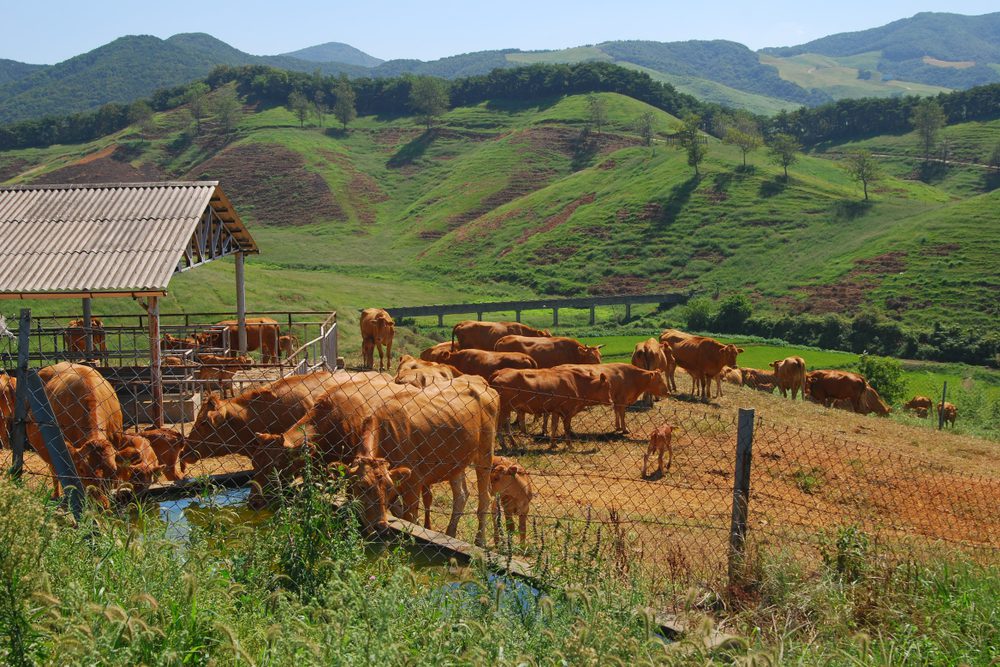
Hanwoo cattle in South Korea. Image: Shutterstock
SOUTH Korea’s cattle farmers have voiced fierce opposition to any expansion of US beef imports, warning of large-scale protests if the government caved to pressure from Washington during recent trade talks.
However, the South Korean Government has confirmed to local media that no additional access to Korea’s beef or rice markets would be granted in the final agreement, sparking relief from the country’s livestock sector.
The United States had asked South Korea to lift its restrictions on beef from cattle aged over 30 months and to allow further imports.
In a press conference staged outside the US Embassy in Seoul this week, the Hanwoo Association—representing around 80,000 Korean cattle farmers—slammed what they called a “submissive” negotiation stance and vowed to launch an anti-government campaign if the requests were granted.
 The group argued that Korean farmers had already borne the brunt of past trade deals, particularly the 2008 Korea-US Free Trade Agreement (KORUS FTA), and demanded a 25 percent retaliatory tariff be applied to US beef imports. They also warned of a general rally involving up to 10,000 farmers if the government compromised further.
Despite the tensions, media reports from South Korea have today confirmed that the presidential office has stated concessions were not part of the final trade deal.
Speaking at a press briefing on Thursday, presidential policy chief Kim Yong-beom said: “The US strongly demanded we import more US rice and beef. But considering our food security and farmers who are desperate to keep their market share here, we held our position and reached an agreement.”
The broader deal included tariff reductions on non-agricultural goods, including a lowering of US tariffs on Korean imports from 25 percent to 15 percent and a commitment by Korea to invest $350 billion and purchase $100 billion worth of US energy products. But in a move welcomed by local farming groups, the deal preserved Korea’s existing protections for rice and beef.
The Korea Herald reported that the agreement left the country’s food producers “relieved” after fears that decades-old safeguards might be dismantled under pressure. The longstanding ban on US beef from cattle older than 30 months—introduced due to concerns over mad cow disease—will remain in place.
The government also emphasised that South Korea is already the largest importer of US beef globally and has opened its market to 99.7 percent of US agricultural products.
While the latest deal avoided further agricultural liberalisation, the episode underscores the sensitivity of beef trade in Korea and the potential for political fallout when domestic livelihoods are perceived to be under threat.
South Korea regularly ranks among Australia’s most important export beef customers, both for volume and quality. While Australian beef enjoys strong demand, it faces competition from US beef, which benefits from more favorable tariff conditions under their FTA with Korea. Korea’s duty rate on US imported beef (dominated by one cut – bone-in short-rib, which is highly prized by Korean consumers) stood at 5.3pc in 2024 will diminish to zero in 2026. Australia’s equivalent tariff wind-down reaches zero in 2028.