
WITH key questions still going unanswered about a decision to allow the importation of beef from the United States into Australia, the Coalition is calling for a senate inquiry into the Government’s processes.
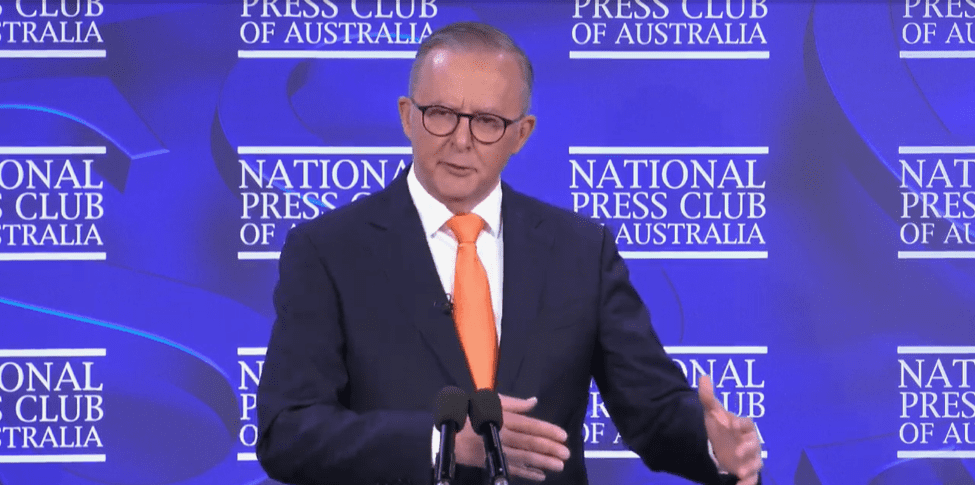
Australian Prime Minister Anthony Albanese at the National Press Club today.
The Government last week handed down a scientific review of the US beef market, which concluded that beef from Canada and Mexico, that is slaughtered in the US, was safe to come into Australia.
The process has not been well received by some industry groups, including Cattle Australia, AgForce and NSW Farmers, who came out to call for a review of the process when it became clear that many of their questions were going unanswered.
They say that if the scientific review of the systems and disease risks in those countries was rigorous than an independent review should be no issue.
But those calls have immediately been dismissed by Prime Minister Anthony Albanese who was asked if he would consider the review by ABC Insiders host David Speers at the weekend.
“There has been an independent review and it took 10 years,” he said referring to last week’s report.
“It has been done independently and at arm’s length of any political decisions.”
Questions still going unanswered
US beef has been allowed into Australia since 2019, however, guaranteeing that beef is not from Mexico or Canada has been an issue. In 2020, the US industry applied to include beef from Mexico and Canada that was slaughtered in the US to also be permitted.
 In response to the push from the US industry, which garnered support from President Trump, Cattle Australia has said that US beef must be able to demonstrate that it is subject to equivalent standards of the Australian beef industry – which is full traceability.
With the Prime Minister putting the decision back on the Department of Agriculture’s review, Beef Central asked the department what measures the US had put into place to demonstrate equivalence. This article will be updated if a response is provided.
Canda’s herd has full traceability and the review says that Mexico has an ear tag system with serial numbers that can be traced back to farm gate.
While it is unclear how much uptake it has, there a traceability program run by the United States Department of Agriculture called Process Verified Program.
Many in the industry are still unclear as to whether the new protocols will allow the importation of beef that has been fed products Australian beef producers can not use, such as beta agonists.
Plant inspections are another issue. The USDA regularly audits processors in Australia, with processors required to give almost full access to USDA officials to comply. It is unclear whether Australia will be doing the same to US exporters.
Nationals call for senate inquiry
The Coalition is now callinfor a senate inquiry into the decision, with Nationals leader David Littleproud saying he is deeply concerned about the lack of transparency from the Government.
“The Coalition, and Australia, needs assurance that Labor isn’t sacrificing our high biosecurity standards,” Mr Littleproud said.
“The timing of this decision, just as the Prime Minister seeks to obtain a meeting with the US President, is concerning.
“Our biosecurity cannot be a bargaining tool. The protocol outlining the import conditions, only released today, provide little detail on the science and the traceability requirements.”
The Nationals’ Senator Matt Canavan said the Inquiry will look at the threat of importing beef that has been exposed to diseases, the process and risk assessment undertaken by the Albanese Government, the implication of future possible outbreaks in the United States and relevant countries, and the protocols and equivalency standards for exports and imports.
“It’s imperative we understand what impact Labor’s decision will have on Australia’s reputation as having the world’s best and safest beef,” Senator Canavan said.
“Our biosecurity standards are world-leading and our beef producers deserve to know whether they are being sacrificed at the political alter. A Senate Inquiry is vitally needed to fully understand the urgency and advice behind the Government’s decision.”