
A RECENT truck rollover involving tick-infested cattle in Queensland’s Tick Free Zone is currently under investigation by the Department of Primary Industries.
Beef Central understands the truck had loaded bulls from the Emerald saleyards (in the Tick Infested Zone) and was travelling through the Tick Free Zone to a meatworks in the south-east.
 The truck rolled over near Injune and the cattle were able to be quickly mustered into the town’s rodeo grounds.
Less than 10 head had to be destroyed and the remaining animals were reloaded within a matter of hours.
One local producer involved in helping muster the cattle said it was lucky the truck rolled close to town and didn’t have to be mustered into a property as the cattle had visibly engorged ticks hanging off them.
“I have had a cattle tick outbreak on my property, and it is a hugely time consuming, financially draining and limits your market access for a period of time,” he said.
“While this rollover happened near town and has not affected any properties, it has cost our council as they were going to spray the rodeo grounds to ensure planned events can go ahead at the facility.
“I was extremely disappointed by the DPI lack of response. No one came out when the incident occurred and there has been no follow up since.”
Because the incident is currently under investigation the DPI was unable to provide further details.
“The managers of the facility involved in the reloading of the animals have undertaken mitigation measures in accordance with their general biosecurity obligation. There are no restrictions on the facility under the Biosecurity Act 2014,” the written statement from the DPI said.
Industry confusion around biosecurity requirements
Since 2016 the state’s Biosecurity Act has allowed cattle to travel from the infested zone through the free area, back into the infested zone providing these risk minimisation requirements are followed:
- No vehicle stops for more than a two-hour period while in the free zone;
- No total vehicle stops for more than a total of four hours while in the free zone;
- No cross loading, loading or unloading in the free zone.
If these requirements cannot be met the cattle are required to have a tick free visual inspection and chemical treatment or a tick free manual inspection, according to the Qld Biosecurity Manual.
The manual also states everyone has a General Biosecurity Obligation to minimise the risk of spreading a biosecurity matter or carrier, which includes cattle ticks.
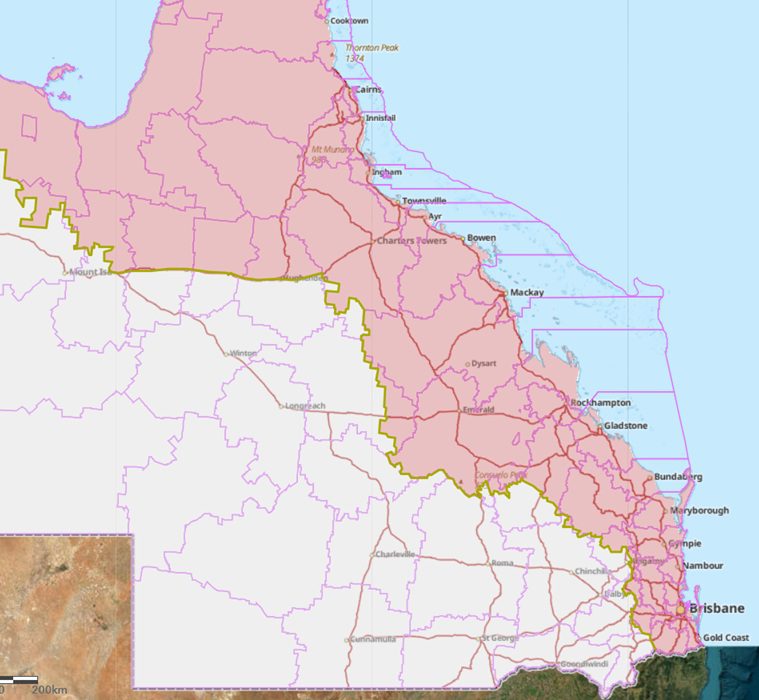
Qld cattle tick line.
Stated in Qld’s Biosecurity Regulation – “a person must not move the carrier unless, for high-risk tick carriers, the person gets an acceptable biosecurity certificate that states the carrier meets the risk minimisation requirements for the carrier, before moving the carrier; and … the carrier is dealt with in accordance with the risk minimisation requirements for the carrier.”
Given the convoluted nature of the requirements, it is easy to understand why there is confusion amongst industry about what exactly is required by law for cattle travelling from the infested zone through the free area, back into the infested zone.
It is not until an incident like the truck rollover where minimisation efforts need to be proven under the General Biosecurity Obligation.
Truck rollovers rare
The move to allow cattle to travel from the infested zone, through the free zone direct to a meatworks was always supported by processors and producers in the infested zone citing it was better for the animal’s welfare by reducing travel times and unnecessary chemical exposure.
 “When you look at how often truck rollovers in the clean area happen, it is rare and therefore low risk movement,” one industry participant told Beef Central.
“This is not what is causing cattle tick outbreaks in the free zone.”
As of the 6 May, there are 252 restricted places for cattle tick in the Tick Free Zone, according to the DPI, which is up from 229 in March.
In 2020 a Qld transport company was fined $25,000 and a truck driver $5,000 for failing to comply with their general biosecurity obligation.
The prosecution arose after the company moved cattle from the cattle tick infested zone through the cattle tick free zone, without undertaking reasonable actions to prevent a cattle tick infestation in the free zone.
It was the first prosecution under the Biosecurity Act 2014 for a failure to comply with the general biosecurity obligation.
Cattle tick review underway in Qld
In March the Qld Government announced an internal review of cattle tick management and last week highlighted 40 new biosecurity officers had been recruited.
The Crisafulli Government committed to hiring 100 new biosecurity officers in the first term in office, with 40 officers now recruited in 21 locations across the state from Bamaga and Cairns in the north, to Nambour in the south and as far west as Charleville.
Previous articles:
Does Queensland’s tick line still have integrity? – Beef Central
Dalby agents respond to concerns about repeated tick outbreaks – Beef Central