ANOTHER outbreak of cattle ticks on a property in Queensland’s tick-free zone has renewed calls for stronger biosecurity requirements and government intervention in outbreaks.
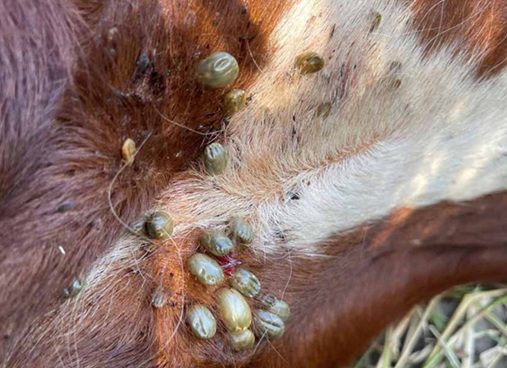
Typical appearance of cattle ticks (Source: NSW DPIRD)
The outbreak was discovered after a number of cattle died and a veterinarian was called to inspect the cattle, on which cattle ticks were found.
The property near Taroom borders an existing outbreak in the area, but the cattle were inspected clean and treated as a precaution last year when the owner was first alerted to the neighbouring outbreak.
It is not known if this infestation has come from cattle next door or from new cattle entering the property, which would make this a new outbreak.
“The property owner did the right thing last year and inspected their cattle to ensure the property was clean and chemically treated them as an extra precaution,” a veterinarian told Beef Central.
“The first sign of cattle ticks was when a small number of cattle died. The producer then mustered the property, and fully engorged ticks were found, and discoloured urine was noticed in some unwell cattle at this time too.”
Calls to reinstate first removed properties
Beef Central spoke with the affected landholder who explained he had lost faith in cattle tick management in Qld and called for the reinstatement of restrictions on first removed properties.
Former government stock inspector and current third-party scratcher Doug Stuart, who still operates the Taroom clearing dip, explained in February, how the first removed property restrictions worked, prior to tick management changes in 2016.
 “All neighbouring properties were told they had to front their cattle to be inspected and that was one way to determine how far the infestation had gone,” Mr Stuart said.
“Those properties were called ‘first removed’ and had the same movement restrictions for store cattle as the infected property.
“So, to move cattle that producer would have to have a clean inspection and treatment and that was through a clearing dip rather than on property treatment, like is done now.”
This is one of the changes to the current system producers and livestock agents in the tick-free zone have been calling for since the Taroom outbreak began earlier this year.
“When our neighbour told us they found ticks on their cattle we mustered the adjoining paddocks, got a third-party scratcher in to inspect the cattle from those paddocks, treated them, scratched again, treated again and no ticks were ever found, so we resumed normal cattle movements” the affected landholder told Beef Central.
“This is why I think the Government needs to reinstate the mandatory restrictions on first removed properties and treat every beast as dirty and enforce movement restrictions until a full program has been completed.
“I would also like to see Department of Primary Industry (DPI) tick specialists run the operation when an infestation is found, they should be the ones scratching and clearing the cattle in the outbreak.”
In July the Qld Government announced it was adopting recommendations from a cattle tick review, which included that three new Biosecurity Inspectors dedicated to cattle tick management would be employed and based in elevated risk areas (Kingaroy, Dalby and Central Qld).
The Government also promised to make changes to the Accredited Certifier model (also referred to as third-party scratchers), which has been under scrutiny with tick infested cattle regularly arriving in saleyards in the tick-free zone, despite being certified as clean.
“We don’t know if the ticks have come from next door or from cattle we have bought onto the property, but we only buy from the tick-free zone, so somewhere the system is breaking down,” the affected landholder told Beef Central.
“I have completely lost faith in the system and am now treating all cattle as if they have ticks and I know a lot of other producers in this area are doing the same.”
Beef Central has been told by several cattle producers in the area they send all cattle they buy to Doug Stuart at the Taroom clearing dip, before taking them onto their properties, but the excess workload is only being created because they no longer trust that cattle in the tick-free zone are clean.
“Any cattle I buy go through the dip before they go onto my property because I have seen what people go through and the cost of eradication, so prevention is far cheaper than the cure,” a Taroom cattle producer told Beef Central.
Perfect conditions for ticks
Now is the time for cattle producers to be on the lookout for ticks with rain and warming temperatures providing ideal conditions for the parasite.
“Do not become complacent. This outbreak started despite the producer doing everything right and they still got ticks,” a vet told Beef Central.
“This rain has provided perfect conditions for ticks so they will be on the move.
“This is the time of year you want to find ticks because you can do something about them, they are really active in spring and summer, so it’s important to get onto them now so they don’t spread through summer.”
Increase in restricted properties in the tick free zone
The Qld DPI said there are now 255 restricted properties for cattle tick in the cattle tick free zone, which is up from 229 restricted places in March.
The 255 restricted places in the cattle tick free zone are:
- 160 are in the South Burnett Local Government Area (LGA)
- 62 are in the Toowoomba LGA
- 26 are in Western Downs and Banana LGAs
- Seven are located elsewhere in the state.
“Biosecurity Queensland is responding to a detection of cattle tick and tick fever in the Taroom district after samples were submitted for testing by the landholder’s veterinarian last week,” a spokesperson for the DPI said.
“Officers have been in contact with the owner of the affected property and have the property under restrictions.
“Biosecurity Queensland officers will work with the affected owners and neighbouring properties to manage the risk. Activities may include surveillance such as herd inspections to determine the extent of the infestations, as well as tracing and risk assessing livestock movements to contain any potential spread of the cattle tick.
“DPI urges all producers to review their biosecurity practices in response to the confirmed presence of cattle tick in the cattle tick-free zone.”
Cattle producers are being urged to be alert for sudden cattle deaths that may indicate the presence of cattle tick and tick fever. If cattle show any signs of tick fever, consult a veterinarian immediately.
Producers who suspect they have found cattle tick on their cattle should keep the tick and contact their local Biosecurity Officer so a positive identification can be made and appropriate advice provided.
To find out more about cattle ticks or tick fever, contact the DPI customer service centre on 13 25 23 or visit the Business Queensland website.
For more information on how to identify cattle tick, visit the Business Queensland website.
HAVE YOUR SAY