
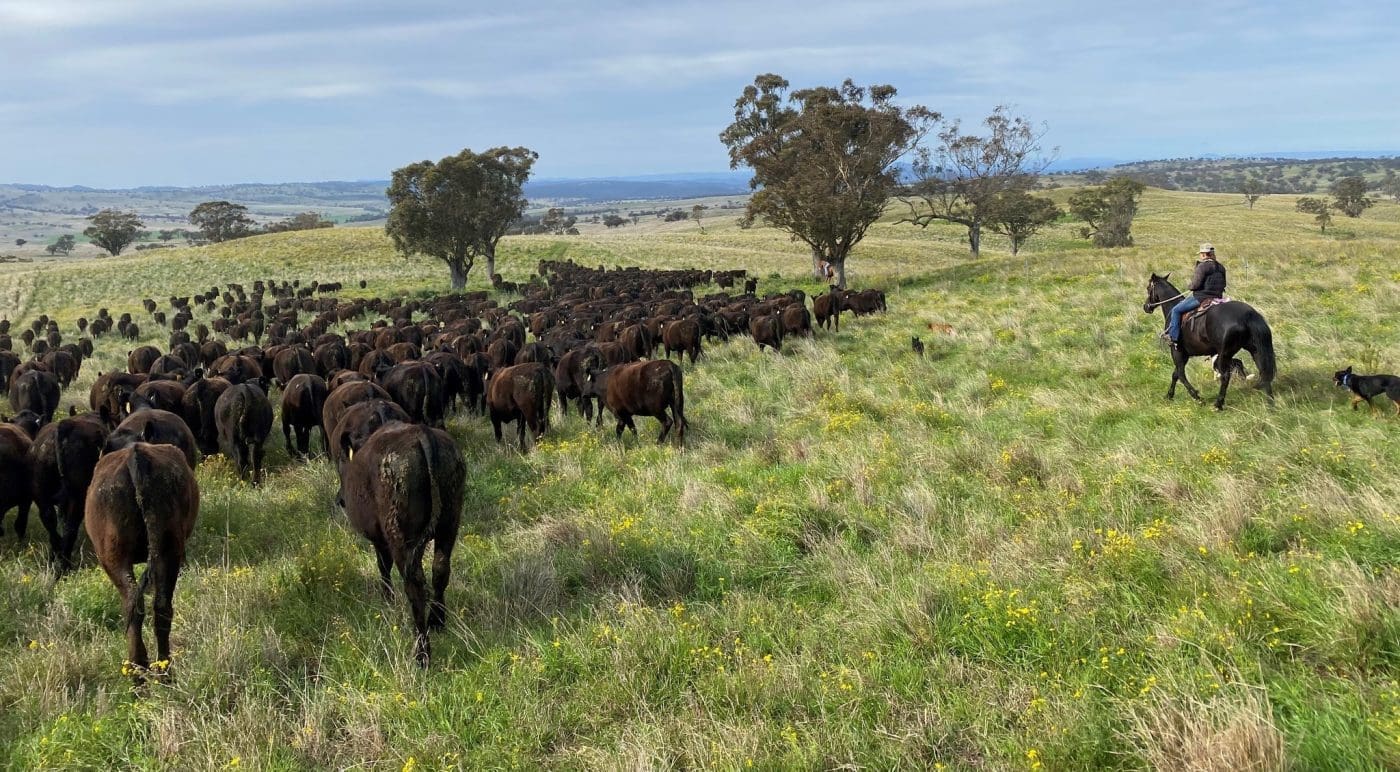
A NEW research paper has developed the first methodology enabling livestock companies to report their greenhouse gas emissions using both GWP100 and GWP*.
The study, Bridging the Climate-Corporate Gap: Utilizing GWP* with GWP100 for Livestock Companies’ Greenhouse Gas Inventories, was authored by Sarah C. Klopatek, Logan R. Thompson, Sara E. Place and Matthew R. Beck and published in Frontiers in Climate on August 18, 2026.
The development is significant for the cattle industry because the two metrics provide different perspectives on methane’s contribution to climate warming.
GWP100 is required under established corporate and international reporting frameworks, including Australia’s reporting under the Paris Agreement. It converts greenhouse gases into carbon dioxide equivalents based on their warming potential over 100 years.
However, GWP100 does not fully account for the effect of changing emission rates from short-lived gases from biological sources such as methane from livestock.
GWP* was developed to more accurately reflect the difference.
Previous studies have shown that GWP100, the most widely used reporting metric, can dramatically overstate the warming effect of emissions from stable sources – such as in Australia where herd numbers have moved up and down within a stable 25-30 million head range for decades – by as much as 300 to 400 percent.
At the same time, the metric is also reported to dramatically understate the warming effect of rapidly growing herds by a similar degree.
Australian industry groups Cattle Australia, Sheep Producers Australia, Australian Wool Innovation and the National Farmers’ Federation joined an international “split gas coalition” last year, which pushed countries to report methane emissions from livestock separately to carbon dioxide emissions from fossil fuels.
The Australian red meat industry also last year moved away from a target set in 2017 to achieve Carbon Neutrality by 2030 MLA managing director Michael Crowley providing an update to a Senate Estimates hearing earlier this year.
One key obstacle to preventing corporates from reporting emissions in GWP* has been its requirement for 20 years of historical methane data.
Large companies including in the livestock sector have only recently been required to start compiling detailed greenhouse gas inventories and have not had the historical data they need to calculate the metric.
‘Shadow company’ solution
The researchers addressed this by developing a “shadow company” methodology.
The technique uses changes recorded in national cattle methane inventories to estimate a company’s methane emissions during the 20 years before its chosen reporting baseline.
A company calculates its share of national cattle methane emissions in the baseline year and applies that proportion to the country’s historical emissions data. This creates the 20-year emissions history required to begin reporting under GWP* immediately.
The researchers said the approach is also designed to prevent companies from selecting or constructing historical emissions data that would produce an inaccurate or misleading result.
It also requires calculations to be undertaken separately for each country in which a company operates, reflecting differences in national cattle herd and emissions trends.
Tested on a multinational beef business
The methodology was tested using a hypothetical “Global Beef Company” processing one million cattle annually in each of Australia, Brazil and the United States.
The researchers modelled the company’s Scope 3 livestock emissions using procedures and data sources similar to those used by meat processors and retailers. They then examined emissions growth and reduction scenarios over 80 years.
The modelling showed Australia’s declining cattle emissions over the historical period produced a negative baseline GWP* methane value, reflecting a declining contribution to warming relative to earlier emissions.
Brazil’s expanding herd and rising methane emissions produced a strongly positive result, while the relatively stable US herd generated a smaller positive result.
For the model company’s 2020 baseline, methane’s calculated warming contribution was 41 percent lower under GWP* than under GWP100.
Another point raised in this study that contrasts with previous ones was that when methane emissions were held constant, the cumulative GWP* result remained positive and increased over time. “Therefore, companies that do not implement interventions to reduce CH4 emissions will continue to have positive effects on warming.”
Dual and split-gas reporting recommended
The study does not propose replacing GWP100. Instead, it recommends “dual reporting” so companies disclose results under both GWP100 and GWP*.
“The purpose of this study was not to wade into the dispute about which metric is “better”, the authors state in the paper.
“The purpose, rather, was to provide companies with the ability to expand the scope of their reporting to include GWP* along with their current GWP100 inventories.
“Utilizing multiple metrics can enable companies to inclusively evaluate long-term and short-term impacts of their respective GHG emissions on climate, and, ideally, allow them to better assess their progress towards stated climate goals, such as commitments related to climate neutrality.
“The knowledge acquired during this evaluation process may better inform organizations on how and where to focus their financial resources for reducing emissions.”
The authors also recommended reporting the physical mass of methane and separating methane, carbon dioxide and nitrous oxide rather than presenting only a single combined carbon dioxide-equivalent figure.
This “split-gas” approach recognised that the gases behaved differently in the atmosphere and required different reduction strategies.
The methodology also enabled companies to report both absolute emissions and emissions intensity per kilogram of product. This would help businesses demonstrate production-efficiency gains that may not be visible in their total emissions.
They also pointed to the risk that GWP* could be misinterpreted or used to support greenwashing claims.
“As such we aimed to develop a methodology for corporate accounting to ensure the proper use of the metric and to enact scientific guardrails” for GWP* in corporate accounting.
Earlier article: We’re counting methane emissions wrong (and why it matters to every Australian) 7 July 2026
SumClimate already calculates livestock emissions using AR6 GWP100 values, with methane retained as a distinct gas throughout the calculation. Importantly, biogenic and fossil methane are treated separately, using GWP100 factors of 27.02 and 29.8 respectively, rather than being collapsed into a single CH₄ category.
Every calculation run records and publishes the GWP values applied, together with the relevant IPCC citation, within SumClimate’s technical product.
For SumClimate, therefore, split-gas reporting, including separate disclosure of methane in both mass and CO₂e, is primarily a reporting configuration change rather than a redevelopment of the underlying methodology. We would argue that this is also the more defensible element of the split-gas proposal: it does not alter the emissions inventory or the science underpinning it. It simply prevents aggregation into CO₂e from obscuring the individual gas, particularly methane, that is central to the debate. On GWP* specifically, the shadow company approach provides a practical solution to the data challenge and is something SumClimate could implement. The mathematics is straightforward, and the national cattle methane time series required for the calculation is publicly available.
We would, however, raise two cautions with the authors. First, allocating a company share of the national methane trend attributes national herd dynamics rather than the behaviour of the company itself. An Australian operation that increased its own herd over the relevant 20 year period could still inherit a negative GWP* outcome because the national herd declined. That result could be difficult to defend under assurance and could be vulnerable to claims of greenwashing.
Second, corporate boundaries can change in ways that atmospheric emissions do not. If a company acquires a neighbouring operation and its livestock, the calculation may show a step change in attributed warming even though the underlying animals and their emissions already existed. The baseline share approach does not fully correct for this ownership effect.
Both issues can be managed through transparent methodology and disclosure, but they reinforce our view that GWP* is best presented alongside GWP100 as supplementary warming context rather than replacing the reported emissions figure. That is how we are able to implement it within SumClimate, and it is consistent with the current direction of AASB S2, the GHG Protocol and SBTi FLAG.