
IS the Australian beef industry now seeing the end of the unusual feedlot asset sale cycle that started during the back half of last year?
On face value, it might appear that way, but its looking like some very significant lotfeeding assets may come to market in coming weeks that will keep the momentum going for a while yet, at least.
And in a classic domino effect, some of the larger custom feeding customers that previous fed cattle in yards sold last year – but whose new owners now want to use the pen space themselves – may in turn look to purchase their own grainfeeding assets, Beef Central has been told.
Recent global geopolitical uncertainty and fuel price alarm may have underlined confidence in some segments of agriculture, but interested buyers in major feedlot assets looked at the sector with a very long-term perspective.
“We’re working on another three potential feedlot listings,” a marketing agent close to the recent feedlot asset cycle told Beef Central this morning. “Despite appearances, there’s still a fair bit of action in this space,” he said.
“If I was trying to characterise where the feedlot asset property market is at, I’d say the recent deals already completed have disrupted, or are about to disrupt a whole lot of other supply chains. Some of that may lead to further sales and acquisitions.”
“And other large grainfed beef processors are looking for more feedlot supply security, to support their grainfed brand programs.”
Asked whether JBS, which has not expanded its Australian feedlot footprint since its purchase of the Riverina Beef (formerly Rockdale) site in 2010, was likely to seek expansion, he thought it unlikely.
“I don’t think JBS sees buying hard assets (ie Australian feedlot infrastructure) as being in any way a sensible use of their capital,” he said.
Both the company’s feedlot divisions in the US and Australia are now owned by outside equity.
Asked whether there was any interest from investors who wanted to own feedlot assets, but did not want to run them themselves, he said ‘infrastructure style’ investors from overseas now had an appetite for Australian feedlots as an asset class.
“That appetite to invest is in turning attracting other feedlot owns to test the market, and that’s the conversations we are having right now,” he said.
“The current geopolitical tensions and fuel crisis has not even been raised by the potential investors we are talking with,” the marketer said.
Recent sales
To re-cap, there was an unprecedented period during 2025 when five large Queensland and NSW feedlot assets were put to market within a relatively short period of time. In combination, the five yards offered one-time feeding capacity of close to 100,000 head.
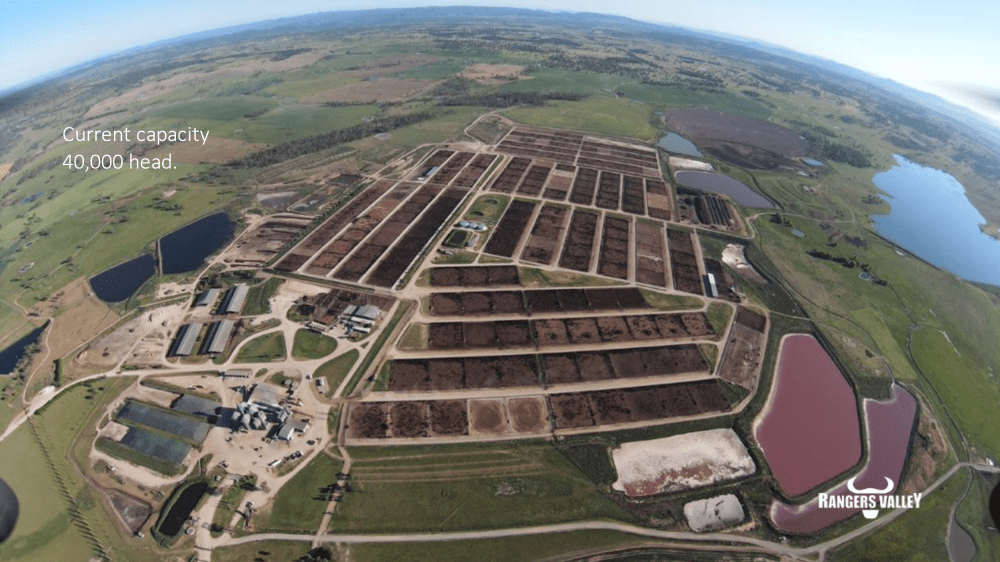
Setting off the sequence last year was Japanese-trading company Marubeni’s 40,000 head Rangers Valley feedlot near Glen Innes, in northern NSW, that sold in October to Stanbroke Beef in a deal worth between $380m and $400 million, including cattle and export beef brands.
Since then, Mort & Co has sold its Pinegrove feedlot business near Millmerran on the southern Darling Downs for an undisclosed price to cattle producers Peter & Jane Hughes and family, working in partnership with Warwick lotfeeder Chris Shaw, who owns and operates the Elbow Valley Beef dedicated Wagyu feedlot near Warwick, not far from Millmerran.
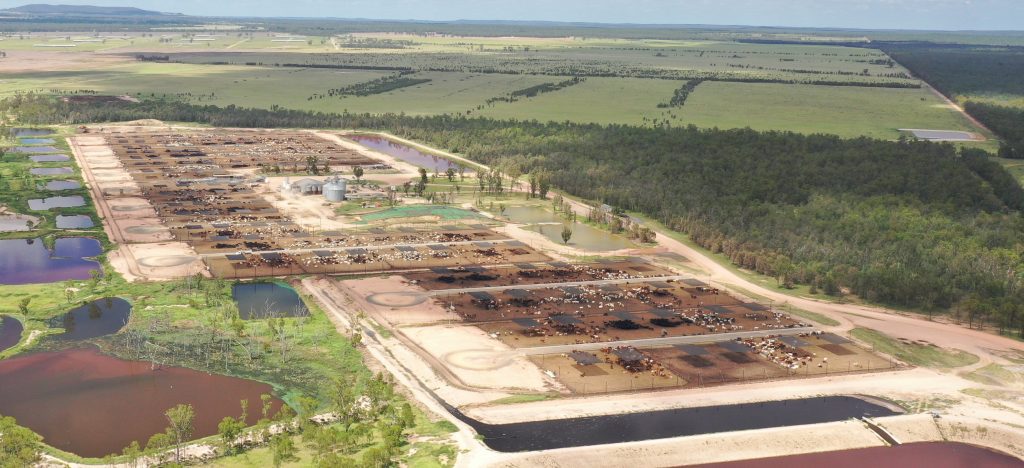
Pinegrove feedlot near Millmerran
In February, Elders Killara feedlot near Quirindi in New South Wales, sold in a deal worth $196 million, valuing the asset, minus cattle, at somewhere around $3500 a beast area – possibly a new record for a yard of this size. The sale was subject to Foreign Investment Review board approval (through buyer, Australian Meat Group’s minority shareholding by Chinese investors).
Still working through a sale process are two other significant feedyards put to market late last year. Both are understood to be in advanced stages of negotiation:
- Mort & Co’s Yarranbrook feedlot near Inglewood in southern Queensland, is believed to be close to being transacted, with details surrounding water rights transfer being one of the few points yet to be resolved. Yarranbrook is a large-scale feedlot operation with a capacity of 18,540 SCU, and approval to expand to 35,000 SCU. Mort & Co acquired outright ownership in 2024 and has since upgraded water systems, effluent management and on-site infrastructure. The feedlot and farm spans 13,439ha, and is supported by more than 3000ML of water entitlements from the Macintyre Brook and Coolmunda Dam system.
- The Shearer-Smith family’s Smithfield feedlot near Proston is now in a second-round offer process, with marketing agents confident a deal will be completed in coming months.The modern, well-equipped and well-located Smithfield yard is the nation’s second largest feedlot located in ticky country, developed to its full licensed capacity of 18,500 SCU.
In March this year, another substantial Queensland commercial feedlot came to market.
Allied Beef’s Vandyke Feedlot, 25km west of Springsure in Central Queensland joined the five previous yards seeking buyers since last July. Offers close this Thursday, through a campaign run through LAWD.
Interest has been described as strong, especially from local, substantial private cattle producers and one large corporate entity.
Van Dyke is a mid-sized yard licensed for 8640 Standard Cattle Units, turning over about 32,000 cattle last year. The yard has previously fed longfed Wagyu, but more recently has concentrated on 100-130 day grainfed cattle.
Allied Beef first leased the feedlot in 2017 before purchasing it outright in 2021, and investing in a comprehensive refurbishment program. Click here to read Beef Central’s earlier Top 25 Lotfeeders profile on Allied Beef’s operations.
It is no secret that Allied Beef has been looking at other feedlot investment sites further south over the past 12 months, with a view to expansion, which may add context to the Vandyke sale decision.
The surrounding property includes 2231ha of country, with 53ha devoted to the feedlot footprint, 335ha of dryland cropping, 548ha of grazing and the balance comprising timbered grazing.
Beyond those publicly-facing sales and listings, there were a couple of more obscure sales of feedlot assets last year that failed to draw as much attention.
One was the Australian Food & Agriculture Co’s Conargo Feedlot located 25km north of Deniliquin in the western Riverina region.
Approved for 12,000 head of cattle, Conargo was sold as part of the Bell family’s broader portfolio of grazing and cropping properties covering some 45,000ha around Coonamble operated under the AFA banner. Stockbroking identity Colin Bell passed away four years ago.
The buyer of the assets, including the Conargo feedlot, which has operated since 2017, was Malcolm Harris’s Cleveland Agriculture, paying around $200 million.
Conargo was used principally by AFA to feed company-bred and purchased livestock as well as custom feeding for a number of clients.
Strong demand for grainfed beef
Herron Todd White valuer Angus Ross recently suggested that the recent surge in feedlot listings appeared to reflect most feedlots operating at or near capacity, strong processor demand for grainfed beef, and an increase in dollars-per-SCU values.
Sales appeared to have been motivated by a number of factors, including:
- Corporate restructuring
- Producers looking to secure feed space and create a level of vertical integration (often in conjunction with branded beef marketing)
- Large family and corporate operations looking to diversify formerly live export-reliant northern businesses, and in the case of established feedlots,
- The current cost of development (both physical and bureaucratic).
“Discussions with experienced operators suggest legislative costs alone, associated with an approval/development of a new feedlot at the scale of circa 20,000 SCU may equate to about $500 per SCU,” Mr Ross said.
Smaller assets on offer
While there are currently no other large feedlots on the open market (stand by for a substantial announcement in coming weeks), there is a plethora of small feedlot assets, or grazing properties with some feedlot expansion potential, listed across the country. Here’s a sample:
Back Paddock feedlot, Lameroo SA
Colliers and Raine & Horne hold the listing for the Back Paddock feedlot and backgrounding operation near Lameroo in South Australia. A “Top 100 Producer” in last year’s Meat Standards Australia Eating Quality Awards, the 561ha property comprises a well-equipped 4000 head cattle feedlot plus backgrounding/cropping country in the state’s Mallee region, an hour’s drive east of Murray Bridge. The feedlot is in proximity to key supply chain infrastructure including meat processors, saleyards, grain handling facilities, hay processors and the port of Adelaide.
Kyabram VIC
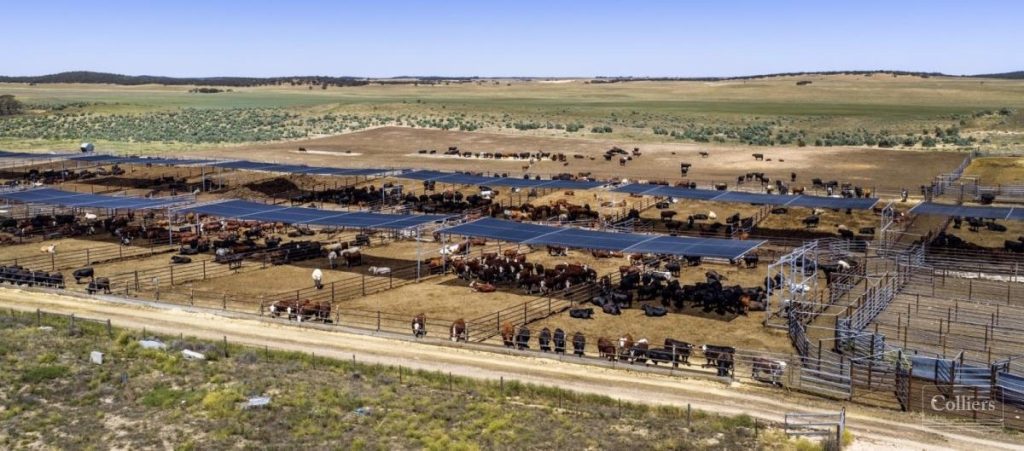
Elders Echuca hold the listing for a small mixed farming/lotfeeding aggregation supported by planning approval for a new feedlot development, designed to accommodate 2400 Standard Cattle Units. The 379ha holding is located near Kyabram. The development includes a new hay shed and commodity shed to complement the existing 16 feeding pens and 5 holding pens.
The aggregation is currently operating as a custom feeding enterprise, turning off 10,000–12,000 SCU annually. With 8000 tonnes of silage on hand including corn, sorghum, ryegrass, and cereals, available for negotiation the operation is well supported. The existing stock provider has also committed to ongoing supply, offering the purchaser a secure, ready-made turnkey business opportunity. Previously operated as a dairy, the farm supported 600 cows.
Complementing operations are 16 holding paddocks (all with troughs and feeders), quality laneways, cattle yards, and a large feed pad.
Ashby, Ellangowan QLD
Near Ellangowan on Queensland’s southern Darling Downs, 245ha Ashby is ideally positioned 30km south-east of Pittsworth, roughly half way between Toowoomba and Warwick. Agents Ray White Toowoomba say the property benefits from B-double road access and is only 7km from the Ellangowan road train split pad.
Ashby offers a well-balanced mix of open box country, comprising chocolate, light and dark soil types across gently rising terrain with established contour banks. All paddocks have been historically cultivated and are now sown to improved pastures, presenting productive and well-maintained country.
The feedlot is licensed for 450-head SCU feedlot, with concrete feed bunkers with steel rails, and gravel laneways. Water is supplied through two bores: a 14 megalitre intensive license with 3-phase submersible (1000 gal/hr); solar equipped submersible stock/domestic bore (700 gal/hr), plus two dams, one five megaltres in size.
Cattle yards include an RPM-covered vet squeeze crush with curved dual-laneway race, elevated walkway, and three-way draft. Water connected to two pens, adjoining loading ramp; comfortably works 200 head.
Improvements include four-bay machinery & workshop shed 30 x 12m, four-bay hay/feed mill shed 24 x 12m; Silos: 610t total grain storage, 10t molasses tank, 22-inch Brecken 3 Phase roller mill; Silage pits totalling 3000t with gravel pads and concrete blocks.
- Regular property editor Linda Rowley is on annual leave, returning next week.