
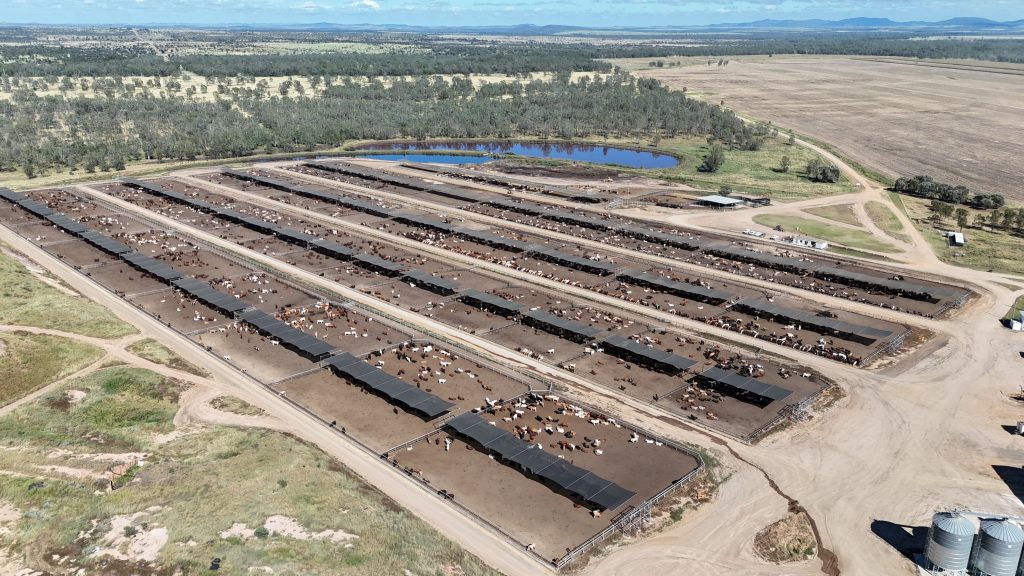
Van Dyke is a mid-sized yard licensed for 8640 Standard Cattle Units, turning over about 32,000 cattle last year.
ANOTHER substantial Queensland commercial feedlot has come to market, continuing a sequence of grainfeeding asset sales and offerings that started nine months ago.
Allied Beef’s Vandyke Feedlot, 25km west of Springsure in Central Queensland joins five previous yards seeking buyers since last June.
Van Dyke is a mid-sized yard licensed for 8640 Standard Cattle Units, turning over about 32,000 cattle last year. The yard has previously fed longfed Wagyu, but more recently has concentrated on 100-130 day grainfed cattle.
Allied Beef first leased the feedlot in 2017 before purchasing it outright in 2021, and investing in a comprehensive refurbishment program. Click here to read Beef Central’s earlier Top 25 Lotfeeders profile on Allied Beef’s operations.
It is no secret that Allied Beef has been looking at other feedlot investment sites further south over the past 12 months, with a view to expansion. Stand by for an update on this process soon, which may add context to this week’s announcement about the Vandyke sale decision.
Vandyke presents a prime opportunity for corporate investors or family businesses to secure a proven asset in one of the state’s key grain and beef regions, marketing agents LAWD said in a release this morning.
The surrounding property includes 2231ha of country, with 53ha devoted to the feedlot footprint, 335ha of dryland cropping, 548ha of grazing and the balance comprising timbered grazing.
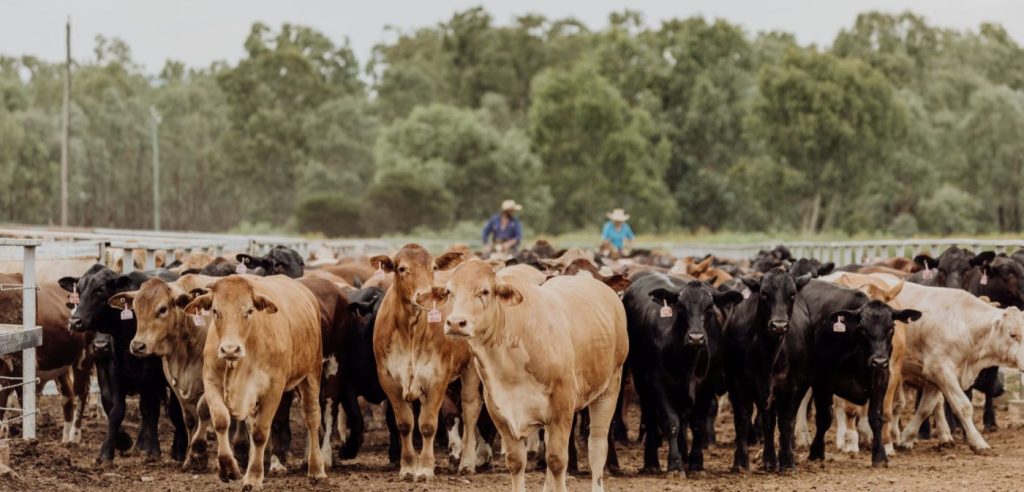
Flatback feeders being shifted at Vandyke feedlot
Allied Beef managing director James Maclean said the property would be highly complementary to an existing Northern Territory or North Queensland beef operation, or corporate investors seeking a feedlot with scale.
“Feeder cattle are typically sourced from the North West and processed in Central or Southern Queensland plants, Mr Maclean said.
“We’ve done short-term feeding for the major supermarkets and have fed a number of Wagyu cattle on long-term programs.”
“The site would also lend itself to a purebred or Wagyu operation that could wean cattle onto the property and finish them in the feedlot,” he said.
Backgrounding of store cattle on the property varies according to demand and seasonal conditions, however Allied regularly grazes up to 1000 head for two to three months before they enter the feedlot. Grazing land surrounding the feedlot is fenced into seven paddocks plus laneways.
The feedlot complex includes 52 main feeding pens, two hospital pens, steel panel induction/processing yards, a feed mill with associated commodity/feed shed and an office with staff amenities. Supporting infrastructure includes a weighbridge, machinery shed and generator shed, as well as accommodation options for staff.
The cultivation areas are used for silage production, yielding 14-15t/ha on average of forage sorghum used as roughage in the feedlot.
Secure livestock water is sourced via a 155 megalitre groundwater allocation, equipped with two sub-artesian groundwater bores that reticulate water to tanks and associated troughs. Additional livestock water is provided from a 55mL catchment dam, seasonal waterholes and creeks.
In the past five years, Allied Beef has invested heavily to maximise operational efficiencies, building 15 new feedlot pens to boost carrying capacity by 30-40pc. New roller mills and grain tempering facilities complement the 1750t of grain storage capacity in nine silos.
The company has also upgraded liquid supplement systems, induction yards and power, and is installing a large-scale solar system, together with a backup generator to ensure the feedlot can operate off-grid.
The main homestead is a five-bedroom, high-set timber Queenslander with views of the local ranges, while staff accommodation is provided by two cottages, each with three bedrooms, and a singles quarters with kitchenette, common room and eight ensuite-style bedrooms.
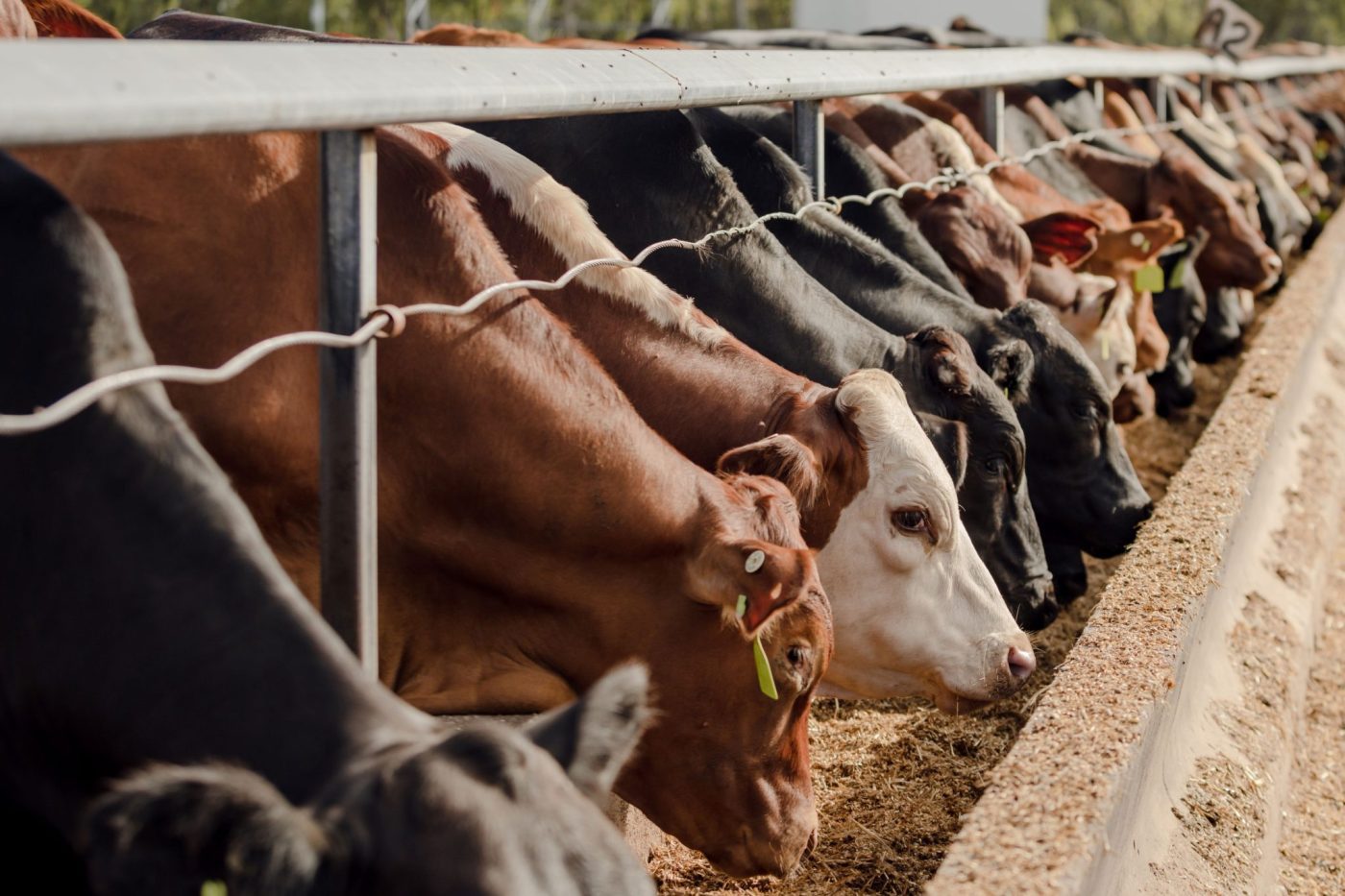
Cattle on feed at Vandyke
Joint marketing agent, RBV’s Rural Director, Matt Beard, said Vandyke was experiencing a tremendous season, and increasing market demand for feedlot assets augured well for its sale.
LAWD senior director Danny Thomas, said the feedlot presented an exceptional opportunity for a wide range of market participants across the beef supply chain.
“We expect Vandyke to garner interest from a diverse group of perspective buyers,” Mr Thomas said.
Recent feedlot sale trend
Recent Australian feedlot asset sales have notched up more than $700 million in value, with potentially more to come.
Key recent sales have included:
- Rangers Valley near Glen Innes, in northern NSW, that sold in October to Stanbroke Beef in a deal worth close to $400 million, including cattle and export beef brands.
- Elders Killara feedlot near Quirindi in New South Wales, in a deal worth $196 million, valuing the asset, minus cattle, at somewhere around $3500 a beast area – possibly a new record for a yard of this size. The sale is still subject to Foreign Investment Review board approval (through buyer, Australian Meat Group’s minority shareholding by Chinese investors).
- Mort & Co has sold its Pinegrove feedlot business near Millmerran on the southern Darling Downs for an undisclosed price to cattle producers Peter & Jane Hughes and family, working in partnership with Warwick lotfeeder Chris Shaw, who owns and operates the Elbow Valley Beef dedicated Wagyu feedlot near Warwick, not far from Millmerran.
Remaining on the market, in some cases in advanced stages of transaction are:
- Mort & Co’s Yarranbrook feedlot near Inglewood in southern Queensland, where a deal is understood to be close, but not yet finalised
- The Shearer-Smith family’s Smithfield feedlot near Proston is approaching a second round offers process, expected to be completed around early April.
Strong demand for grainfed beef
Herron Todd White valuer Angus Ross wrote in HTW’s recent monthly outlook that the recent surge in feedlot listings appeared to reflect most feedlots operating at or near capacity, strong processor demand for grainfed beef, and an increase in dollars-per-SCU values.
Sales appeared to have been motivated by a number of factors, Mr Ross wrote.
These included:
- Corporate restructuring
- Producers looking to secure feed space and create a level of vertical integration (often in conjunction with branded beef marketing)
- Large family and corporate operations looking to diversify formerly live export-reliant northern businesses, and in the case of established feedlots,
- The current cost of development (both physical and bureaucratic).
“Discussions with experienced operators suggest legislative costs associated with an approval/development of a new feedlot at the scale of circa 20,000 SCU may equate to about $500 per SCU,” Mr Ross said.
“While rumours have emerged about further uplift in developed SCU rates above this range, sales are typically occurring from $1000 to $2500 per SCU, depending on development. Due to the cost of development as mentioned, undeveloped licences typically vary from $50 to $250 per SCU,” he said.
- Vandyke Feedlot is being offered for sale by Expression of Interest closing on Thursday, 16 April. Marketing contacts: LAWD’s Tim McKinnon or RBV Rural Director, Matt Beard.