
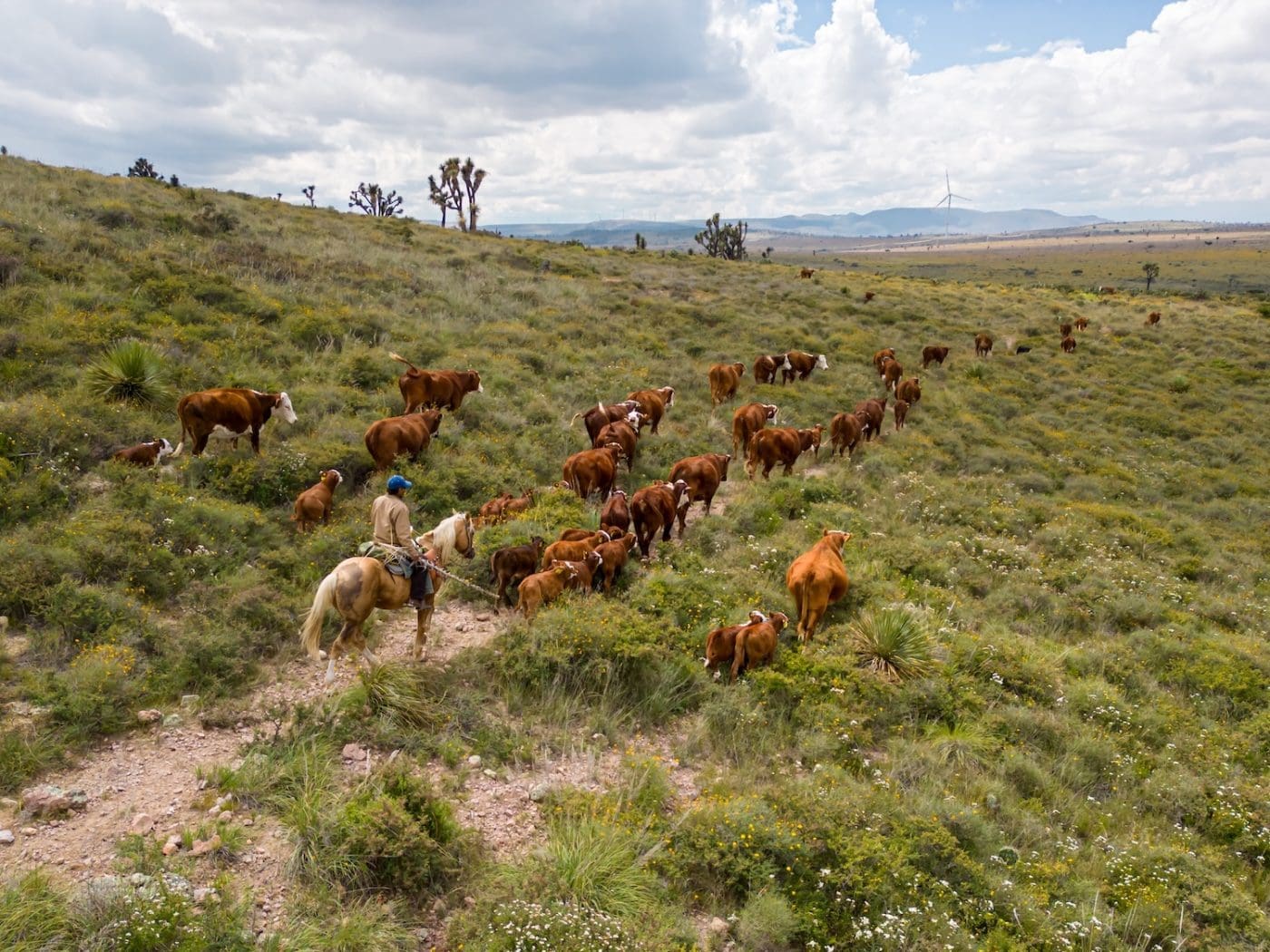
Herding cattle in Mexico. Image: Shutterstock
A PARTIAL reopening of the United States border to Mexican cattle is on track to commence tonight, Australian time, despite the first case of New World screwworm recently being confirmed in the Mexican state from which cattle will be sourced.
From August 24, the US Department of Agriculture will reopen the port of Douglas, Arizona, to cattle from neighbouring Sonora, beginning a phased resumption of a trade that has been disrupted by New World screwworm concerns since late 2024.
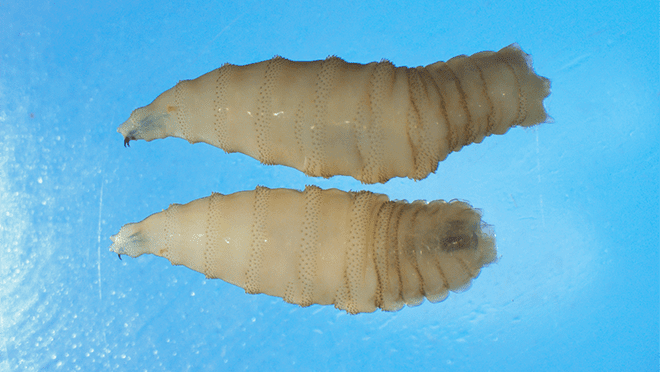 New World screwworm (NWS) is a parasitic fly whose larvae infest wounds and feed on the living tissue of warm-blooded animals, potentially killing untreated livestock.
The US-Mexico cattle trade has been shuttered on and off since NWS was detected in southern Mexico in November 2024, with the latest border closure put in place in July 2025.
Douglas will be the first US port reopened to Mexican cattle, with the USDA indicating further openings at Santa Teresa and Columbus in New Mexico will be considered after the initial reopening is assessed.
Sonora and neighbouring Chihuahua were identified by USDA’s Animal and Plant Health Inspection Service (APHIS) as the lowest-risk Mexican states for NWS because of their “strong, well-established inspection programs and their geographic distance from southern Mexico, where most cases are concentrated”.
However, the reopening comes just days after Sonora confirmed its first case of NWS, potentially complicating efforts to progressively restore cattle movements across the border.
Sonora Governor Alfonso Durazo said emergency surveillance, containment and control measures had been activated following the detection.
Despite the development, USDA said in its most recent statement last week that it had no plans to change the scheduled reopening of the Douglas crossing, which is about 470km from where the Sonora detection was confirmed.
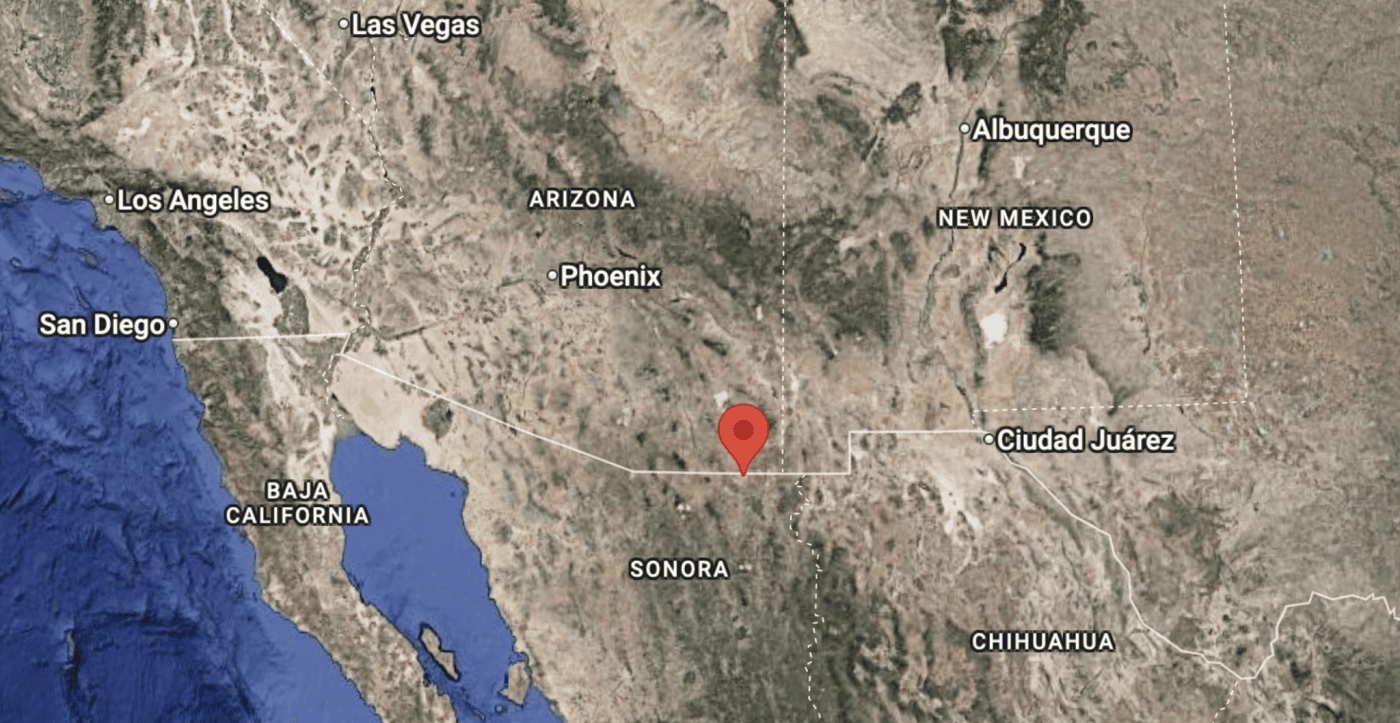
Google map showing location of Douglas, Arizona, on the US/Mexico border.
When USDA announced on July 24 that the partial resumption of trade would take place from August 24, it stressed that the planned border reopenings would depend on any changes to its assessment of NWS risk.
It said every animal entering the US through Douglas will undergo veterinary inspections, including inspection by USDA veterinarians, to ensure it is free of signs of NWS.
Initial cattle movements will also be tightly restricted. Around 700 cattle per day will be permitted through Douglas during the first week, increasing to 900 per day in the second week before progressively rising to around 1300 head per day.
Any animal failing to meet APHIS import requirements will be denied entry, while detection of NWS would immediately halt imports through the facility, the USDA said.
The new requirements also include radio-frequency identification (RFID) ear tags for imported Mexican cattle.
Mexico currently has recorded total animal cases exceeding 38,500 head with 1969 active NWS cases. 30 of the country’s 32 states have been affected.
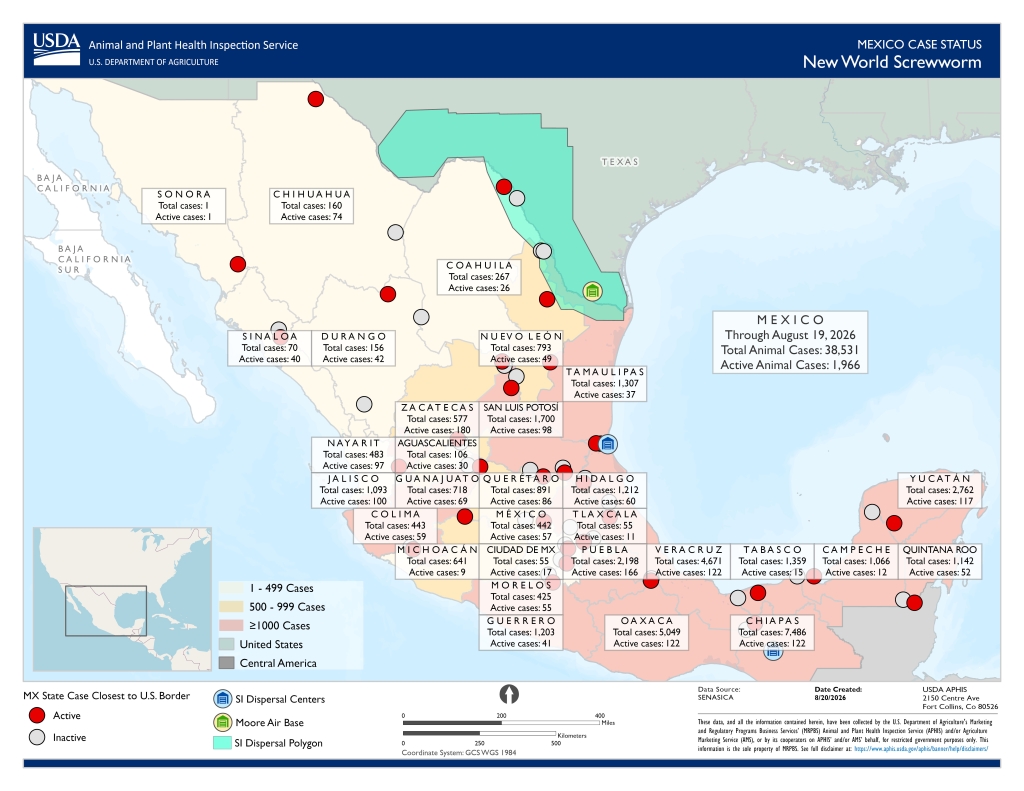
New World Screwworm detections in Mexico as of 19 August 2026. Souce: USDA.
The pest has also crossed into the United States, with more than 40 cases reported in Texas since early June and a single case detected in a dog in New Mexico.
The US Government has directed substantial funding towards controlling the threat, including investment in sterile fly production and dispersal facilities.
Sterile insect technology involves breeding and releasing large numbers of sterile male screwworm flies, which mate with wild females without producing offspring, progressively suppressing the population.
However, current sterile fly production remains well short of the 500 million per week levels USDA has previously indicated it hoped to have to push the pest back towards the Darién Gap containment zone between Panama and Colombia.
The USDA Animal and Plant Health Inspection Service currently disperses 100 million sterile flies per week sourced from the joint Panama facility (COPEG). With the newly inaugurated Metapa facility in Mexico ramping up, capacity is expanding, and a future domestic plant in Texas is projected to add another 300 million per week.
US ranchers have also raised concerns about reports of illegal cattle movements between Central America and Mexico and the potential for livestock moving outside official channels to bypass biosecurity measures and contribute to the northward spread of NWS.
Cattle shortage adds pressure to reopen trade
The reopening comes as the US grapples with historically tight cattle supplies, high beef prices and mounting pressure on processing capacity.
Mexico supplied around 1.2 million cattle annually to US feedlots before the initial November 2024 NWS detection disrupted the trade.
Restoring at least some of that supply would provide additional feeder cattle to US feedlots at a time when domestic cattle numbers remain historically low.
The shortage is also placing considerable pressure on US beef processors.
Tyson Foods last week announced it would end operations at its Joslin, Illinois, beef plant and Eagle Mountain, Utah, case-ready facility, while also seeking to sell its Pasco, Washington, beef facility.
The company said the restructure was necessary amid “one of the most historic cattle shortages the country has ever experienced”.
US cattle groups divided
US rancher group R-CALF has argued the border should remain closed until Mexico can demonstrate it has eradicated NWS, saying increased reliance on imported cattle has exposed the US industry to greater animal health and biosecurity risks.
“Our position has not changed since Mexico’s initial announcement that the New World screwworm had entered its borders. Until Mexico can demonstrate it has fully eradicated the pest from within its borders, the USDA should maintain and strengthen all of its defences against the pest, including keeping the border closed,” the group said when the plan to partially open the US-Mexico border was first announced.
In contrast, the National Cattlemen’s Beef Association, which represents both ranchers and cattle feeders, said the US was well postioned to handle resumed trade.
In a statement in response to the planned border reopening NCBA CEO Colin Woodall said measures implemented by USDA and producers in border states had put the country in a stronger position to safely resume trade.
“Secretary Rollins and her team at USDA have been fighting the spread of New World screwworm with an aggressive five-point plan and comprehensive response playbook. Their work – along with the diligence of cattle producers in border states – bought the United States valuable time to improve our domestic readiness. The whole-of-government response has put us in a strong position to begin safely and gradually reopening our southern border to cattle shipments. This decision will help normalize business for cattle operations throughout the border states and Southern Plains. We appreciate the continued work of USDA to support American producers and the U.S. cattle industry.”
However, NCBA has opposed a separate move announced by US President Donald Trump at the weekend to allow 300,000 tonnes of ground beef to enter the US without tariff restrictions.
“Undercutting American farmers and ranchers with products from foreign competitors does nothing to create market confidence or encourage rebuilding the herd, the representative body said.
“Current retail prices are high because of strong consumer demand for the high-quality beef we produce. Incentivising additional foreign imports undermines America’s producers at a critical time as they make decisions about rebuilding numbers for next year.
“US farmers and ranchers need stability. Unlike spur-of–the-moment trading decisions made based on White House social media posts, the decisions and investments ranchers make in their herds are made years in advance, not days or weeks.”
Jenna Stanton, director of policy with the US Cattlemen’s Association, told CNN many ranchers viewed the Trump administration’s push to reopen the Mexican border as an attempt to ease market pressures and lower the cost of beef.
Closure reshapes Mexican industry
Meanwhile, there are signs the extended disruption to cattle exports has prompted structural changes within Mexico’s beef industry that could outlast the border closure.
Rogelio Perez of Mexico’s National Confederation of Livestock Organizations told Reuters the shutdown had forced Mexican producers to adjust by expanding domestic feeding operations and shifting towards exporting processed beef rather than live cattle.
Ultimately, he said, that had strengthened Mexico’s cattle and beef industry by keeping more value from cattle production within the country.
“The profit from producing meat now stays in Mexico with a consequent impact on the American industry,” he said.
President Trump,
Secretary Rollins, Directorate Schmoyer, Secretary Kennedy and Director Schwartz,
The U.S.-Mexico border cannot be reopened on August 24, 2026 because Mexico has NOT adhered to the Joint Action Plan between APHIS and SENASICA.
(Washington, D.C., July 24, 2026) – The U.S. Department of Agriculture (USDA) is announcing a coordinated, phased reopening of southern cattle ports, contingent on Mexico’s adherence to the Joint Action Plan. Beginning August 24, 2026, USDA will open the Douglas, AZ port of entry to cattle trade, while simultaneously initiating the operational steps necessary for subsequent openings at the Santa Teresa, NM, and Columbus, NM, ports.
For many years, Sonora and Chihuahua have maintained a strong animal health infrastructure program, built on the backs of successful animal disease control measures. While the rest of Mexico has not been able to stop the spread of the screwworm or stop legal and illegal movement, Sonora and Chihuahua do have a track record of success in these spaces, giving USDA confidence that they can do the job.
With the Action Plan between APHIS and Senasica, reopening of the border was contingent upon regionalization of the national territory of Mexico to the “secure” States of Chihuahua and Sonora.
The opening of ports may be paused if USDA IDENTIFIES INCREASED RISK IN SONORA OR CHIHUAHUA via post-opening audits or other observations/information.
https://www.usda.gov/about-usda/news/press-releases/2026/07/24/usda-announces-phased-reopening-southern-ports-livestock-trade
INCREASED RISK OF MEXICO NWS CASES
Aug 19, 2026 Additional 1,000+ NWS cases per week during July-Aug 2026
Aug 18, 2026 First NWS case in southern Sonora
Jul 15, 2026 First NWS case in southern Chihuahua to 160 NWS cases moving northward to Juarez across from Texas border on Aug 18, 2026.
July 21, 2026 509 NWS human cases
Based on prior trends in Chihuahua, the first case of NWS in southern Sonora will multiply to 160 cases and move northward to the Arizona border in 1 month.
Despite all defensive actions stated by USDA/Mexico officials, new NWS cases remain undeterred in Mexico, including NWS in selected border-opening adjacent States of Chihuahua and Sonora.
Secretary Rollins Suspends Live Animal Imports Through Ports of Entry Along Southern Border, Effective Immediately
(Washington, D.C., May 11, 2025) – U.S. Secretary of Agriculture Brooke L. Rollins today announced the suspension of live cattle, horse, and bison imports through U.S. ports of entry along the southern border due to the continued and rapid northward spread of New World Screwworm (NWS) in Mexico, effective immediately. NWS has been recently detected in remote farms with minimal cattle movement as far north as Oaxaca and Veracruz, about 700 miles away from the U.S. border.
Effective eradication, which remains our shared goal and best interest of both the U.S. and Mexico, requires a three-pronged approach: robust active field surveillance with education and outreach to ensure prevention, treatment, and early detection; controlled animal movement to limit spread; and sustained sterile insect dispersal. Suspending livestock transport through southern ports of entry will assist in the effort to limit northbound transport of NWS through livestock commerce, and will allow the U.S. to reassess whether current mitigation standards remain sufficient.
The U.S. previously and successfully led the eradication of NWS in the U.S. and Mexico, however this cost billions of dollars and took decades. Unfortunately, these recent detections in Mexico show that this dangerous pest is back and remains a serious threat to the health of our animals, our food supply, and the security of our country.
https://www.usda.gov/about-usda/news/press-releases/2025/05/11/secretary-rollins-suspends-live-animal-imports-through-ports-entry-along-southern-border-effective