
UNITED States president Donald Trump on Saturday announced a 90-day tariff suspension on ground beef imports, designed to “substantially lower ground beef prices for American families while giving the US cattle herd time to rebuild.”
In his latest round of unpredictable tariff measures, Trump’s post on Truth Social read: “Today, I concluded a deal to substantially lower the price of ground beef for working American families. As everyone knows, under President Biden, beef prices soared at their fastest rate and the American beef herd fell to its smallest size in modern history.
Image: Shutterstock
“As we work to rebuild this herd and help our ranchers, for the next 90 days, the US will allow up to 300,000 tonnes of product for ground beef to be imported, with no out of quota tariff.
Analysts in the US have already aligned the announcement, targeted at cost-of-living challenges in the US, with the US mid-term elections, due to take place on 3 November.
Brazil will clearly be the biggest beneficiary under the measure, early Australian industry reaction suggests.
Trump’s post, while thin on detail, said he had received a commitment that “this beef will be sold at 25 percent below current market prices. This deal will reduce prices for Americans while giving space for our Great American Beef Herd to grow again.”
However Trump did not specify eligible countries of origin, quota permissions, products eligible for tariff relief or participating exporters and importers. More detail will be added to this story on Monday, if greater detail comes to hand.
The decision comes as US retail beef prices have hit all time record highs this year, while consumer demand for beef remains remarkably strong.
The US domestic beef herd has hit 70-year lows due to drought impact four or five years ago, and is yet to show any real signs of herd recovery, as beef producers continue to sell replacement heifers into feedlot programs at record high prices, rather than retain them for breeding purposes.
Trump first flagged the possibility of tariff relief on imported beef back in May.
Brazil big beneficiary
The biggest impact on Australia from the announcement will not be in tariff relief on our own beef exports to the US, but in our competitive position in the US imported beef market from tariff relief on Brazilian beef.
Australian beef currently attracts no tariff on shipments into the US, while for most of this year (disregarding Trump’s earlier retaliatory tariff measures), Brazilian beef has been exposed to a tariff of 26.4pc – paid by the importer, not the exporter.
At the same time, Australian lamb and goatmeat exports have attracted a 12.5pc import tariff since 24 July, designed as punitive measures over Trump’s belief that the Australian Government has failed to adequately police forced labour in its supply chains (ie products imported to Australia from China). Other countries exporting to the US have attracted similar measures.
Brazil operates under a tiny 35,000t ‘Other Country’ access quota for its beef exports into the US. That quota filled within six days at the start of the year, with Brazilian beef exposed to a 26.4pc out of quota tariff for the remainder of the year.
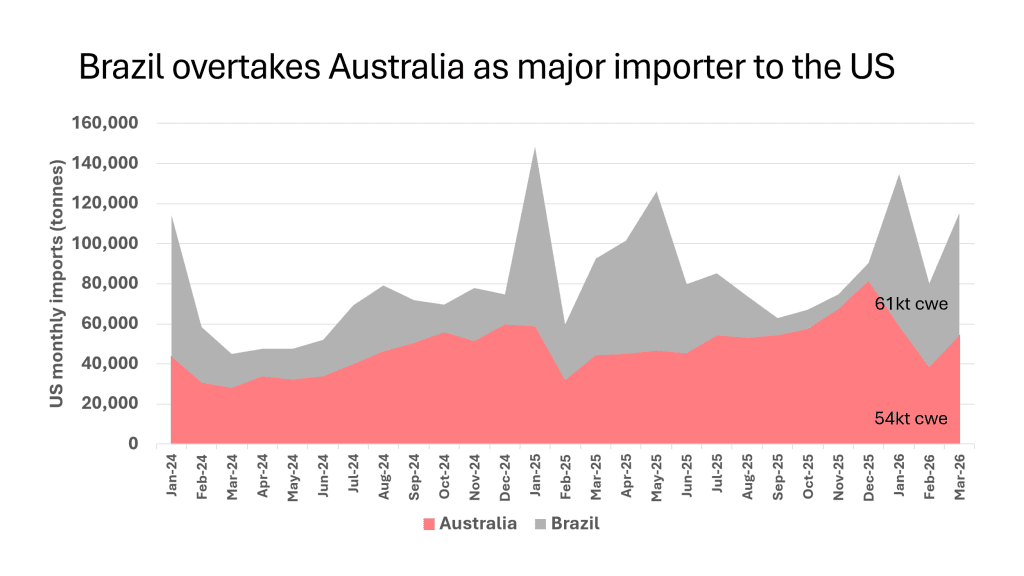
Recent monthly Brazilian shipments to the US have averaged about 60,000t – up dramatically from a volumes seen only year or two ago.
To make matters worse, Brazil is about to fill its China beef quota for the year, having surpassed 90pc on August 10. Once filled, it is widely anticipated that the US will be the default target for even more Brazilian beef for the remainder of the year, to escape the harsh 55pc Chinese tariffs until 31 December.
At current rates of Brazilian consignment, it suggests that the 300,000t window on tariff-free access to the US could last until around the end of 2026. What happens after that is anyone’s guess, given Trump’s erratic tariff and quota policy history.
By March this year, Brazil had stepped ahead of Australia for the first time as the largest monthly exporter of beef to the US.
Source: Elders. Click on image for a larger view
Some trade sources have already speculated that the decision announced on Saturday morning (Australian time) could be diluted or walked-back, once more detail comes to hand early next week.
US cattle producers condemn tariff action
The US National Cattlemens Beef Association has condemned Trump’s action, saying no cow-calf producer in America is asking for increased imports.
“Undercutting American farmers and ranchers with products from foreign competitors does nothing to create market confidence or encourage rebuilding the herd, the representative body said.
“For the second time in less than 12 months, the Trump Administration is intervening in markets in an attempt to artificially lower beef prices,” NCBA said in a statement.
“Current retail prices are high because of strong consumer demand for the high-quality beef we produce. Incentivising additional foreign imports undermines America’s producers at a critical time as they make decisions about rebuilding numbers for next year,” it warned.
“US farmers and ranchers need stability. Unlike spur-of–the-moment trading decisions made based on White House social media posts, the decisions and investments ranchers make in their herds are made years in advance, not days or weeks.”
“The Trump Administration’s repeated whiplash on trade policy and beef imports has real impacts on cattle producers in rural America. USDA created and promoted a stronger “Product of the USA” label, only to abandon it and decide that MCOOL (Country Of Origin Labelling) was the only option.
“Trump’s announcement is not about helping US cattle producers. It’s not about putting their finger on the scale for one cattle industry group or another. It is 100pc about the 74 days between now and the midterm elections.”
Social media responses
Responses to an NCBA post on social media were mixed, with calls for clearer Country Of Origin Labelling common. One person said: “Building up our domestic cattle herds is not going to happen overnight. We are losing ranch land and ranchers at an alarming rate. We are at the lowest numbers of cattle in our country and the answer isn’t easy to fix. President Trump is thinking of both the consumer and the cattle rancher. He’s no dummy.”
“I’d be curious to see the numbers on how many US households are changing their diets based on the ability to afford beef,” another said. “As much as I enjoy beef, I have slowly turned to a more plant based diet. Meat has become a luxury.”
“Americans are still free to decide to pay more for American ground beef or buy cheap imports. We decide, not Trump,” another consumer said.
“Beef cow numbers are at 1954 level,” US beef producer Lindell Whitelock said. “It takes five years to increase the numbers, but the reality is a farmer who is just entering the business or a farmer wanting to expand cannot wait 3-5 years for a payday. As we lose family farms fewer younger farmers will be taking over the family farm, and being able to keep those herds in place. Economics is the main issue.”
Tariff war erupts with Canada
Also on Friday night, US time, Trump announced 50pc tariffs on Canadian good entering the US, but it is understood that Canadian beef and cattle is excluded.
Canada immediately retaliated, with Prime Minister Mark Carney on Saturday announcing that tariffs on imports from the US across a raft of sectors would be imposed from 8 September.
I am so glad that Trump has identified that the drought and Covid were actions by Joe Biden. Trump has caused world disruption on a scale greater than any other world leader ever and will take many years to correct after he is forgotten