
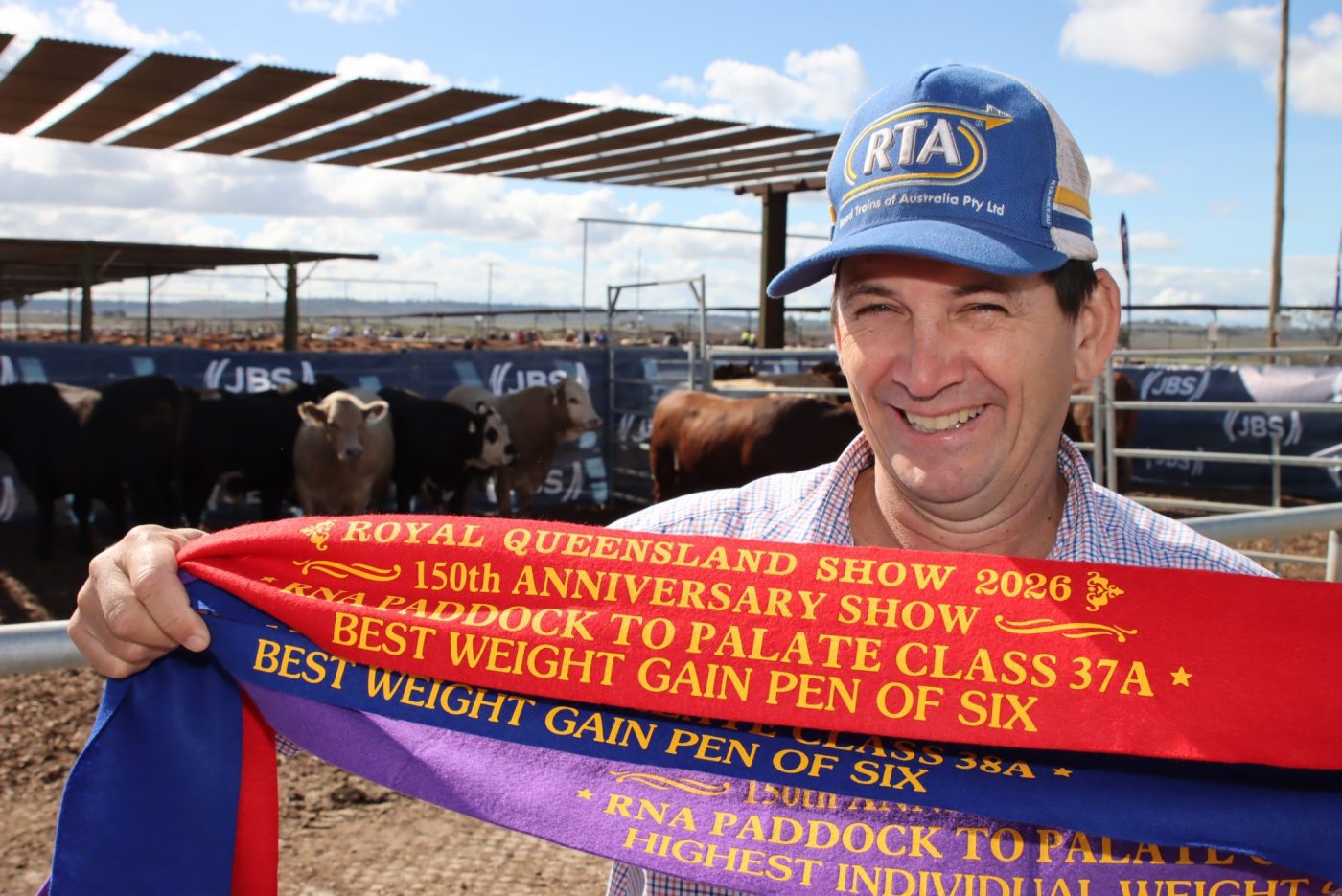
IT may be tempting to think buying the highest-priced bulls is the best way to breed championship-winning cattle, but that has not been the case for one of the most successful exhibitors in the prestigious RNA Paddock to Palate competition.
Instead, a disciplined breeding strategy focused on buying commercial herd bulls has helped underpin the long-running success of Russell Pastoral Operations in the strongly contested commercially-focused competition.
Russell Pastoral Operations breeds cattle from a predominantly Angus base across its 55,000ha, 5000-breeder Champion Station near Blackall, before backgrounding progeny to feeder weights at Jimbour Station on Queensland’s Darling Downs.
A word that perhaps best captures the breeding priority overseen by managing director Adam Armstrong and the Russell Pastoral Operations team is “balance”.
Related article: Champion Station to host virtual fencing and emissions field day
Indeed the balance being achieved in the Angus-based crossbred herd between growth rates and carcase quality has been repeatedly reinforced in Russell Pastoral Operation’s consistent success in both the weight gain and chiller performance sections of the Paddock to Palate competition over the past decade.
 In this year’s weight gain results announced at JBS Australia’s Beef City feedlot on Tuesday, Russell Pastoral Operations steers won the 100-day trade class with an average daily gain of 2.69kg, ahead of second-placed Gyranda Pastoral Company (2.61kg/day) and third-placed David Crombie’s Aurelian Pastoral Company (2.55kg/day).
Greg Kelly, Juandah Grazing, recorded the highest individual weight gain in the class with a steer averaging 3.12kg/day.
In the heavier 120-day export HGP class, Russell Pastoral Operations placed second with a pen of six steers averaging 2.98kg/day.
That class was won by Simon and Myriam Daley (3.03kg/day) (see separate article), while Michael Hinz, Hinz Grazing, Drillham, placed third with 2.96kg/day.
Russell Pastoral Operations also claimed the highest individual weight gain in the 120-day export HGP class, with a steer averaging 3.43kg/day.
That equates to an overall weight gain of 411kg over the 120-day feeding period, putting to rest thoughts that the extension from 100 to 120 days this year might see gains plateau in the final three weeks.
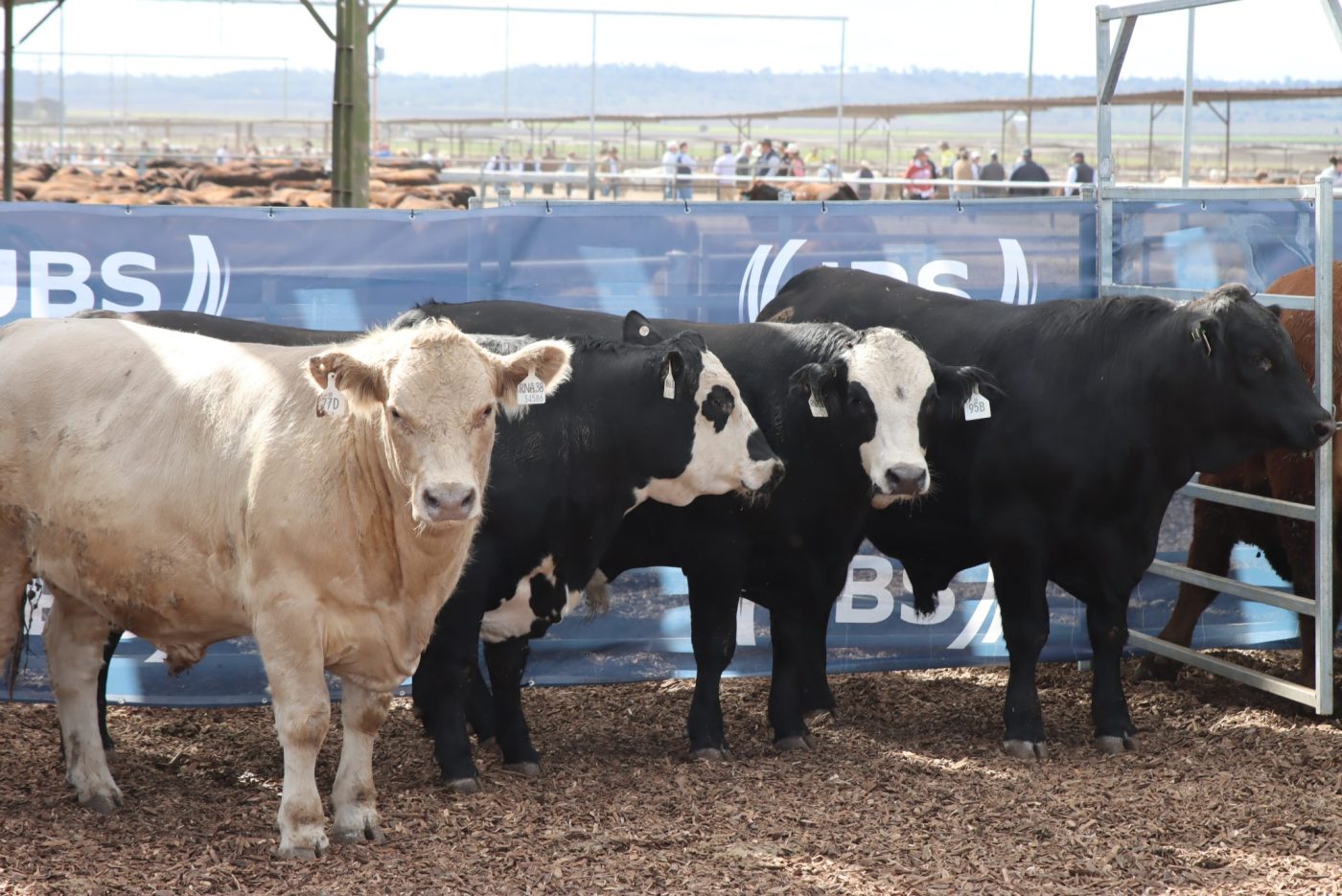
Angus cross Champion station cattle from the winning pen in the 100 day trade class which averaged 2.69kg/day, and (left) the animal in the same class with the highest individual weight gain of 3.12kg/day, a Charolais cross exhibit entered by Greg Kelly of Juandah Grazing.
Mr Armstrong said significant time is spent studying Estimated Breeding Values and stud averages, looking for bloodlines capable of delivering both growth and intramuscular fat (IMF).
“We’re trying to achieve balance, which is hard when you have antagonistic traits,” he said.
“I do spend a lot of time on EBVs and looking at stud averages, because I’m not targeting the ring animals, so I’m not actually buying known EBVs.
“I’m buying the average of the stud, and I’m taking a punt that if they’ve got that approach across the whole genetic program, their whole average is lifted as a result and I can go and buy a dozen herd bulls, I am going to get what I want.”
He said there was still a degree of subjectiveness and gains can sometimes be “fleeting”. “You can actually get growth and IMF at the same time, and then a few years down the track you’ve lost it. You’ve gone one way more than the other. So there is a lot of subjectiveness in this and that is the problem.”
He foresees much greater use of objective tools in guiding commercial breeding operations in future.
The current breeding herd on Champion Station has been developed over the past 20 years from a quality Braford/Shorthorn base to predominantly Angus, with a higher ratio of Charolais bulls to Angus bulls joined in recent years.
“And that is just trying to keep those growth rates going, and I picked Charolais bulls from a stud that was at the higher end of the IMF side of things.
“IMF to me is proxy for carcase quality.”
The Angus base enables about 30 percent of the operation’s turnoff to be sold into a straight Angus market.
“We get paid that Angus premium and that is very important to us these days. If flatbacks are trading on the Downs at $5/kg we’ll average $5.20, $5.25 and every bit counts.”
In selecting cattle for the annual competition Mr Armstrong said that in an extensive commercial operation it usually came down to what was available at the time, with an emphasis on picking those that “have grown a good frame and are looking like they want to explode”.
“And again that is highly subjective. You’re not going to send one that looks dumpy and has started laying down fat already, we will pick those animals with frame that clearly demonstrate potential to put serious weight on.”
Seasonal conditions also highlighted the rapid growth rates inherent in the Champion Station herd, with rain shortly before cattle were due to be entered triggering a rapid weight spike.
Mr Armstrong said the timing created a scramble, with one draft for the 100-day class producing six overweight disqualifications.
“We know our cattle grow, but sometimes they can get a bit over excited.”
He said one of the more interesting takeaways from this year’s competition was the presence of extensive commercial producers over seedstock operations in competition placings.
He believes that points to heterosis playing a major role, along with improved cattle selection by commercial producers in combining subjective assessment with increasing use of objective tools such as in-paddock weighing.
Looking ahead, he is hopeful the additional 20 days on feed in the competition this year could deliver stronger carcase performance for their Angus-content cattle.
“I think what we will see with our crossbred cattle is that we hope to do even better on the carcase side, because with that Angus content we expect we should see our carcases grade overall better.”