
THE beef industry is making progress in its aspiration to move towards a Value-Based Marketing model, that may one day value slaughter and feeder animals not only on meat quality and carcase weight, but also meat yield, sustainability credentials and other features.
The subject was discussed at some length during a Feeder Steer Master Class held in Ballarat, Victoria on Wednesday. The key focus of the day was on exploring optimising supply chain productivity right along the chain, with technology (demonstrated in various forms) playing a key role in that.
Sarah Strachan addresses the Ballarat Feeder Steer Masterclass
Meat & Livestock Australia’s 2025-2030 five-year strategic plan emphasises Value-Based Marketing (VBM) as a core strategy, aiming to increase industry profitability by linking production traits (covering genetics, quality, yield and sustainability) to market price signals. This is designed to create a two-way data flow for better rewards, and building brand equity through verified credentials like provenance and welfare to meet consumer demand – all supported by data, technology and collaborative supply chain efforts.
MLA’s general manager for research, extension and adoption, Sarah Strachan, told the Ballarat gathering that the industry had made investments, for a long time, in technologies like objective carcase measurement, Meat Standards Australia and data collection and dissemination, that were now at a point where there were no longer any excuses in adopting those tools and ‘really changing things.’
Given the advancement in these tools, MLA now felt it was time to demonstrate that VBM can “now become a reality,” she said.
“But it’s not a one size fits all approach,” she said. “We will absolutely be making investments supply chain by supply chain, depending on what VBM means to that network.
Ms Strachan said there were plenty of definitions of VBM around, but MLA’s was translating a consumer demand driver into a pricing signal, to create and capture more value at every point along the chain.
“There are plenty of market signals out there for our red meat. Let’s listen to them, because those consumers giving those market signals are the only ones putting their hands in their pockets to put money into our supply chains. The question is: How do we meet or try to exceed that expectation every single time, when they have so many protein choices in front of them?”
Ms Strachan said market signals usually informed what a beef brand specification might include, whether that be from the feedlot, brand owner or processor.
“That then determines whether your cattle meet that brand spec, or not,” she said.
“If we can get the flow going from those market signals and the performance data being produced across the industry, we can continue to create value, and indeed capture more value.”
Modular approach needs ‘knitting together’
The industry was doing ‘really great things’ at a modular level, in areas like genetics, lotfeeding, carcase feedback, and processing.
“Now it’s time to knit these things together really well, and seamlessly – so that each one is feeding into the other – both via carcase and feedlot performance feeding back, as well as feeding forward livestock credentials from the producer level – which is something that’s not that currently well done through the industry.
Prediction tools
So what are the opportunities to create and capture value for feeder steer producers or those finishing cattle?
Being able to have systems that help us predict how animals are likely to perform in the feedlot or in the chillers will be incredibly beneficial to the feedlot sector, Ms Strachan said. More on the development of genomic prediction tools in a separate story later this week.
“Managing the top end of those animals is actually pretty easy,” she said. “It’s managing the bottom end that helps deliver those greater efficiencies in the feedlot.”
Waiting for pricing signals
Ms Strachan said the industry did not have to wait until pricing signals started to emerge before embracing VBM.
“It’s become really clear to me that we don’t have to wait for that to happen,” she said.
“That’s because there are really clear signals right now, and we don’t necessarily need to wait for perfect data or price premiums – even though there are lots of opportunities for that to happen.”
“We can do the low-hanging fruit right now, that would actually lead to getting more money in the chain.
Her example of this was illustrated using MSA pricing grids, where the producer either “met the minimum MSA requirements, or did not”.
“That can be a really significant pricing differential,” she said. “Just getting over the line, in terms of compliance, can represent a significant amount of money. There can be as much as 10pc non-compliance rate for MSA during the year. There’s a lot of money being left on the table – being close to the end of the financial year, it is likely that those Australian producers who get over the hurdle (cattle compliant with MSA) probably earned an additional $400 million in farmgate returns over those who did not.
The range of tools allowing producers to make that transition, including genetics and on-farm management and nutrition, had really seen the value created and captured.
Yield factor
Meat yield became a popular talking point during the Ballarat Feeder Steer MasterClass, especially in the area of lifting carcase yield without compromising meat quality and other traits.
Sarah Strachan presented this graph, representing 45,000 slaughter cattle, broken down by the proportion represented in each yield category.
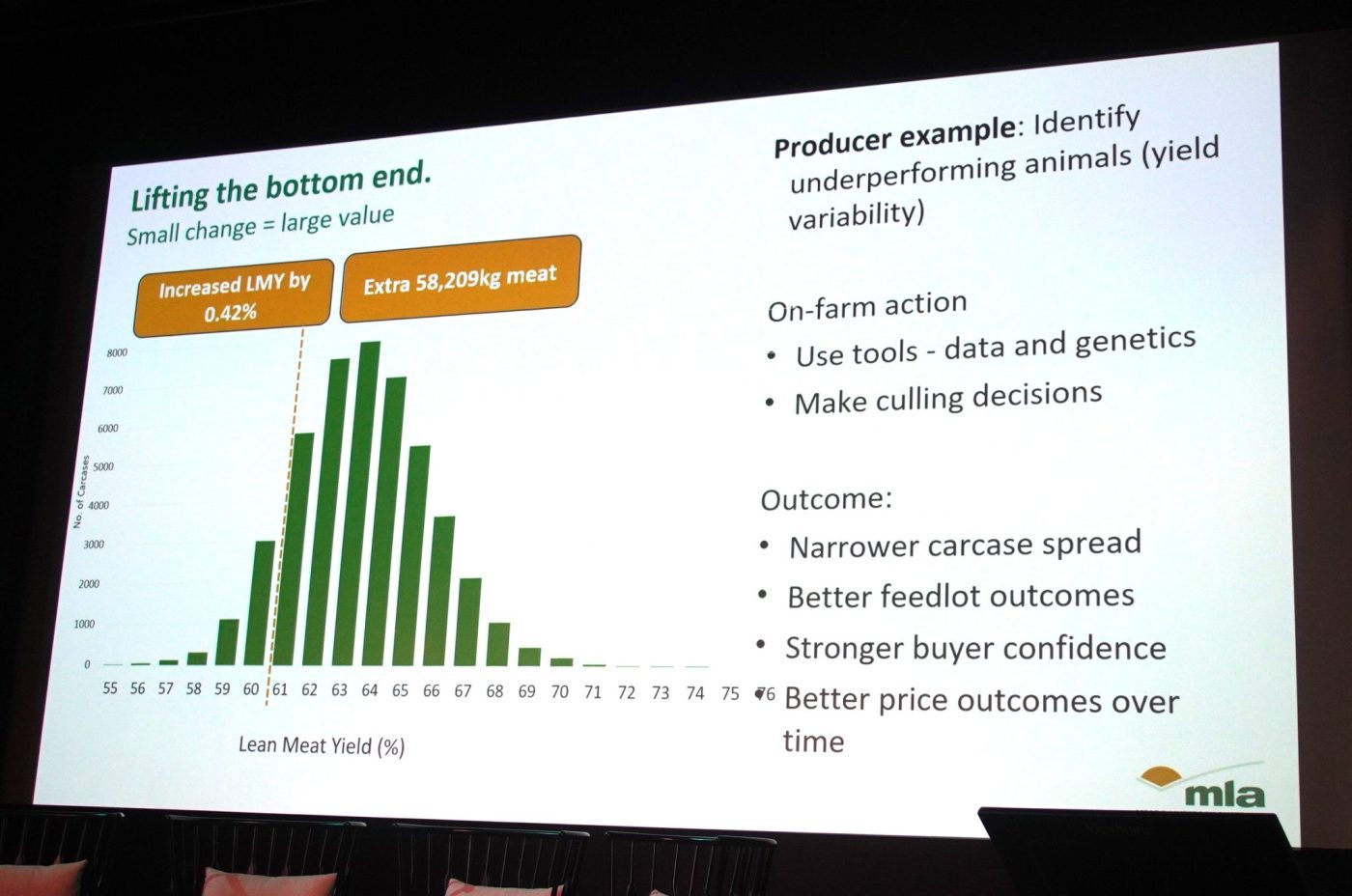
“There’s a huge amount of variation there – so if we could use tools in making culling decisions, with the intention of lifting the bottom of that curve a little – and shifting the average of a herd or a population as well, would make an enormous difference. Within the 45,000 head on the graph, by increasing their yield by less than half of one percent, it would deliver an extra 58,200kg of boneless meat.
“Yes, the processor will get that extra meat to sell, but when we have more of the pie being sold, there is more of the pie to share with others along the chain.”
“And through this predictability in how animals are likely to perform, its starts to challenge the status quo of how we even describe meat to the market.”
Days on feed flaws
The inadequacy of using ‘days on feed’ as a benchmark of quality was discussed at several points during the Ballarat Masterclass.
“Days on feed guarantees nothing more than the amount of time an animal has been fed,” Ms Strachan said.
“A lot of brands are described on days on feed, because it’s the best they’ve had as a proxy, up to this point. But now we have systems, like the MSA eating quality index, that show cattle with a wide range of days on feed from 100 days to 250 days, that have all produced exactly the same eating quality score. In some cases, the lotfeeder has put an extra 150 days of grain down their throats, to get the same EQ outcome.”
“This is why VBM is a call-out to MLA over the next five years – because we now have the tools that can help us improve this predictability, we have technology coming through that can scan animals at induction, and hopefully, in-field weighing back on farm, to do some predictions of likely performance as well. And we have a suite of objective carcase measurement technologies coming through as well, to make all this happen.
“I say, that let’s us start removing language (like days on feed) that isn’t really describing what a consumer thinks about our meat, and allows us to get closer to a consumer-driven beef language.”
Consumer preferences
Ms Strachan cherry-picked a few items from MLA’s abundant global markets insights that she felt were relevant to the VBM conversation.
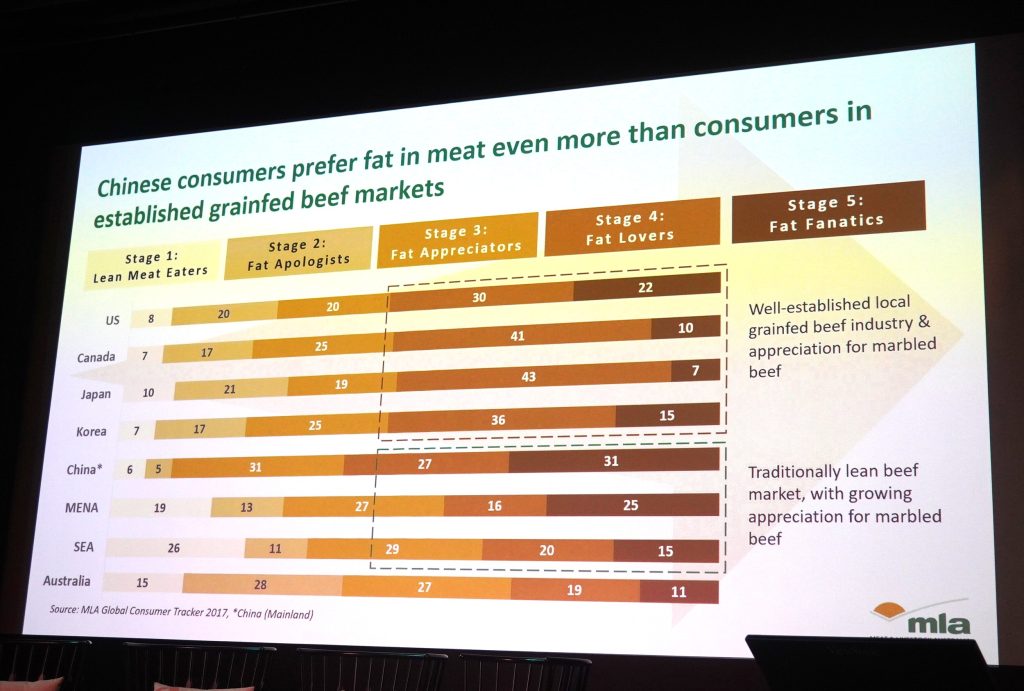
“What we’re seeing are some real changes,” she said. “Our strong grainfed export markets (‘fat appreciators’ or ‘fat lovers’ in the graph below) around the world like Japan and Korea remain really strong, but there’s markets that have traditionally been very manufacturing/lean beef focussed that are changing.”
“When we look at China, the Middle East and Southeast Asia, we’re seeing the proportion of consumers who are actually changing their tastes towards a fattier product (traditionally associated with grainfed beef) growing.”
That really opened up opportunities for higher quality Australian beef, she said.
As seen in the graph below, a global consumer tracking survey, using Indonesia and the Middle East as examples, showed substantial growth between 2017 and 2025 in consumer appreciation of higher fat levels in meat.
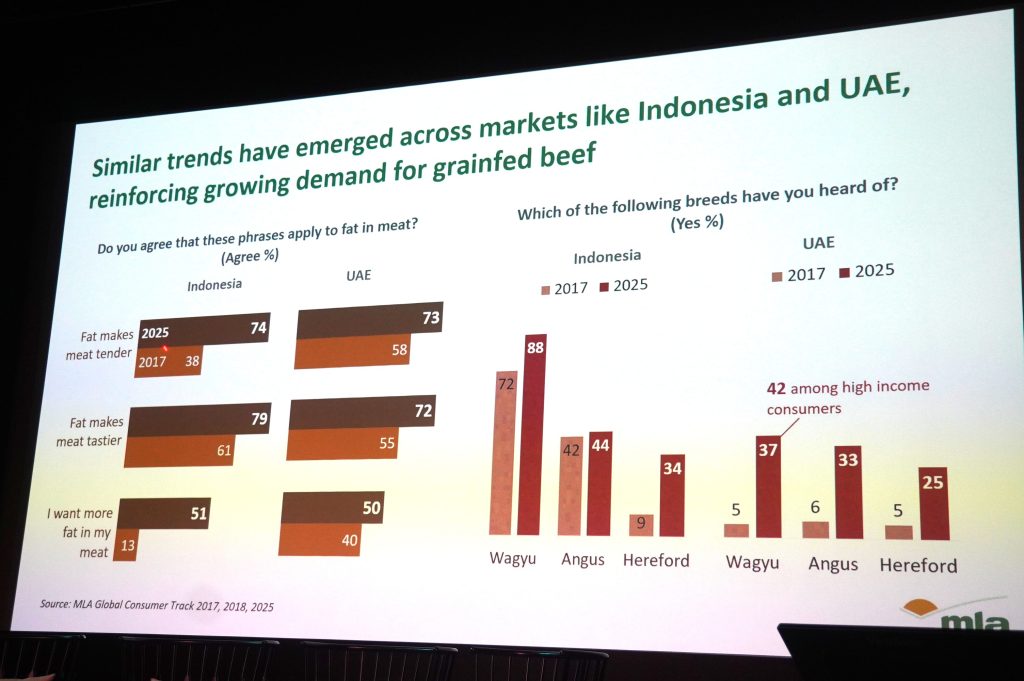
“This is just music to our ears, as a grainfed product,” Ms Strachan told the feeder steer masterclass. “Similarly, there is growing awareness of breeds (associated with grainfed product), so it’s all coming together nicely around having lots of options, and consumers who have recognition around grainfed beef, and are willing to pay for it.”
In the past 12 months, MLA consumer survey work had shown that 24pc of consumers were eating beef more often, driven ‘hugely’ by the health and protein story. That’s the first time in 15 years that the number of consumers who say they are increasing beef consumption, rather than decreasing – in a market where beef prices have remained ‘really high’ compared with other protein.
“That really informs some of the targeted marketing messages we have around beef,” Ms Strachan said.
For the 22pc who said they were eating beef less often, the primary reason (and there was a really big gap between the first and second most common reason) was price.
“But that doesn’t mean we can’t do something with those consumers,” Ms Strachan said.
“Some of the carcase utilisation work that both MLA and individual processors are investing in can help in this area. MSA is about finding every cut in the entire carcase; putting it into the right cooking method; and establish different price levels that give consumers options. If it’s too expensive to buy the top-shelf loin cuts, let’s find a mid-range priced item that absolutely meets their expectations.”
But consistency remained incredibly important, the consumer research continues to show. “When they choose to put red meat in their trolley, we can’t afford to let them down, because it’s going to be very easy for them not to come back to red meat again.”
Trust remains a currency across all markets
Trust remained an important currency across all beef markets, Ms Strachan said.
A cattle producer delivering a feeder steer into a feedlot was very much a part of the consumer’s trust across the system.
“Trust in beef means a whole bunch of different things in different countries,” she said.
In some, it was very much driven by food safety; in others, consistency of eating quality, or animal welfare and environmental concerns. All of these things make up what consumers think trust is, and Australian farming in general enjoyed a very good reputation in this space, with farmers not far behind nurses, doctors and teachers on the ‘trust index.’
“In Australia, trust drivers do start to include environmental issues. When you think about a consumer looking to make a 30-second decision about a purchase in the supermarket, they’re not necessarily looking to understand everything about that piece of meat. Often it’s as simple as knowing they want to eat red meat; and what the occasion is.
“How the meat was produced is not the first thing the typical consumer is thinking about, but when it is called-out, they may be willing to pay more, depending on what it is. And the word ‘environment’ often means different things to different consumers.
But what consumer research clearly shows is that higher levels of consumer trust translate into increased consumption, as illustrated in this graph.
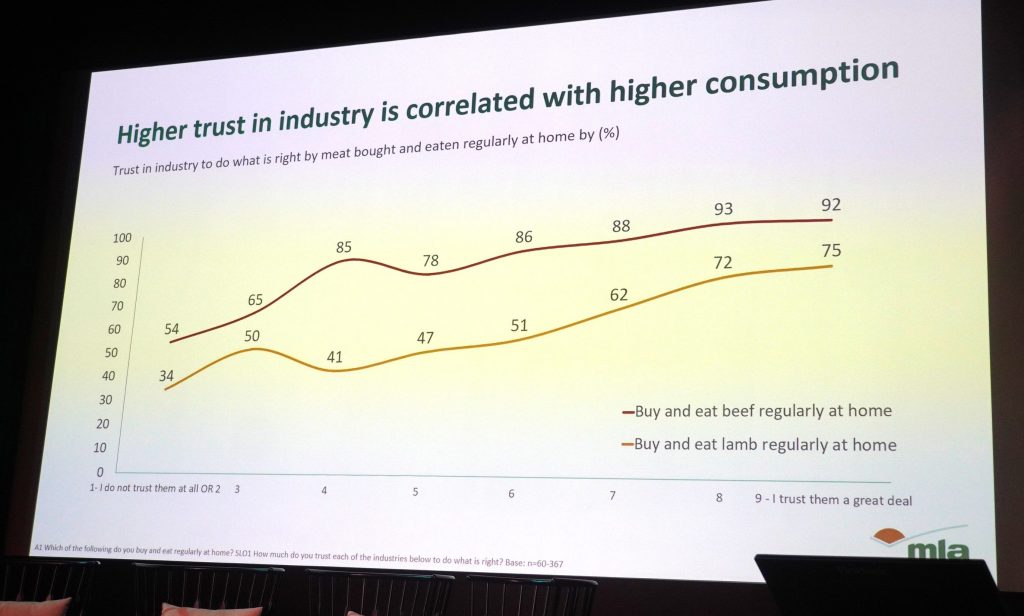
On a trust index from ‘I don’t trust beef farmers at all’ to ‘I trust them a lot’, higher trust leads to more regular consumption, Ms Strachan said.
“But this is something that we can’t take for granted, and can’t be complacent about.”
Australia was in the box seat to benefit from this, she said.
“We have a great country that is really well suited to livestock production, and we take great responsibility for it. We have the world’s leading eating quality program and integrity systems – our industry is committed to sustainability and we’re happy to put it out there and show how were measuring it, through our sustainability frameworks.”
However other exporting countries were catching up, Ms Strachan warned.
“We absolutely have a differential, but other countries are getting pretty sophisticated as well, so we can’t just rest on our laurels – we have to remain committed to this principal and continue to seek the ‘next thing’ that sets us apart from our competitors.”
HAVE YOUR SAY