
AUSTRALIAN export lean beef trimmings prices have come under considerable pressure over the past few days, as the wash-out of the US decision to allow 300,000 tonnes of tariff free Brazilian trimmings into the country in coming months starts to take real effect.
In round terms, measured in Aussie dollars, lean 90s trimmings prices today are down about $1.40/kg compared with just five weeks ago. See Beef Central’s home-page dashboard for a graph reflecting this trend.
 The most recent weekly 90CL cow-meat quote provided by MLA for 28 August was A$9.94/kg CIF – the lowest level seen for 21 months, after lean imported trimmings prices went through a big surge, peaking above A$13/kg last November.
However reflecting the current fast-moving market, traders spoken to this morning told Beef Central that imported lean 90s prices have fallen considerably further than that since Friday, with one prominent contact quoting 940-950c/kg. That’s close to prices last seen in October 2024.
In USc/kg terms, the trader quoted the market into the US for business being written today at US320-325c/lb, down 40c/lb over the past six weeks.
Trump tariff impact
In what was already a pretty fragile market environment, US President Trump’s tariff removal last week on 300,000 tonnes of (mostly) Brazilian imported grinding beef over the next three months has only greased the wheels.
“The tariff removal has just exacerbated everything. The export trimmings market is under a lot of pressure this week,” the Australian export trader said.
The latest Brazilian tariff removal (26.4pc) for beef entering the US has made Brazilian meat even more competitive in the US market, clearly pulling Australian prices lower.
Even prior to the latest tariff move, Brazil had been pushing increasing quantities of beef into the US market, given that it is now within days (if not hours) of filling its China beef quota for the year, meaning Brazilian exports to China for the remainder of 2026 will attract a harsh 55pc tariff.
Adding to the current price pressure is currency movement, with the Aussie dollar rising US2.4c over the past two months, making our exports a little less competitive.
In 50 years, Australia has never faced such heavy competition in the US
In essence, all this means Australia – the primary supplier of imported beef to the US market for the past 50 years – has never faced such heavy competition in the US imported beef market.
Disconnect between meat and cattle prices
“The current price reaction is all on the back of Brazil,” another trader said.
“Meat trading conditions are horrendous at present. The buy (cattle prices) and sell (export meat prices) just don’t make sense.”
Beef Central highlighted rising slaughter cattle prices (especially cows) and the big disconnect that’s emerging with the meat market in Tuesday’s weekly kill report.
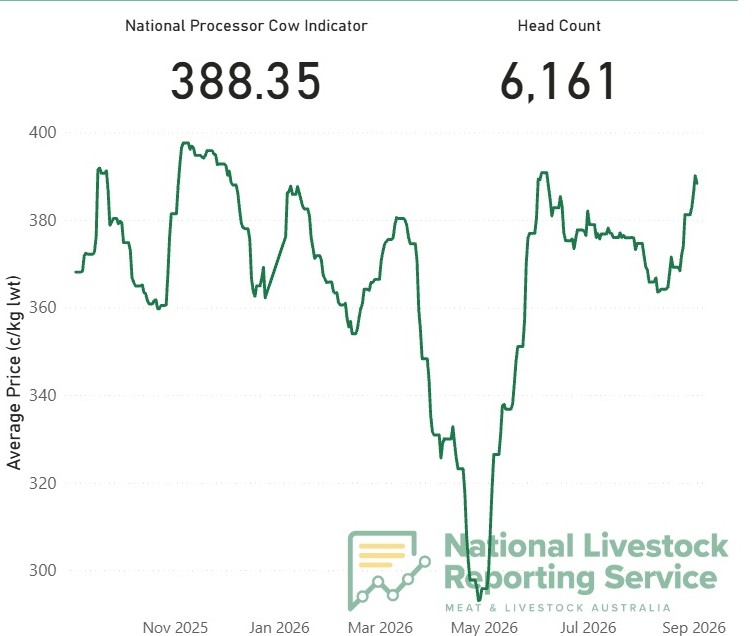
Click on graph for a larger view
MLA’s slaughter cow indicator published here illustrates this price trend, rising 20c/kg liveweight since late August.
Cows at Wagga sale on Monday averaged 415c/kg liveweight; Wodonga 426c/kg and Naracoorte 422c/kg. The NLRS slaughter cow indicator is a seven-day rolling average covering all cows +400kg sold to processors through 22 NLRS-reported saleyards.
Some possible reasons for the recent surge in cow prices are discussed in Tuesday’s weekly kill report.
Market in ‘disarray’
Filing his weekly US imported beef market report on Friday, analyst Len Steiner described the US imported beef market as being ‘somewhat in disarray’, with domestic end-users trying to understand the impact of the Presidential Declaration on prices offered from Brazil and Paraguay.
“Traders indicate that Brazilian prices were under pressure and traded significantly lower, although the removal of the tariff still means significant savings for Brazilian packers,” Dr Steiner said.
South American frozen 90CL has traded at a 28pc discount to US domestic in recent weeks, so the 25pc discount noted in the presidential declaration should be easy to achieve, he suggested.
“It should be noted, however, that Trump’s declaration does not specify what is meant by market price.”
Before the latest tariff relief decision by the Trump Administration, imported beef prices were already trending lower, given that Brazil was likely going to be out of quota in China by early September, and the suspension of Brazilian beef trade into the European Union.
“Brazilian packers were expected to curtail slaughter and may still do so, but the US tariff decision provides some financial relief,” Dr Steiner said.
“It remains to be seen how quickly Brazilian suppliers will be able to adjust to some of the logistics and manufacturing requirements. Only lean grinding beef, with very specific product codes will be allowed to enter the US using the special 100,000t/month allocation.
Discussions with US importers revealed that Brazilian prices last week traded US10-15c/lb lower than they were prior to Trump’s decision.
However, this was for product that will be delivered some time in October rather than nearby product, Dr Steiner said. “That’s because product delivering say in the next 15 days is already in the country.”
The chart below illustrates the spread between Australian/NZ and South American 90CL boneless beef into the US.
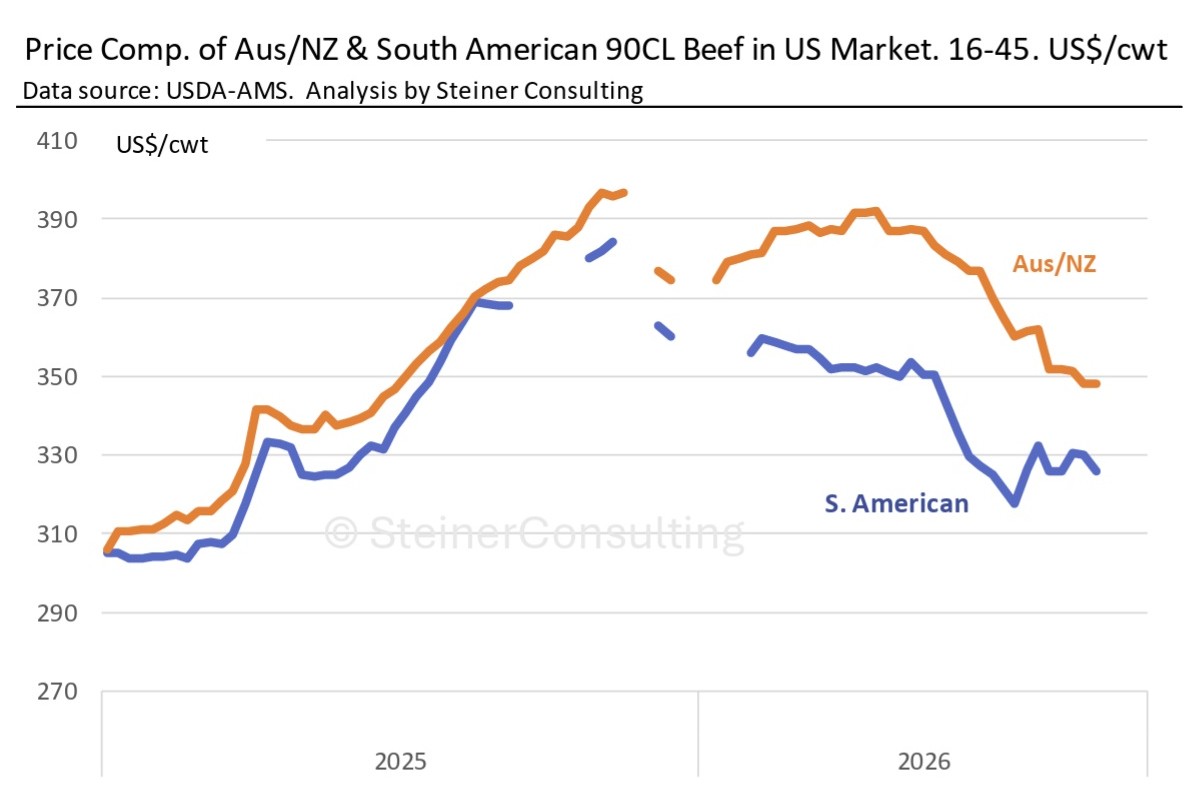
Price comparison Aust/NZ Vs South America 90CL beef, 2024-26 – US$/cwt. Data source: USDA-AMS. Analysis: Steiner Consulting
“In his declaration made last week, President Trump noted that US officials would pay close attention to whether beef entering under the special 300,000t allocation was trading 25pc below the market price,” Dr Steiner said.
“We took this to assume this meant below the price of the domestic 90CL benchmark. This would be especially easy to achieve, considering that South American lean beef prices were already down by more than 28pc.
“However, the declaration does not specify what will be considered the market price. Could it not be the market price for imported beef? After all, the suppliers currently using the special allocation were already paying the 26.5pc tariff and in that case the deal would have been to give that tariff to end-users and ultimately US consumers.
“But it seems the goal of the declaration was to push more imported beef into the US, and in the process, push down prices for lean beef, at least temporarily (and coincidentally) through the Mid-Term Elections in November.
“So we think the market benchmark referenced in the declaration is domestic market.
South American lean beef had traded well below Australian and NZ prices in 2026, although the spread had started to narrow, especially after Australia filled its China quota.
The spread is likely to widen again in October/November, although both are expected to be down, Dr Steiner said.
August exports
Australian lean trimmings shipments to the US for August are on track to be about 43,000t, 5.5pc above this time last year, Dr Steiner said.
DAFF’s official monthly beef export data for August should be out any time now – we’ll post a summary once it becomes available. We’re anticipating a considerable year-on-year shift out of China and South Korea, with greater relative volume into the US, and perhaps Japan.
HAVE YOUR SAY