
PRICES for Australian export lean beef trimmings and cow beef used for burgers, tacos and other popular ground beef items have continued to deteriorate, as global beef trading conditions adjust to recent tariff headwinds.
Australian lean trimmings being sold into the United States were quoted on Friday at US342c/lb, and in Aussie dollars/kg CIF terms, at $10.83/kg.
As this graph shows, that’s down almost A40c/kg in the past month, and back by $1.16/kg or ten percent since the recent high point in early April. Recent trimmings values are now below where they sat this time last year, for the first time in two or three years.
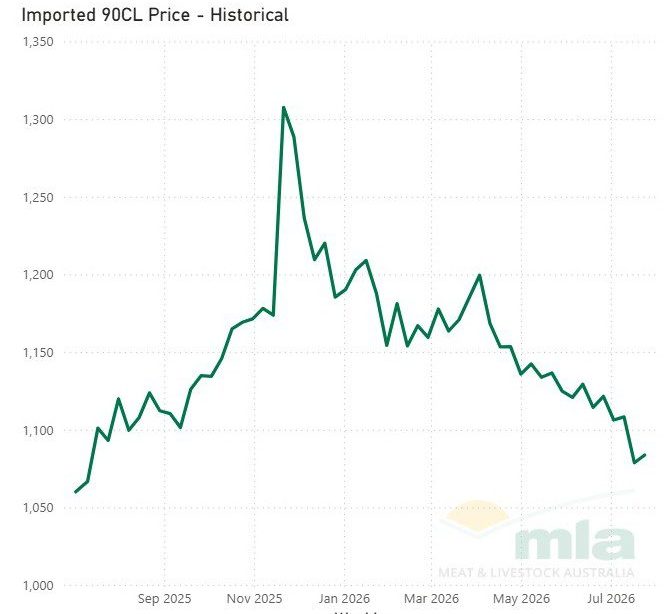
US imported 90CL price A$/kg CIF, past 12 months. Click on image for a larger view
Not surprisingly, given recent tariff developments, Australian lean trimmings prices into China, Japan and Korea have also trended down in recent weeks, meat trade reports show.
While the 90CL beef market into the US has been in a general declining trend since November, latest tariff/quota actions in China and Korea have only added to pressures, as more product is re-directed into the US and other alternate markets, meat traders said yesterday.
In Australia, domestic cold storage stocks of beef have continued to build, putting considerable downwards pressure on pricing (separate story to come on this topic).
Australia officially filled its Korean quota for the year on Tuesday last week, adding 24pc in tariff for the remainder of the year. Six weeks ago, Australia filled its 2026 quota to China, adding 55pc in additional tariff to importers’ saddle bags. Chinese buyers have broadly shunned out-of-quota trade, although fattier trimmings items continued to draw interest, Comtell Asia pacific analyst Junie Lin said in commentary this morning.
 “Australian beef’s traditional foothold in Southeast Asia also came under mounting pressure as Brazil, facing its own quota constraints in China, stepped up its diversion efforts into the same markets,” she wrote. “The added competition proved increasingly disruptive in price-sensitive developing economies grappling with currency headwinds, where Australian product struggled to hold its ground on value.”
July beef export date due Friday or Monday should tell a more complete story of trade impact from tariffs into China, as well as impact in alternate destinations like the US.
In its latest weekly US imported beef market report released Friday, Steiner Consulting described imported beef market activity as slow, as buyers focussed on nearby needs and remained comfortable with their current positions.
“Forward buying is discounted, especially for product delivering in the October/November timeframe. That’s because of more offerings from Australia for that time period, but also with South America expected to be more active given the lack of access to China at that time and New Zealand seasonally starting to ramp up,” Steiner’s report said.
A sharp correction in US domestic wholesale beef prices as US consumers tighten their purse-strings had also injected more uncertainty in imported beef markets.
“Domestic fresh lean beef is holding steady (as of Friday), but is expected to move lower after Labor Day (first Monday in September).”
“There is plenty of speculation as to where US wholesale beef prices go from here, and that was before the USDA announced it will open the door to Mexican cattle in 30 days*,” Steiner said.
“That may add to buyer reluctance to add their fall (northern hemisphere autumn) positions,” Friday’s report said.
* See Beef Central’s report published yesterday about the return of Mexican live cattle trade into the US and what it means for beef supply/demand.
- Stand by for an upcoming summary of a global Lean Trimmings Futures risk management product launched by the Chicago Mercantile Exchange last week.
HAVE YOUR SAY