
FOLLOWING talks last week between US President Donald Trump and China’s President Xi, China has agreed to restore export access to 425 US beef processing plants that have been excluded from the market for up to two years.
China’s General Administration of Customs on Friday granted new five-year registration to 425 ‘overdue’ US beef establishment licenses, with an additional 77 new establishments added to the system. Another 38 US beef establishments remain suspended.
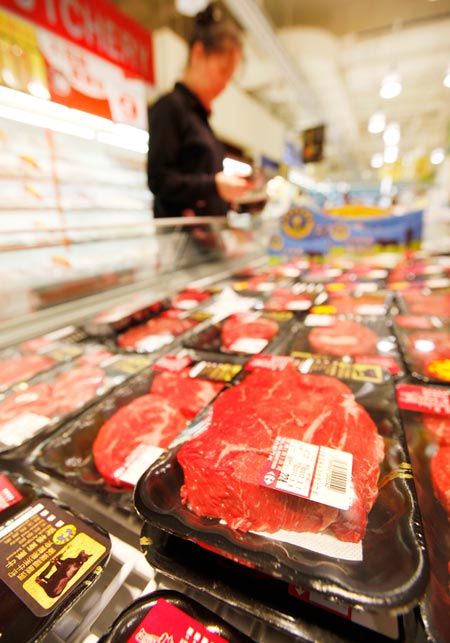 The news came on the eve of the enormous SIAL Food Trade Show in Shanghai that started yesterday, and is sure to draw topical discussion during the event.
The renewed US plant registrations started appearing on the GACC website on Thursday, only to change to ‘suspended’ again over the next 12 hours, adding layers of confusion. It has since been confirmed that the re-registrations are in fact valid.
The US Meat Export Federation provided a response, saying it greatly appreciated US beef access being prioritised at last week’s presidential summit.
“Renewal of US beef establishment registrations is a critical step forward for US beef exports to China,” USMEF president Dan Halstrom said.
“We await more details and a further readout from USTR’s engagements with China, and note with appreciation Ambassador Greer’s optimism for US agricultural trade with China.”
“China’s renewal of US beef establishments is excellent news for the US beef industry and for the customers in China who are anxious to resume purchases,” USMEF said.
It has not been made clear how China plans to treat US beef imports, under this year’s severe quota measures that will see Australian and Brazilian exports hit with a 55pc tariff some time during the back half of this year. Australia has now hit 80pc of its 2026 quota of 204,000t, and is likely to trigger the tariff around the middle of June.
Implications for Australia
In practical terms, renewed US access to China means relatively little to Australia this year, with US domestic production severely hampered by a national cattle herd at 70 year lows and domestic beef production down 15-20pc compared with two years ago.
“Given the high price of US beef, we do not think there will be a rush of US beef heading for China, following the announcement,” analysts Steiner Consulting said on Friday.
“However, there is some pent up demand for high quality, grainfed beef as well as fat beef trimmings to blend with lean beef from Brazil.”
Under the terms of its access to China this year, the US has a quota of 164,000t, suggesting it will not go within a bull’s roar of triggering its 2026 tariff.

Simon Quilty
Analyst Simon Quilty from Global Agritrends told Beef Central that the US principally sold forequarter meat into the China market, and any increase in exports into that market later this year would have to come from US exports that would otherwise go to Korea or Japan.
‘If US trade into China is to start to gain traction, it would all be re-diversion out of the Japanese and Korean export markets – there is no other place to take this forequarter meat from,” he said.
At the same time, US exports into Japan and Korea this year to date are down 20pc and 7.2pc respectively, on the same period last year.
“Simply taking some of that forequarter meat and sending it to China is only going to exacerbate the shortage of US product in both those other markets, and that can only help Australia,” Mr Quilty said. ‘There’s just not enough export meat in the world this year to go around.”
However, because of the different China trade rules applying to US beef from Australian (see explanation below), the US could respond immediately to the re-opening of the trade window into China.
“Where it gets a little more complex is next year,” Mr Quilty said.
 “We see southern Australia’s beef herd in rebuild phase next year; the US herd in rebuild; Japan and Korean beef herds are in rebuild; and there’s even talk of herd rebuild in Brazil. The impact of heifer retention next year across the globe means any impact of the US competing more directly with Australian in the China imported beef market is reduced.”
Asked why Australia had been so much slower to fill its 204,000t China quota than what had been anticipated earlier this year, Mr Quilty said he thought the fact that only about ten Australian plants had ‘genuine’ access to China for chilled beef might be part of the reason.
“Another 15 plants have since been added to the chilled eligible list, but if that original number of participants had been 25 or 35, it might have been a completely different story,” he said.
“Possibly the Chinese importers also realised that it was much better to focus on the quality end of the trade out of Australia, rather than wasting valuable quota on cheap items like bones,” he said. “Common sense prevailed.”
Mr Quilty earlier had forecast a China quota fill date this year around 22 June, “and I still think we will come really close to that.”
“The last nuance might see that drag out a week or so, as airfreight come in to try to fill that last portion, perhaps into the first week in July.”
Asked when China was again likely to start buying Australian beef to place into bonded cold storage for the new (tariff-free) quota year starting 1 January, he said he thought around October.
“It’s not as if we have to wait until 1 January next year for the Australian cattle and meat trade to be impacted by the start of the new tariff free year for beef into China,” he said.
US imported beef tariff removal
In other important global trade access developments, there has not yet been any formal confirmation that President Trump’s surprise announcement last week about tariff removal on all imported beef entering the US will go ahead.
Washington is yet to post Executive Orders on the announcement, leading some to suspect the measure may not go ahead.
“President Trump decided not to sign the executive order and it is highly uncertain if he ever will,” Steiner Consulting said in commentary on Friday, noting a lot of pushback from US cattle producers.
While the measure means little in Australia’s direct trade terms with the US (we already pay zero tariff), it was the prospect of removeal of the remaining 26.4pc tariff on Brazilian beef imports that had potential to greatly change Australia’s competitive competitive position into the US – specially in segments like lean manufacturing beef used for hamburger production.
Brazilian imported 90CL prices into the US since the start of this year are down 2pc, while Australia’s are up 2pc, and the US domestic price is up about 15pc.
“From Australia’s point of view, the failure to execute on Trump’s tariff announcement would be a big win,” Simon Quilty said.
“There is this underlying concern about the extraordinary amount of Brazilian beef that could end up in the US market under a tariff-free arrangement – particularly of Brazil fills its own China quota later this year,” he said.
“The removal of a Brazil tariff would make the product hugely attractive in the US.”
The US National Cattlemens Beef Association has been working hard behind the scenes in the US, lobbying against the imported beef tariff decision on the grounds of damage to the US domestic cattle industry.
“The NCBA might be half a chance to get the US government to turn away from the tariff move, because if you look at all the other exporting countries that operate under quota to the US, none of them apart from Australia and Brazil are likely to fill their allocations this year.
“There’s simply not enough beef globally to meet everyone’s needs.”
One metric to look at out of this year’s US and China tariff impacts was the price of feeder steers in Australia.
“The truth is, they have hardly come off the boil. Today, with this rain that’s about, southern Angus feeder steers are at 530-535c/kg . They haven’t missed a beat.
“Those grainfed supply chains are already finding other markets for that beef – despite the challenges in tariffs into China and indirectly, potentially the US.”
“This is reflecting meat pricing globally at the moment, and really. It’s about strong global demand.”
US supplies China under different rules than Australia
Back in 2020, a bilateral trade deal struck between the US and China saw China commit to an additional $32 billion of US agricultural exports, a large chunk of which was for beef. In fact little real volume emerged, before the lack of renewal of US licenses started to limit trade further during 2024.
The US has technically had official beef access to China since 2017, however the deal struck between the two countries in 2020 removed many of the restrictions on US beef, including:
- A shift from strict HGP-free requirements to maximum residue levels. This contrasts strongly with Australia’s conditions surrounding no HGP beef
- Recognition of US industry traceability systems, with no individual animal identification required, and
- Removal of the previous 30-month age limit on US cattle supplying the trade – a residual condition from the days when concerns existed about BSE in US beef.
Beef from US cattle treated with ractopamine, a widely used beta-agonist in the US, is still banned from entering China. Ractopamine is not used in Australia, but is widely used in the latter stages of grain finishing in the US.
According to MLA’s website, under the US-China Phase-One economic and trade agreement, under the 2020 agreement the strict HGP-free requirement that previously applied to American beef was removed.
Instead of an outright ban, the two countries agreed to transition to a system based on specific Maximum Residue Limits for hormone implant usage. This agreement also removed other restrictive parameters that had historically hindered US meat exporters, such as cattle age limitations and complex individual animal traceability requirements.
“This shift permits the vast majority of conventionally grainfed US cattle—which frequently utilise growth promotants for efficiency – to be legally exported to the Chinese market,” MLA’s briefing says.