
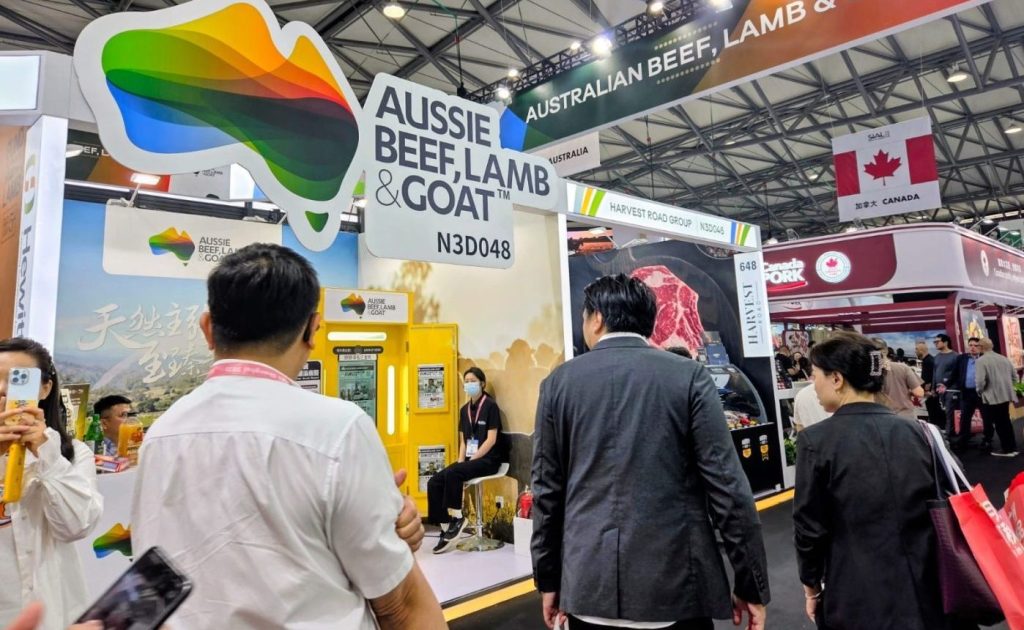
Visitors in front of MLA’s trade pavilion at SIAL on Friday
CONCERNS about chilled and frozen beef business into China once key export nations fill their 2026 quotas was in clear evidence at the giant SIAL Food Trade show held in Shanghai last week.
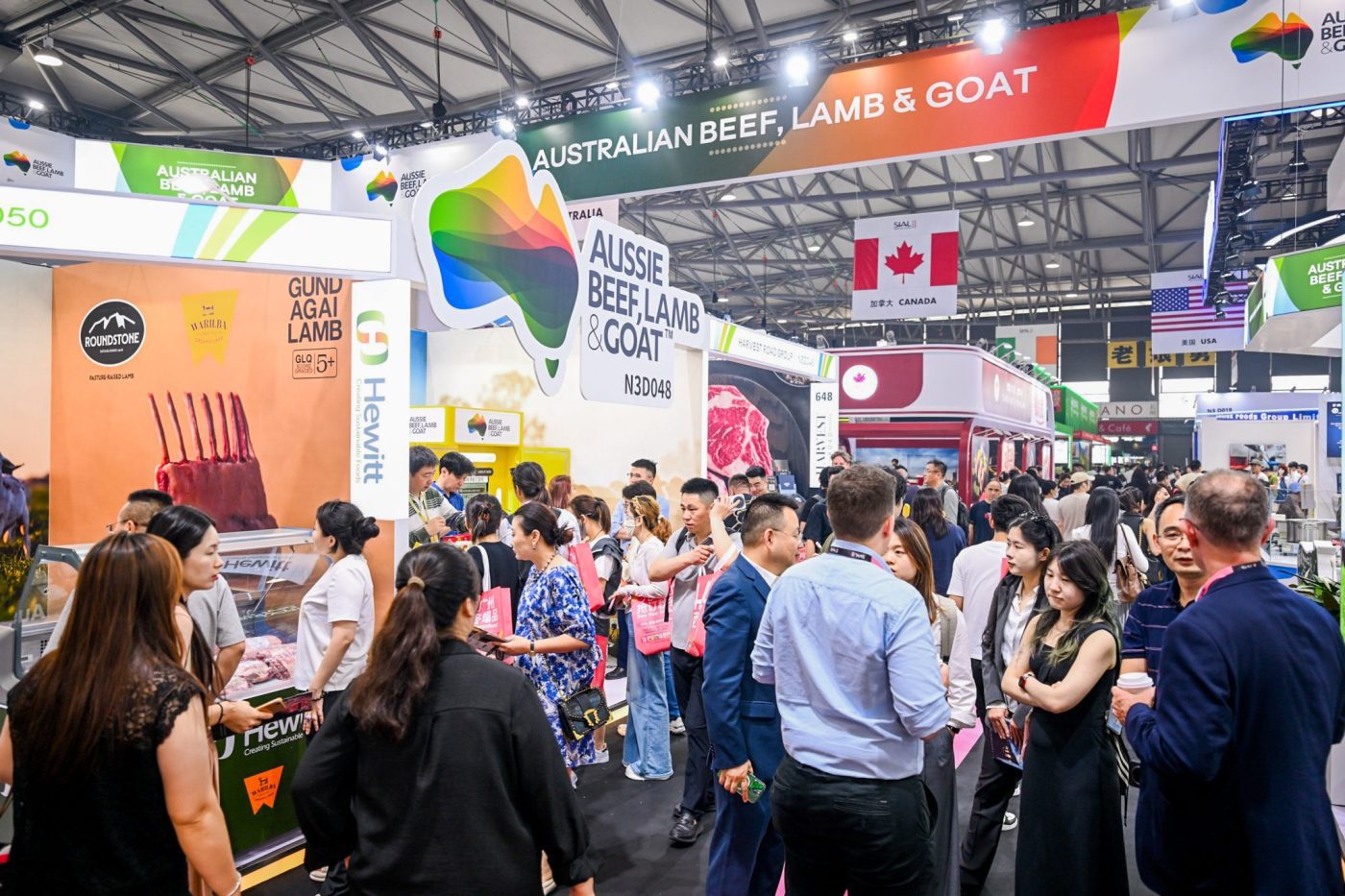
SIAL, which finished on Friday, is one of the world’s largest food exhibitions, and has become a gathering point for red meat exporters from across the world to engage with existing and new Chinese customers.
Meat & Livestock Australia’s general manager for international markets, Andrew Cox, said about 20 Australian red meat exporters had a presence at SIAL this year, either on the MLA stand or separately via importer/distributor or global corporate sites.
Networking events hosted by MLA and other activity was described as ‘very busy,’ as food service, manufacturing and retail customers focussed on security of beef supply for the remainder of the year.
Mr Cox said there was a distinct sense of uncertainty during SIAL around what may, or may not happen with tariffs into China for the remainder of the year.
“Nobody knows exactly what will happen, at this stage,” he said.
Trade talks
Both Australian Trade minister Don Farrell and Brazilian Agriculture Minister André de Paula visited China last week on trade matters, including pressing their nations’ cases for increased beef quotas for the remainder of the year. There have been no developments flagged by Australian government trade channels at this stage.
A Federal Government Trade statement issued on May 18 simply said Minister Farrell would meet Chinese Minister of Commerce Wang Wentao.
“Australia has always been an advocate of free and fair trade,” the statement said.
Both Brazil and Australia have evidently argued for two or three key adjustments on this year’s quota/tariff measures:
- Exclusion of chilled beef, on the basis that high quality chilled imports do not compete with Chinese domestic beef, and
- Re-allocation of unused quota from other exporters (Argentina, Uruguay and New Zealand will not go close to filling their 2026 allocations, Chinese government data suggests.)
- Exemption of bones from the quota volume. China is a major customer for beef bones, but trade in this lower-value item limits opportunity for higher quality cuts, once the quota is filled.
Brazil could lose up to US$3 billion worth of export revenue in China this year if its quota is not changed, Brazilian beef industry body Abrafrigo said earlier.
 Australia may have some advantage over Brazil in any tariff triggering, redirecting flows to Japan and South Korea where Brazil currently does not enjoy access, as well as the United States.
Following the re-admission of US beef to China a fortnight ago following US President Donald Trump’s visit to China, the current extreme prices for US beef are likely to make US beef unattractive in China, Beef Central was told.
“Despite the headline that 400 US plants have been re-listed, there are still a lot of US facilities – including some of the largest factories – that still do not have access,” one Australian trader told us. “For example, JBS only has one of its US beef plants re-registered for China, and JBS is one of the US’s largest beef producers.”
A big change in the Chinese imported beef market over the past ten years had been the move from spot trading commodity business to long-term relationships, under ‘program’ business, MLA’s Andrew Cox said.
“Obviously Chinese customers and their long-term imported beef suppliers are discussing what they will do – particularly in the chilled beef space – once the 55pc tariff is activated. These business relationships are built on trust and long-term alliances, so it may be disruptive.”
“But there is no doubt that Australian chilled beef volumes into China will come down dramatically, once the tariff is imposed.”
Australia has now filled 80pc of its 2026 China beef quota of 205,000t, and is likely to trigger the prohibitive 55pc tariff some time before the end of June. Brazil may not be far behind.
And if exporters start to build stocks held in bonded cold storage in China around November/December for release in a new tariff year from January, the risk is the quotas will fill even faster next year, traders said on Friday.
Separate to this, there has also been talk of making purchases now for cold storage in Australia, before shipment in December in time for the new quota year. Cold storage capacity and price would likely be a limiting factor in this, Beef Central was told.
One big distinction between Australian and Brazilian product entering China is that Australia is much more dominant in the chilled trade, with almost all Brazilian beef sold in frozen form.
It’s worth noting that a number of Australian exporters attending SIAL on Friday were heading to Bangkok for a similar southeast Asian trade show event this week – evidently looking at post-tariff beef export options in secondary markets.
Big drop in food service trade
A large eastern states beef exporter attending SIAL on Friday told Beef Central that Australian food service business into China would fall dramatically, once the 55pc tariff is imposed.
“Supermarkets that require fresh beef are already pivoting to Canada for grainfed and Argentina and Uruguay for grassfed,” he said.
“They will continue to buy reduced volumes from Australian export processors, but expect volumes to fall 80pc,” he said, “even if Australians help offset the 55pc tariff, in one way or another.”
Beef being diverted ‘elsewhere’, however ‘elsewhere’ is a problem
The possibility of imported beef tariffs being removed in the US (announced by Trump last week, but still not subject to Executive Orders) has created real problems in the US beef supply chain,” an export contact said on Friday.
“That’s because there are US importers who are sitting on hundreds of loads of beef trimmings, who now face huge losses if he does drop the tariff. They are offloading or bidding prices significantly lower to offset this, and bring the average down.”
The impact was seen late last week, when pricing for US Fresh 90cl trimmings was quoted at US$4.54c/lb, while Australian imported was $3.40/lb (down from $4/lb earlier) and Brazil, $3.00/lb.
“At the same time Brazil is offering robbed 90cl to China at $2.65/lb, so the talk is that Brazil will keep selling to the US at $3.00/lb and this price could fall further – especially when Brazil fills its China quota in August, and needs to send a much larger proportion of its exports to the US.”
Export beef now being diverted from China into other markets is now creating problems, especially on loins, the export contact said.
“Importers are saying there are 50 loads of grainfed lip-on cube rolls available to the US from the big three Australian packers, carrying a big price drop from US$10/lb to $8.50/lb, with 65cl manufacturing meat back to $6.25/kg from $7.25/kg.”
“At the same time, Japan is now holding off large purchases of grainfed waiting to see the pressure build on Aussie packers, and Korea has its own problems with a 24pc Safeguard tariff going to be triggered soon,” he said.
The exporter said he thought there would be particular pressure on 100 day grainfed, HGP treated markets.
“Loins are struggling and Japan is looking to pull market back, plus trim price is back 15pc across the board – and with the trim price under pressure, that will affect cow prices as well,” he said.
Looking ahead to 2027
The exporter said every China importer and every Aussie packer was talking about starting to pack frozen beef for China in October, November and December, for delivery from 1 January next year, when the tariff reverts to zero.
“That will happen either by storing in cold stores here, or sending containers on ‘Slow Boats’ to China. That surge at the start of the year means next year’s China quota could fill by March.”
“Given China is now stopping, the US is under a lot of pressure, Korea has its own tariff issues and Japan isa rubbing their hands together looking for cheaper meat once competition from China disappears, a correction in global beef prices has already started,” he said.