
 Dr Ced Wise is widely regarded as the godfather of bovine reproduction in Australia. The 2025 Australian Cattle Veterinarians Jakob Malmo Bovine Practitioner of the Year, he is Chairman and Head Veterinarian of Wise Repro. A pioneer of Multiple Ovulation Embryo Transfer in Australia in the 1980s, he has spent four decades building what is now one of the most comprehensive bovine reproduction operations in the country.
WHAT got Australian beef to where it is today is not what will keep it there. The margin for avoidable loss has all but disappeared.
After four decades on the frontline of bovine reproduction, Dr Ced Wise reflects on how far the Australian beef industry has come and what it now costs producers to leave reproductive outcomes to chance.
The Australian beef industry is more productive than it has ever been.
Carcases are heavier. Export markets are broader. Feedlot numbers have grown substantially. Slaughter volumes have reached levels that would have seemed extraordinary a generation ago. By almost every conventional measure, the industry is performing well.
And yet, when I talk to producers across Queensland and beyond, as I have done for forty years, the conversation carries a different weight these days.
Input costs have risen, margins have narrowed and the pressure keeps building across fuel, fertiliser, labour, finance and compliance. Markets remain exposed to forces beyond anyone’s control.
What has changed is the tolerance for preventable loss
A calf that did not have to be lost. A conception that did not have to fail. A joining season that could have been better managed. A bull that should never have gone into the paddock.
These are no longer inefficiencies that can simply be absorbed by the business. In today’s operating environment, they directly affect profitability.
That is the context in which I want to reflect on where this industry has come from, what has changed over the past forty years and where I believe it needs to go next.
The greatest change I have witnessed
When I first started working in bovine reproduction, breeding decisions were often based on experience, visual appraisal and a degree of faith. A producer selected a bull, turned him out with the cows and expected the job to get done. Most of the time it did. Sometimes it didn’t.
If reproductive performance was disappointing, there were limited tools available to understand why. Fertility was largely assumed. Genetics were assessed through phenotype and pedigree. Breeding outcomes were often accepted rather than measured.
The greatest shift in Australian beef over forty years is not in carcase weight or export volume. It is the shift from assumption to evidence in breeding decisions.
Today, producers have access to an extraordinary range of tools that allow them to make informed decisions about genetics, fertility and herd performance. BreedPlan
transformed the way the industry evaluated animals and while some breeds have since developed their own evaluation systems, the principle it established remains the same: objective data over assumption. Estimated Breeding Values allow producers to compare genetics objectively. Genomics provides another layer of information that helps identify superior animals earlier and with greater confidence. For the first time in history, producers can make breeding decisions supported by large amounts of objective data rather than relying solely on visual observation.
The result has been extraordinary genetic progress. The modern producer is no longer simply selecting cattle. They are selecting measurable performance traits that influence fertility, growth, feed efficiency, carcase quality and profitability.
Importantly, this evolution has reduced risk. The best producers today are not necessarily those with the most cattle. They are often the producers making the most informed decisions.
“Data does not replace the eye of a good cattleman. It never will.”
But I want to be clear about something, because I see it misunderstood more often than I would like. Data does not replace the eye of a good cattleman. It never will.
Genomics and EBVs will tell you a great deal about an animal’s genetic potential. What they won’t tell you is whether that animal is structurally sound enough to walk the country it needs to walk, or whether it is functionally adapted to the environment it will be asked to perform in year after year.
Structural faults are heritable. Feet that won’t last. Legs that won’t hold up. Udders that won’t function. Temperament that creates a management problem every time you work the mob. These are not traits that a genomic panel will fully capture and they compound across generations if they are left unchecked. I have seen herds where the data looked good on paper and the cattle told a very different story on the ground.
Environmental adaptation matters too. A genetically superior animal that cannot survive and perform in your environment is not a superior animal for your operation. Tick resistance. Tropical adaptation. The ability to walk country and utilise feed efficiently under heat and humidity. These things still need to be assessed with your own eyes, by people who know cattle.
The best operators are still in the paddock making hard calls, analysing structural correctness, functional soundness and environmental suitability. They cull those animals not meeting their phenotypic standards, no sentiment, no exceptions.
The data tools are genuinely powerful. But you still need good cattle people who know what they are looking at. The two are not competing. They are complementary.
Identifying superior genetics is only half the equation. Those genetics still need to produce calves.
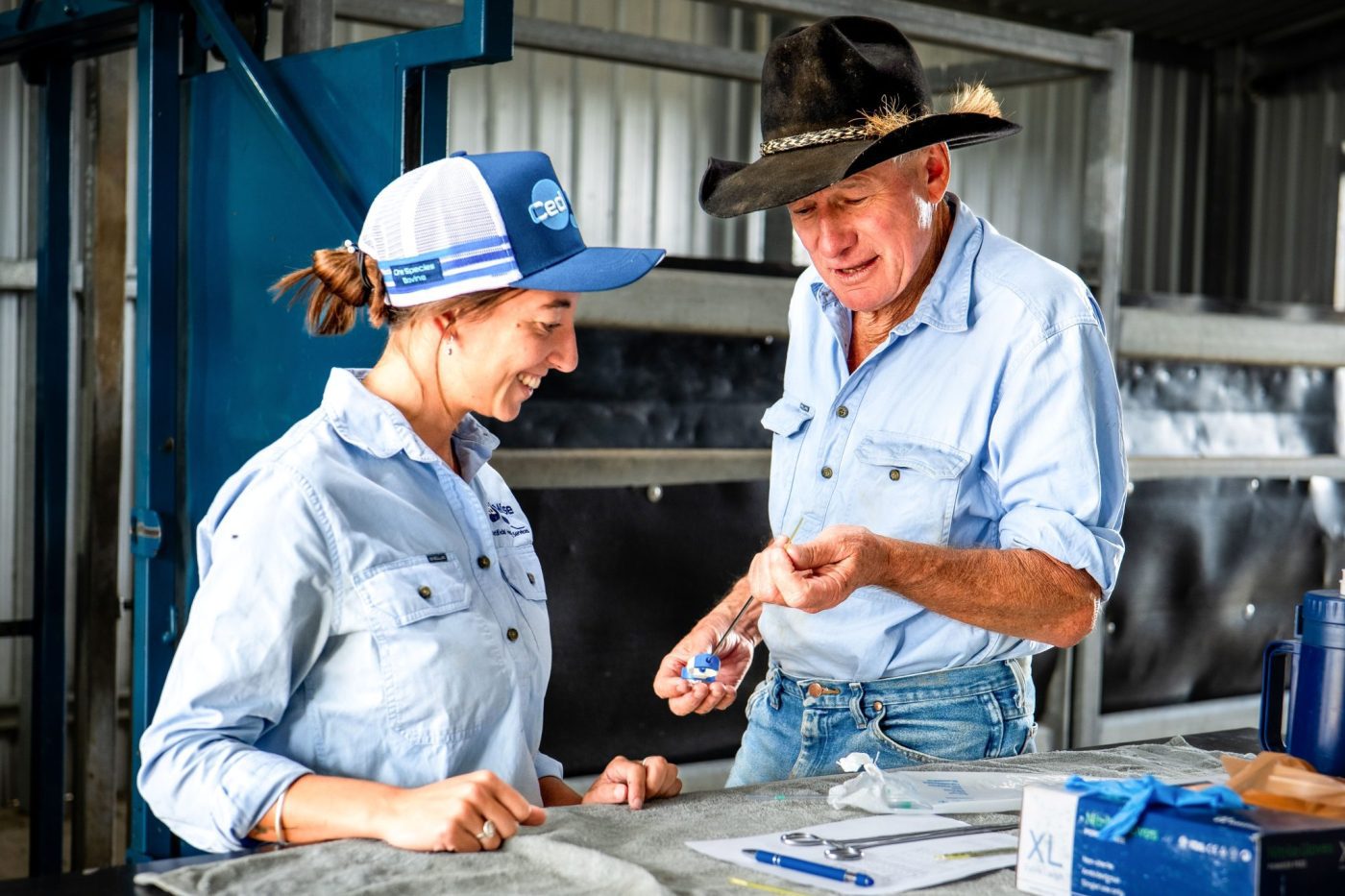
Veterinary assistant Sol Queirolo with Dr Ced Wise at Ced Wise AB Services, Glen Aplin. This is where forty years of knowledge gets handed on.
Reproduction is the core business
Most of the industry treats reproduction as one component of the beef business among many. It isn’t.
Reproduction is the business.
Every kilogram of beef sold starts with a successful conception. Every breeding objective begins with a pregnancy. Every dollar invested in genetics yields a return only if a calf is born.
That reality becomes increasingly important as input costs continue to rise, leaving producers with fewer opportunities to absorb inefficiency elsewhere in the business. The calf becomes more valuable. The empty cow becomes more expensive. The cost of reproductive failure becomes harder to ignore.
Here is what my work has taught me. Poor fertility in a herd is rarely just bad luck. Most losses can be traced to identifiable and manageable causes, but they stay invisible until somebody takes the time to measure them.
Across Wise Repro, we conduct thousands of Bull Breeding Soundness Evaluations each year. The results consistently reinforce the same message. Every year, a proportion of bulls presented for joining fail to meet acceptable fertility standards. Some have poor semen morphology. Others have inadequate motility. Some have physical issues that limit their ability to successfully serve cows.
A bull with sub-optimal morphology or motility, put out with a mob of cows during a short joining period, does not simply underperform. He actively suppresses the conception rate of every cow in that mob.
Consider a bull joined to fifty females. If that bull is infertile and fails to achieve pregnancies, the financial impact is substantial. At a conservative weaner value, fifty missed calves represent a significant sum in unrealised revenue before you account for delayed genetic gain, reduced herd productivity, extended calving patterns or the compounding effects that flow into future seasons. The true cost is often considerably higher.
Yet many producers still rely on assumptions. The bull looks healthy. He worked last year. He passed a veterinary examination twelve months ago. Therefore, he must be fertile. Unfortunately, biology does not work that way. Heat stress impacts semen quality. Disease affects fertility. Injury occurs. Reproductive performance changes over time.
You cannot manage what you do not measure
Assumption remains one of the most expensive management strategies available to Australian agriculture.
Reproductive technology is risk management
Fixed-Time Artificial Insemination (FTAI) is no longer just a seedstock tool. Commercial producers are adopting it precisely because it delivers certainty where uncertainty has traditionally cost them: joining dates, calving patterns, age and weight consistency across the calving season. FTAI also gives commercial producers access to elite genetics through purchased semen. Bulls they could never justify owning can now be used across an entire joining program at a fraction of the cost. Uniform calving simplifies management, improves marketing flexibility and goes straight to the bottom line.
Embryo transfer and IVF are no longer elite stud tools either. They have moved into the mainstream for good reason. The best cow in a herd can only produce so many calves through natural mating. ET and IVF change that equation entirely, multiplying her genetics at a rate that was simply not possible a generation ago. For seedstock producers that means faster genetic gain. For commercial operators rebuilding after drought or destocking, it means protecting the cow families that took decades to develop. The technology is as much an insurance policy as a production tool.
Sexed semen completes the picture. The ability to determine the gender composition of a calf crop gives producers a lever that previous generations never had. Rebuilding a herd, run a female-biased program. Chasing a steer market premium, shift the balance the other way. Rather than accepting whatever arrives, producers can align reproductive decisions directly with business objectives.
And the opportunity does not stop at the farm gate. Australian cattle genetics are among the most sought-after in the world. Elite semen and embryos are no longer just tools for herd improvement. They are export products in their own right, opening revenue streams and global markets that were unimaginable only a generation ago.
The barrier to all of it is never the science. It is the decision to treat reproductive outcome as something you manage rather than something that simply happens.
What the next forty years could hold
The next forty years will not look like the last. When I started out, much of what we do today would have been dismissed as optimistic fiction. I have learned not to underestimate what is coming.
Gene editing technologies are already demonstrating real potential to address economically important traits. Alison Van Eenennaam, an animal genomics researcher at the University of California Davis, is among those doing the most compelling work in this space. Polled genetics into elite horned bloodlines without sacrificing decades of progress and disease susceptibility was addressed through targeted solutions. These are no longer theoretical conversations. They are active areas of scientific investigation.
Closer to home, Australian researchers at the University of Sydney are investigating how artificial intelligence can analyse embryo development and identify characteristics associated with higher pregnancy success. This is not about replacing human judgment. It is about providing skilled embryologists and veterinarians with better information on which to base their decisions. Just as genomics strengthened genetic selection, artificial intelligence has the potential to strengthen reproductive selection.
The common theme across every major advance I have witnessed over forty years is not technology itself. Better information leads to better decisions. Technology is simply the tool that helps us get there.
The cost of inaction
What Australian beef producers have built over the past forty years is genuinely remarkable. The genetics. The evaluation tools. The reproductive technologies. Decades of investment by producers, researchers, veterinarians and breed associations have produced a foundation with no direct parallel anywhere in the world. That foundation is not the finish line. It is the starting point for what comes next.
The industry stands at a moment where the tools have never been better, the science has never been more accessible and the cost of ignoring both has never been higher. Every input cost has risen. Every dollar of margin is harder won. And every calf that did not have to be lost, every conception that did not have to fail, every joining season that could have been managed better. These are no longer inefficiencies a business can absorb. They are the difference between a profitable operation and one that is slowly bleeding out.
The producers who will define the next chapter of Australian beef are not necessarily the biggest. They are the most disciplined. They put eyes on cattle as well as EBVs. They test their bulls before they trust them. They use the tools available to them, and they keep asking hard questions about what their herd is actually doing and why.
Forty years in, the lesson is the same as it has always been.
You cannot manage what you do not measure. You cannot afford to lose a calf you did not have to lose. And the gap between what most herds are doing and what they are capable of doing is still, in most cases, entirely preventable.
That is the opportunity. It has always been there. The only question is whether you are willing to go after it.
“Technology creates opportunity. Disciplined decision-making is what captures it.”
Congratulations Ced,
This is one of the most visionary, balanced, and informative industry letters that I have read, should be compulsory reading for our future Industry leaders.
Thanks for your council and help over the years.
Steve.
Well deserving of the ACV Award. Hard working dedicated veterinarian. Others in this wheelhouse as well as Ced