
THIS week’s property review includes this wrap-up of interesting recent listings across Victoria, South Australia and Queensland, and separate articles on New South Wales listings and recently completed sales of note.
- Western District aggregations return to the market
- $20m+ for Qld beef & irrigation operation
- SA’s Campbell House drops to $18m
Two well-regarded Western District aggregations return to the market
Mondilibi and Manooka
A well regarded Western District aggregation has returned to the market with a reduced price guide of offers above $50 million.
The adjoining 1805ha Mondilibi and 1426ha Manooka are located 12km north of Mortlake in Victoria.
The 3231ha portfolio was initially offered in May 2023 by its British-based owner, the Down Ampney Corporation, with hopes of raising more than $65 million.
Following a repositioning of the owner’s portfolio, a fresh marketing campaign has been launched by JLL Agribusiness.
The aggregation is now available as a whole or as two separate holdings via expressions of interest closing on November 5.
The assets are expected to appeal to large family operators, corporates and institutional investors as a standalone investment or a strategic addition to an existing portfolio, offering valuable geographic diversity through its high and reliable rainfall.
Mondilibi and Manooka support a high-performing mixed farming enterprise focused on prime lamb, wool, beef cattle and opportunity cropping.
Over the past six years, the aggregation has supported an estimated average carrying capacity of 58,235DSE.
During its 50-year tenure, the Down Ampney Corp has heavily invested in the asset.
It has undertaken significant soil amelioration, extensive pasture renovation and consistent annual fertiliser applications.
Efficiency has been a major focus, with a redesigned paddock layout and laneway system optimizing pasture use, alongside continuous investments in livestock genetics and water development.
JLL Agribusiness agent Jock Grimshaw said the aggregation represents a generational opportunity to acquire a refined asset with proven systems.
“The past five or six years have seen continued capital works, from rock picking to pasture renovations, structural improvements and infrastructure upgrades.”
“These investments have enhanced productivity and created greater operational efficiencies,” Mr Grimshaw said.
The potential for passive, diversified income adds a layer of financial security to the aggregation’s agricultural output.
JLL senior director Chris Holgar said the operation was enhanced by the Mt Fyans Wind Farm project which has received development approval from the Victorian government.
“Fifteen turbines have been allocated to Mondilibi and Manooka as part of a larger 81-turbine development. This comes with a proposed 25-year term and a 25-year option,” he said.
Infrastructure includes two homes, four staff residences, sheep and cattle yards, a five-stand shearing shed, numerous sheds and more than 1000 tonnes of grain storage.
Winnidad Pastoral Aggregation
A $24.5 million ($16,150/ha or $6538/acre) price tag is being put forward for the largest portion of the Winnidad Aggregation in the Western District of Victoria.
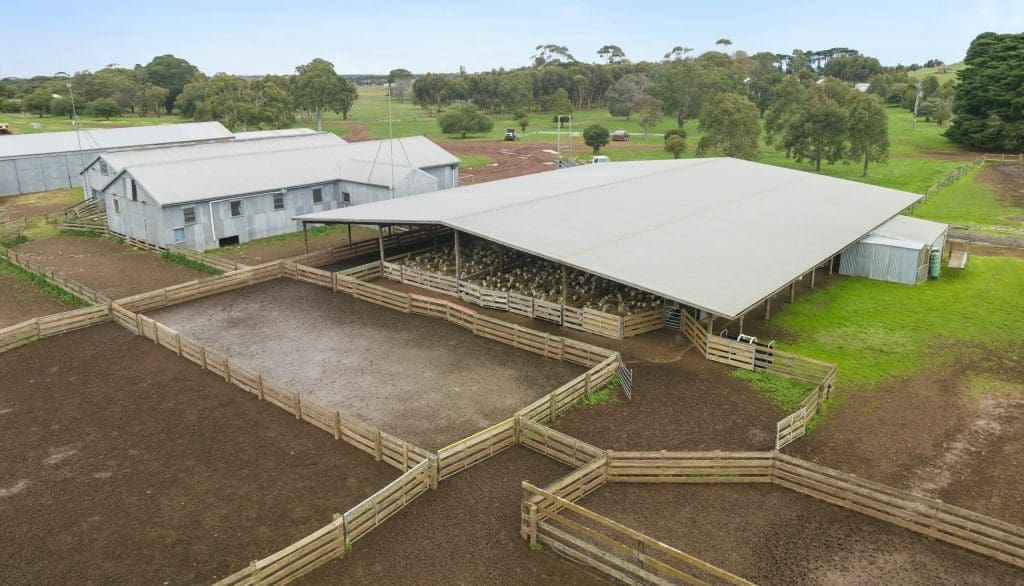
The 1516ha Winnidad neighbours the township of Mortlake, which means cattle can be walked to the adjoining Western Victoria Livestock Exchange (WVLX) saleyards.
The high rainfall asset that breeds and finishes sheep and cattle forms part of the larger Winnidad Aggregation spanning 2161ha which was offered to the market two years ago and remains available for sale.
The holding is watered by seven bores and 25 dams.
Infrastructure includes an historic four-bedroom home, two managers’ residences, sheep and cattle yards and multiple sheds. An extensive laneway system and underpass provides efficient stock movement.
The Winnidad Aggregation was settled in the early 1900s by the McDonald family and is now held by descendants, Sarah and James Law.
Ms Law said her great, great grandfather bought several paddocks along the railway line in Mortlake and added to them over the years.
“It is a beautiful part of the world and a difficult decision to sell. The land is versatile. It can run beef, dairy or sheep and four years ago the wind turbines became operational, providing another income.”
With a combined carrying capacity of 35,000 DSE, the aggregation is running 9000 joined composite ewes producing prime lambs, in addition to 700 cows, heifers and replacements.
Basalt derivative soils supported by consistent fertiliser application underpin the average annual stocking rate of 17DSE/ha.
The gently sloping land is highly suited to pasture improvement with potential for dryland cropping.
The Mortlake South Wind Farm leases three properties near Kolora, which host a combined total of 12 turbines. This includes the 392ha Glen Faye (nine turbines), the 170ha Lumsdens (two turbines) and the 83ha Conheady’s (one turbine).
LAWD agent Col Medway said the aggregation offered a rare opportunity to acquire a commercial-scale asset with diverse income options in the coveted Mortlake district.
“The enterprise will appeal to local businesses seeking to expand, international investors attracted by a large-scale grazing enterprise and those with a mandate to combine renewable energy with agriculture.”
Mr Medway said the ability to purchase whole or part of the Winnidad Aggregation presents an opportunity for all buyer types, with three of the properties benefitting from the secure income provided from the wind turbine rent.
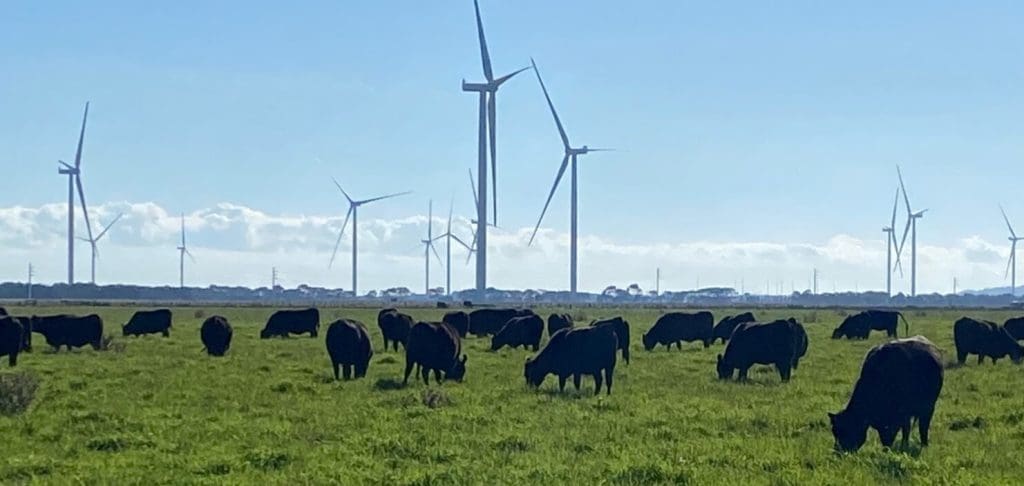
Cattle and wind turbines on Winnidad
$20m+ for Qld beef & irrigation operation
The Wagner family’s integrated beef production and irrigation farming enterprise on the Dawson River in Central Queensland has been listed for sale after failing to sell at auction.
Offers over $20 million are being sought for the 1800ha Boam Creek Aggregation, located 15km south of Theodore and 180km south-west of Rockhampton.
At auction, the 1076ha Acacia (which includes an 89ha special lease) was passed in at $11m and is now listed for $12m, while the 723ha Boam Creek was passed in at $7.75m and is now on the market for $8m.
Described as a drought-resilient grazing, irrigation and farming enterprise, it benefits from substantial water licences (by district standards) that underpin its irrigation areas and support consistent annual production.
Across the holding are 387ha of flood irrigation, 216ha under four centre pivots, 161ha of dryland cropping and 679ha of grazing country growing buffel, green panic and rhodes grasses.
If run entirely for grazing, the aggregation’s potential carrying capacity is around 1900 Adult Equivalents.
Water security
Acacia has 1699ML of high-flow allocation, along with 2263ML per annum from three unregulated bores.
Boam Creek has 3946ML of high-flow allocation and two bores pumping 1460ML per annum.
JLL Agribusiness director Geoff Warriner said the Boam Creek Aggregation was an extensively developed operation.
“As demand grows for properties with reliable water access, it offers investors either a turnkey standalone business or strategic integration opportunity for existing supply chains, delivering valuable protection against seasonal volatility.”
Mr Warriner said the property’s water security provides a significant competitive advantage.
“Substantial water allocations, well above district averages, ensure consistent production capacity regardless of seasonal variations.”
Infrastructure includes three homes, workers accommodation, two cattle yards, three feed pens, two sheds, two silos with 132 tonnes of capacity and two 1200-tonne silage pits.

Cattle on Boam Creek
SA’s Campbell House drops to $18m
Brad and Karin Fischer have put an $18 million price tag on their Coorong district opportunity in the renowned Upper South East region of South Australia.
The 1500ha Campbell House is 16km west of Meningie and 93km south of Murray Bridge.
It is situated in an area between Lake Albert and the Coorong, recognised under the Ramsar Convention as a wetland of international importance.
Campbell House is currently operated as a dairy and irrigation enterprise, however it is also suited to beef, wool and fodder production, cropping and vegetables.
Around 1359ha (91 percent) of the well-drained, sandy loam, clay and limestone soils are arable with 232ha under irrigation and 1127ha used for dryland cropping.
The canola, lupins, barley, oats, together with hay and silage production, support the 600 cow enterprise.
Water security is underpinned by 232ha of spray irrigation with eight remote controlled fibre optic-connected centre pivots and water sourced from the River Murray Prescribed Water Course – River Murray Irrigation Management Zone.
Infrastructure includes a 120-year-old five-bedroom stone homestead, a manager’s residence, a worker’s quarters, a stone cottage, a 50-unit rotary dairy, a compost barn, numerous sheds, five steel cattle yards and 520-tonnes of silo storage.
The sale of Campbell House is being handled by LAWD agents Nigel Gosse and Col Medway.
HAVE YOUR SAY