This week’s property review includes this wrap-up of interesting recent listings across King Island, Tasmania and Victoria, and separate articles on northern listings and recent sales of note.
- $23m+ for King Island cattle portfolio
- EOIs for Tasmania’s historic Woolnorth
- McBrides relaunch SA/Vic Telopea Downs aggregation
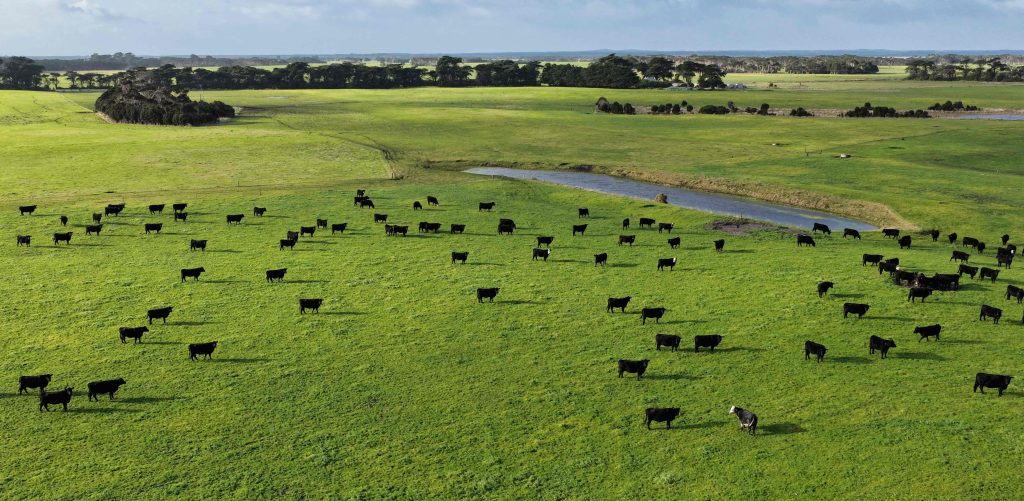
Angus cattle on the heavy-carrying King Island Portfolio
$23m+ for King Island cattle portfolio
A highly developed King Island beef portfolio held by the Sutton family for two generations has been listed for sale, with price expectations above $23 million.
Spanning 1214ha, the King Island Portfolio brings together four complementary grazing assets across the island’s northern and central districts – 394ha Darlot Downs, 478ha Summerfields, 242ha Millstone and 98ha Bokara.
The offering is underpinned by King Island’s extended pasture-growing season, reliable year-round grass production and established reputation for premium beef, dairy and agricultural produce.
Natural biosecurity advantages and low vermin pressure further support the production platform.
The Sutton family first entered the district in 1988 with the purchase of Millstone, before progressively expanding the portfolio and investing in water infrastructure, land development and operational improvements.
In 2012, brothers Alistair and Richard Sutton took over the properties assembled by their parents and continued building scale through neighbouring acquisitions.
Elders has been appointed to market the King Island Portfolio by expressions of interest, closing October 9.
Designed for breeding and steer finishing, the assets combine high-performing inland grazing country with semi-coastal and coastal holdings that provide seasonal flexibility and spelling capacity.
The properties are fully developed, with remotely monitored reticulated stock water systems, internal laneways and modern cattle-handling infrastructure supporting efficient livestock movement and management.
Launceston-based Elders agent Lochie Dornauf said the portfolio had been structured to operate as a larger-scale enterprise rather than four standalone holdings.
Darlot Downs and Summerfields form the core Egg Lagoon grazing platform at the northern end of the island, while nearby Millstone is linked to Summerfields by a 1.4km laneway.
“This northern grouping creates operational efficiency for stock movement, management oversight and seasonal use of complementary country. Bokara provides a separate central King Island holding with additional grazing capacity and infrastructure,” Mr Dornauf said.
Darlot Downs
At the northern Egg Lagoon production base, 394ha Darlot Downs serves as the portfolio’s breeder block. The holding features improved ryegrass and clover pastures, including white clover and sub-clover over sandy loam soils, supported by extensive ti-tree shelter belts. Infrastructure includes a three-bedroom home, cattle yards, a solar-equipped bore and a dam.
Summerfields
The 478ha Summerfields is the largest holding in the portfolio, combining highly productive Egg Lagoon grazing country with complementary semi-coastal and coastal grazing land, including 5.1km of exclusion fencing.
Its heavier grazing country includes peat soil areas with a high-water table beneath, helping support pasture growth through summer.
The coastal country provides seasonal spelling options and helps protect heavier inland paddocks during wetter periods. Pasture renovation has included kikuyu and fescue, with some phalaris.
Summerfields is watered by a bore and spring-fed dam and includes cattle yards.
Millstone
Located near Yambacoona, the 242ha Millstone is used as a feed and finishing block. It includes two distinct soil classes: heavy grazing land with traditional King Island sandy loams and semi-coastal grazing country formed from old dunes with sand-based soils.
Its semi-coastal soils, lucerne-based pasture and laneway connection to Summerfields make it a key part of the northern portfolio’s breeding, backgrounding and finishing flexibility.
Millstone grows 100ha of lucerne-based pasture, supported by fescue, chicory, clover and native grasses.
The property has a spring-fed water system, cattle yards and a shed.
Bokara
Near Loorana, the 98.5ha Bokara provides well-sheltered grazing country with grey sandy loams typical of inland King Island. The holding is mostly heavier grazing land, with limited semi-coastal country to the south. It is watered by dams and supported by modern cattle-handling facilities.
EOIs for Tasmania’s historic Woolnorth
Expressions of interest are being sought for part of one of Tasmania’s most significant rural holdings, on the state’s rugged far north-west coast.
The 1537ha Woolnorth Homestead Title has been carved off the broader Woolnorth aggregation, which was offered to the market in 2024 by Chinese businessman Xianfeng Lu.
The productive holding combines rolling hills with fertile lower country, where extensively renovated pastures of ryegrass, white clover and cocksfoot support cattle and sheep enterprises. It is being offered with a carrying capacity of 2500 cattle.
Located in a high rainfall district, the property is also supported by water from a bore and natural spring.
Infrastructure includes an elevated western red cedar home designed to capture coastal views, six additional residences, staff accommodation, a 13-stand shearing shed, shearers’ quarters, numerous sheds and three dwellings dating from the early 1800s.
Nutrien Harcourts agent Tony Maguire said the landmark property offers a rare link to Tasmania’s pastoral heritage, as well as significant farming, tourism and investment opportunities.
Woolnorth also offers potential for renewable energy development.
In recent years, three portions of Woolnorth have sold:
- The TRT Pastoral Group, owned by Melbourne businessman Tim Roberts-Thomson, paid more than $150m for 6769ha.
- Melbourne-based fund manager Prime Value paid $16.5m for the 713ha Robins Dairy.
- Victorian farmers Harper and Oonagh Kilpatrick secured the 717ha Denium Dairy Farm (on the eastern border of Woolnorth) for $13.8m.
The remaining land, valued at around $150m, is available as a whole or in separate parcels. It includes seven rotary dairies spanning 3496ha, 2677ha of grazing land, around 2000ha of native bushland and 10,371ML of water entitlements.
If converted back to grazing, the breeding and finishing country could run about 6000 breeders.
History
Established by a group of London merchants in 1825, the Van Diemen’s Land Company ran sheep and cattle for 170 years and became a major producer of wool and beef.
From the 1960s to the 1990s, the property ran up to 40,000 sheep and more than 2000 Hereford breeders, while also producing poppies, barley and potatoes.
In 1993, it was sold to New Zealand publicly listed Tasman Agriculture Limited, which converted large areas into dairy country, including eight rotary dairies that have milked up to 8593 cows.
In 2008, Woolnorth was taken over by Taranaki Investment Management Limited, the investment arm of New Zealand’s New Plymouth District Council.
In 2015, the asset, then carrying about 18,000 cows, was listed for sale.
The following year, it was controversially sold for $280m to Mr Lu’s Moon Lake Investments, which outbid TasFoods’ $250m offer at the 11th hour.
Foreign Investment Review Board approval was later granted, subject to Moon Lake undertaking several investment projects on the VDL farms.
Since the 2016 purchase, the Van Diemen’s Land Company has faced a series of problems. While it delivered on some commitments, many undertakings were not fulfilled.
Since its formation in 1825, the Van Diemen’s Land business has been owned by British, New Zealand and Chinese interests – but never by Australians.
McBrides relaunch SA/Vic Telopea Downs aggregation
After a year without a sale, a renewed marketing campaign has been initiated for Victoria’s largest grazing and cropping aggregation, owned by the sixth-generation family-owned company AJ & PA McBride.
Located on the Victorian/South Australian border, Telopea Downs spans 47,660ha across 11 adjoining properties – 10 in Victoria and one in South Australia, midway between the towns of Bordertown and Kaniva.
Telopea Downs was purchased by the McBrides, one of the country’s largest wool producers, in August 2018 from Qatar-owned Hassad Australia for more than $70 million – in what was seen at the time as the largest single farm transaction in Victorian history.
Originally comprising ten properties spanning 40,454ha across western Victoria, Telopea was purchased by Hassad in April 2012 for more than $35m. During its ownership, the company added more than 7000ha to the aggregation which it primarily used as a sheep breeding hub.
With a long-term carrying capacity of more than 100,000 DSE, the holding is currently carrying around 85,000 Merino and crossbred sheep and more than 1100 cattle.
According to the McBrides’ website, the family has been running a Merino flock with some crossbred influence, a beef herd and a large fodder and commercial cropping enterprise growing wheat, barley, lupins, beans and canola.
Since the beginning of 2023, Telopea Downs has been the home of the McBride Angus beef stud which provides bulls for the company’s commercial herds.
The Colliers Agribusiness transactions team has been appointed to handle the international expressions of interest sale process of Telopea Downs.
National director Jesse Manuel said the significant farming operation has benefited from the past and present owners’ continued land and pasture improvement program.
“Telopea Downs has in excess of 27,000ha of clay improved country supporting established renovated pastures and a large-scale cropping program.”
“In addition to the renovated pastures, a targeted fertiliser program together with water infrastructure improvements and upgrading or replacing fencing have enhanced the carrying capacity of Telopea Downs,” Mr Manuel said.
His counterpart Tim Altschwager said Telopea Downs was centrally located, offering proximity to a significant catchment area for the sourcing of stock.
“With a temperate climate, moderate rainfall and irrigation capabilities, the property would add tremendous value to a range of supply chain operations from a breeding or backgrounding perspective.”
Telopea Downs boasts substantial water entitlements totalling 2325ML for irrigation, and more than 300ha of centre pivot development for fodder production to support the livestock enterprise or alternative income streams through seed or horticultural crop production.
The holding is watered by 50 bores.
HAVE YOUR SAY