
A REPORT issued last week by the United States Congress provides an opportunity to compare the extent and nature of foreign-owned agricultural land in the US with that in Australia.
Comparing the US Congress report compiled by the US Department of Agriculture, and an equivalent report compiled earlier this year by the Australian Taxation Office, it shows that about 3.6 percent of US agricultural land is foreign owned (either outright, or partially). In Australia, the figure is more than three-and-a-half times higher, at 13pc.
The most recent US data relates to the calendar year ended December 2024, while Australian statistics are six months later (year ending 30 June 2025).
Worth noting, however, the two reports do not exactly overlay, with the USDA version measuring ownership levels down to 10pc of a farm asset’s value, while Australia reports down to 25pc. The US model measures down to 10 acres (4.4ha) in size, while Australia’s is not size-limited.
The USDA report (click here to access) says foreign persons or entities held interests in more 47 million acres (21m ha, or 213,000sq km) of US agricultural land in late 2024, which accounted for 3.6pc of the nation’s total privately owned agricultural land. The report covers both foreign-owned and US subsidiary-owned US farmland.
Largest foreign land owners in the US included Canada (7.3m ha), the Netherlands (2.13m ha), Germany (1.27m ha) Italy (1.22m) and the United Kingdom (1.22m), collectively totalling 13.18m ha. Other countries accounted for a further 7m ha, with the top five accounting for 61pc of all foreign-owned US farmland acres. USDA reported that “Chinese-primary investor filers” accounted for about 0.5pc of foreign holdings.
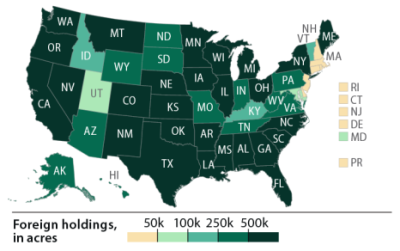 Foreign investment in and ownership of US agricultural land occurs in all US states (see graphic). The states with the most foreign-owned agricultural acreage at the end of 2024 were Texas (2.68m ha), Maine (1.6m ha), Colorado (1.1m), Alabama (1m), and Oklahoma (0.9m ha).
The USDA report said that from 2017 to 2024, foreign holdings of US agricultural land increased an average of 1.1 million hectares annually.
Australian comparison
In comparison, Australia’s most recent foreign ownership of agricultural land report for the period ending 30 June last year, compiled by the Australian Taxation Office, suggests foreign ownership (either outright, majority owned or at least 25pc minority owned) was 50,262,000ha. That represents 13pc of the nation’s total agricultural land area of 387,000,000 ha (3,870,000 sq km).
Last year’s foreign owned portion of Australian ag land was up 1.14m ha on the 2024 year (+2.3pc) – not dissimilar to expansion reported in the US – and 5.6pc higher than the 2023 year.
The source of foreign investment in Australia contrasts significantly with that seen in the US.
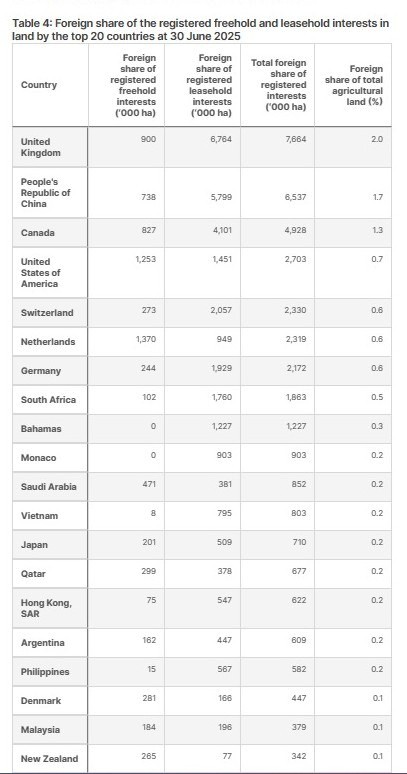
The top five Australian sources ranked by total land area and percentage of overall ag land were:
- United Kingdom (76,640sq km, 2pc)
- People’s Republic of China 65,370 sq km, 1.7pc)
- Canada (49,280sq km, 1.3pc)
- United States (27,030sq km, 0.7pc), and
- Switzerland (23,300sq km, 0.6pc)
The total list of foreign owners or part-owners represents 73 countries, with other large entities including the tax haven of the Bahamas (12,270sq km), South Africa (18,630sq km, principally made up by the Langehoven family), Germany (21,720sq km) and the Netherlands (23,190sq km.) See table at base of page.
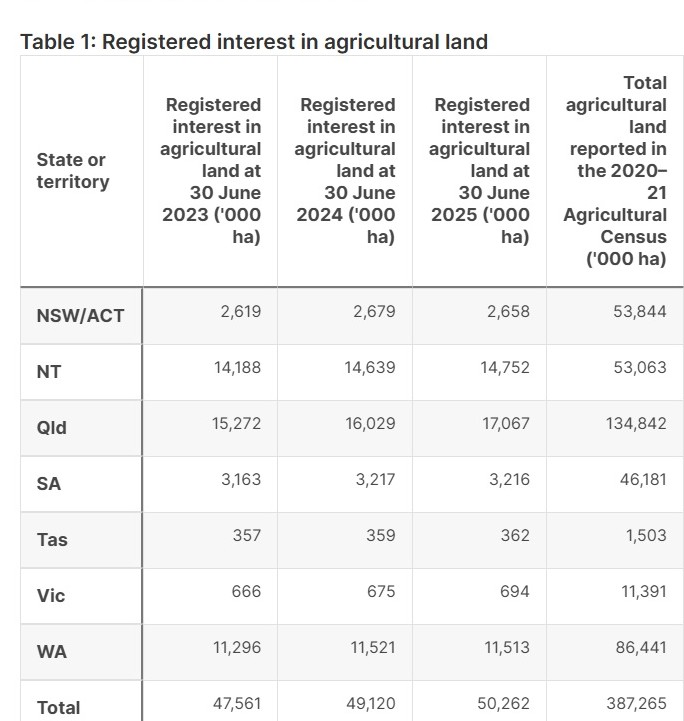
Click on table for a larger view
About 81pc of the foreign owned or partially owned Australian ag land was held under Leasehold tenure, with just 19pc as Freehold.
Less productive, large-scale extensive grazing land dominated the list, with Queensland, the Northern Territory and northern WA providing the overwhelming majority of land area held by foreign interests.
In Queensland, 86pc of the 17,067,000 ha (170,670sq km) of total farm land held by foreign interests was devoted to livestock. In the NT, 97pc of the total foreign owned ag land area of 147,520sq km, was devoted to livestock grazing, and in WA’s total foreign-owned ag land area of 115,130 sq km, 88pc was livestock grazing. Nationally, ‘livestock’ accounted for 437,420sq km or 87pc of the total foreign owned land area devoted to agriculture.
The largest proportion of foreign owned ag land is held in Tasmania, where foreign interests hold 24.1pc or 357,000ha of ag land, and the NT – 27.8pc of 530,630sq km.
US Congress raises concerns
Some members of the US Congress have expressed concerns relating to national security about investments in US agricultural land by foreign adversaries, (eg, the People’s Republic of China), particularly investments near sensitive military sites.
Some of those concerns are being addressed by various bills, some of which propose to amend the Agricultural Foreign Investment Disclosure Act or restrict foreign investment in US agricultural land.
 Current US federal law imposes no restrictions on the amount of private US agricultural land that can be foreign-owned. However, the Agricultural Foreign Investment Declaration Act requires foreign persons who acquire or transfer interest in agricultural land to submit a report to USDA within 90 days of the transaction. Persons who fail to report are subject to civil penalty.
A 2024 Government Accountability Office report identified gaps among AFIDA data collection and information. The report was initiated by some Congress members identifying foreign investments near US military bases and purchases that could lead to foreign control of supply chains.
In June this year, USDA released a proposed rule to amend the AFIDA regulations. The rule proposes changes to define agricultural land to include land used for animal slaughtering (ie meat processing) and solar and wind electric power generation; a requirement to include digital, open-source geospatial maps and property boundaries and a legal description of the land in reporting; and amendments to civil penalties based on transaction and whether the foreign person is associated with a foreign adversary.
Some US states and local authorities have introduced their own proposals or enacted laws to restrict foreign ownership of agricultural land, although according to researchers at the National Agricultural Law Centre, no US state has instituted an absolute prohibition on all foreign ownership. Some require reporting similar to what is required under the US Congress, but there is no uniform approach across such legislation.
For example, some local laws restrict the amount of land that can be owned by foreign persons or the duration of ownership, and some differ in their definition of agricultural land.
Some US states limit or have proposed to prohibit certain foreign persons and entities from acquiring or owning an interest in agricultural land within their state. For example, the Commonwealth of Virginia prohibits ‘foreign adversaries’ from owning agricultural land within the state. Several states also have separate disclosure requirements that resemble those under AFIDA.
USDA has also identified that some local counties also have prohibitions on foreign ownership of agricultural land and other non-agricultural real estate.
US Congress, the executive branch, and state and local governments continue to deliberate on foreign ownership of US agricultural land and whether to amend related laws, the USDA report said.
Trump’s Farm Security Action Plan
In late 2025, the Trump Administration released its National Farm Security Action Plan, laying out the Administration’s plans to work alongside other agencies and state, local, tribal, and territorial governments on potential national security issues in agriculture.
Among the stated goals was “to secure and protect American farmland.” In the plan, the Administration identified that farmland owned by foreign nationals, particularly those from “countries of concern or other foreign adversaries,” was a “potential threat to national security and future economic prosperity.”
The plan states that the Administration will implement AFIDA reforms, work with Congress and state governments to pass legislation impacting foreign land ownership, sign an MOU with the US Treasury to ensure coordination on certain transactions relating to agriculture and farmland, and launch a database for the submission of potential violations of AFIDA regulations.
HAVE YOUR SAY