
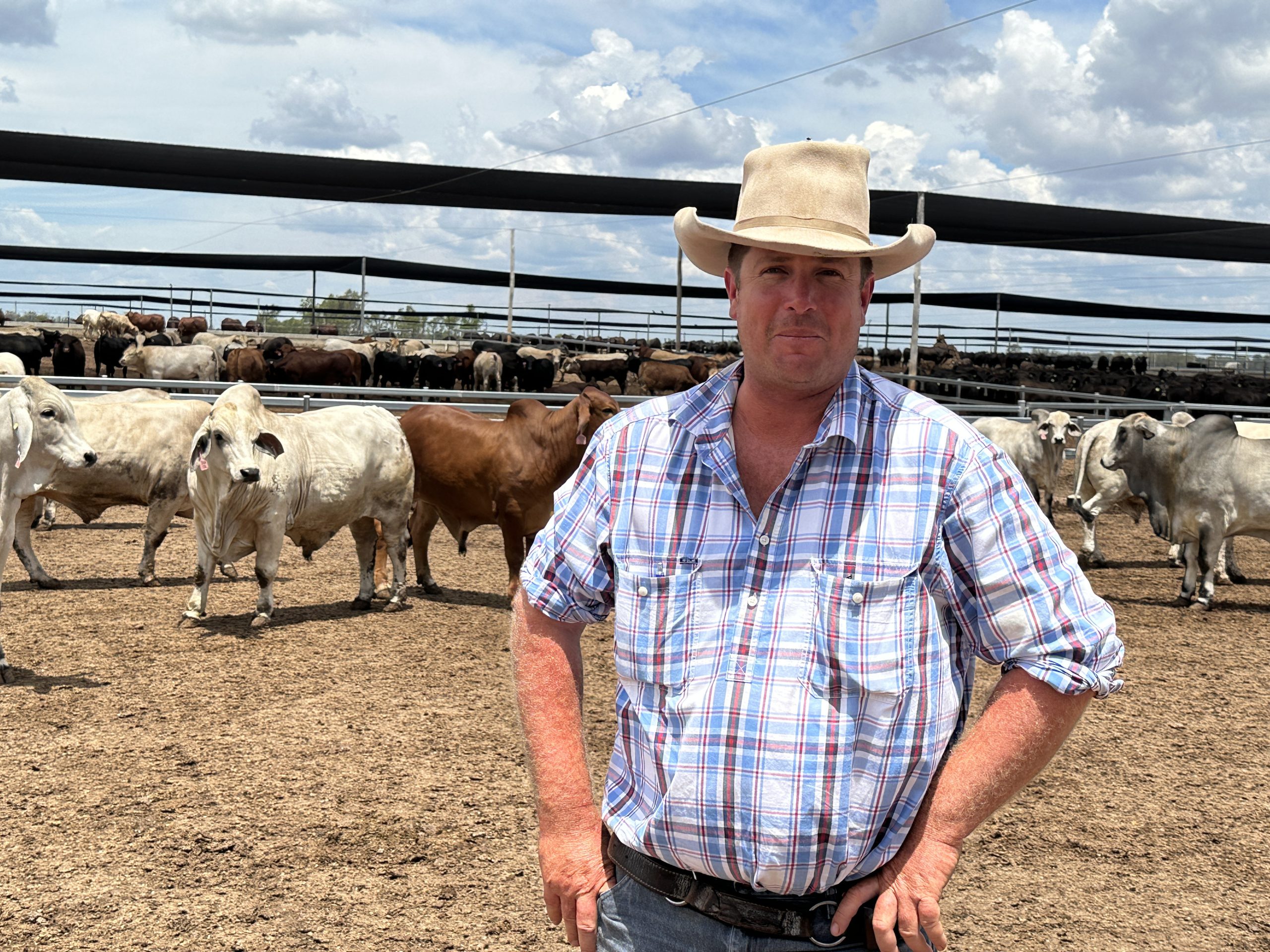
Sandy McCartney from Bucca Pastoral.
IT may seem like a small change to the management of cattle herd, but one successful Queensland producer says bunk training has been a “gamechanger” to his cattle’s performance.
Bundaberg producers Sandy and Jamie-Leigh McCartney were one of two big winners at the recent Australian Brahman Breeders Association steer trial and carcase competition – winning first and second in the HGP treated section and coming second in the HGP-free section.
The other big winners were Scott and Lizette McCamley from Playfields who won the HGP-free section and the individual steer,
Run by Sandy and Jamie-Leigh McCartney, Bucca Partnership has become a showcase of the Brahman breed in recent years for its focus on accessing high value markets while keeping a straight Brahman herd.
The family joins about 1100 Brahman cows and buys steers and heifers for trading near Bundaberg in the wide bay area of Queensland – a high rainfall area with a high parasite burden. They also have some improved country which they cut for silage.
The silage is used to bunk train the weaners, which Mr McCartney said has been a gamechanger.
“I think weaners that are bunk trained have a 10-15kg (dressed weight) advantage because they go straight in the trough and eat straight away,” he said.
“It has been a gamechanger for putting cattle on feed in dry times where we can’t finish our cattle or we have too many in the paddock and we have to lighten off.”
Feed efficiency a strong point of the Brahman breed
The Australian Brahman Breeders Association has been keen to promote the weight gain results of the competition, with the highest weight gain out of the 430 steers being 2.85kg and the 2.5kg for no-HGP section.
Mr McCartney said the main thing the competition has shown is that Brahman cattle can be profitable to feed.
“The feed efficiency of the Brahmans is something that can’t be ignored in the feedlot. They might not put on 2.5kg/day like an Angus, but if they are eating 15pc less food you are in front,” he said.
Huge industry benefit to bunk training
Mr McCartney said the bunk training helped tap into that feed efficiency.
“Before we were bunk training weaners with silage, it wasn’t great because we were getting a few non-eaters,” he said.
“That is probably a reason why some Brahmans are getting discounted because Brahmans they are sensitive to noise and a new environment. But since we have been bunk training we have had no issues.”
Mr McCartney said he believed more wide adoption of bunk training could have significant economic benefits for the industry.
“On our last grid at $8.60/kg dressed weight, you add an extra 10kg to your carcase and you are talking about an $86/head,” he said.
“There is a cost to doing it, especially when you have to buy in feed, you are looking at $2/kg cost of gain on a little weaner. But while you are doing it, you are putting an extra 40kg on your weaners and you have the added benefits of improving rumen development and things like that.
“If you look at it from an industry perspective there is some serious money that can come back to producers.”
Matching markets to land conditions
With the high parasite burden, the McCartney have decided to stick a high-grade Brahman herd and tap into the higher value markets that are available for their types of cattle.
They are European Union accredited, selling a portion of their steers as bullocks in Teys grasslands program and others as feeder steers.
“The EU job has had an 80c premium at times and I think the Brahmans fit the EU job really well,” he said.
“They have to over 5mm over fat and a Brahman has no trouble doing that off grass.”
Surplus heifers are sold preg tested in calf at the Australian Brahman Breeders Association’s Woolooga Commercial Brahman Female Show and Sale – which was held in June.
“I have a background in artificial breeding with IVF, embryo transfer and AI. And I had access to some new genetics from the United States, some other Australian bulls and we breed a few bulls ourselves,” he said.
“I can’t sell enough Brahman females and I don’t get discounted by selling my bullocks into the EU market, so I am in front by selling a straight Brahman. I figured while everyone is getting out of them, I will produce the Brahman to sell to people who want to crossbreed.”
Keeping costs down
Mr McCartney said he had experimented with crossbreeding using Angus bulls recently, however, the cost of managing parasites outweighed the premiums he could access.
“I soon learned of things like pinkeye with black weaners getting cloudy eyes, I had never seen that before.
“We get ticks on our Brahman cows, but with the ticks you get on those crossbred cows I reckon that what I was spending in dipping and extra mustering was taking away all of my gains.
“We only treat our Brahman cattle once a year and some of our breeders don’t get treated at all.”
HAVE YOUR SAY