
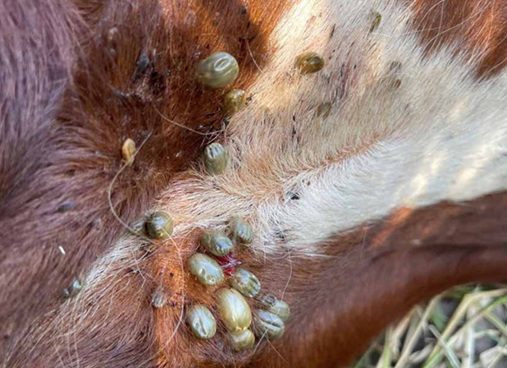
Typical appearance of cattle ticks (Source: NSW DPIRD)
NEW South Wales cattle producers have told Beef Central they are concerned by the growing number of cattle dying from tick fever and are calling for government ‘boots on the ground’ to help eradicate the increase in infestations.
The NSW Department of Primary Industries and Regional Development (DPIRD) said in a written statement there had been 285 cattle tick infestations reported and 54 cattle deaths this financial year.
But industry participants have told Beef Central cattle deaths are in the hundreds in the north-east of the state.
“The number of infected properties is on a dramatic rise and associated with that is the number of cattle deaths from tick fever,” Craig Huf, Chair of Far North Coast Branch of the NSW Farmers Association said.
“We are starting to see the numbers climb in the DPIRD figures, but we also wonder how many more there are that aren’t being reported which is always a concern.”
A report by NSW’s Independent Biosecurity Commissioner earlier this year stated as of 24 February 2026, there were over 580 properties in NSW known to be infested with cattle tick.
“Historically, there were five to six cases of tick fever each year, with increased outbreaks in recent years,” the report stated.
Mr Huf said his branch had been pushing for more government intervention to help stop the spread of cattle ticks for the last four years.
“Escalations in outbreaks and tick fever deaths almost directly correlate with the reduction of staff in the DPIRD and it was good to see that highlighted in the Independent Biosecurity Commissioner’s report earlier this year,” he said.
In March Dr Katherine Clift, the NSW Independent Biosecurity Commissioner, handed down her advice on how the NSW Government could improve its cattle tick program after 12 months of investigation and consultation.
The report highlighted a significant area of stakeholder concern related to the reduction in resources for the program.
“Many stakeholders consulted during the development of this report cite recollections of ‘tickies’ (Department field officers) being a dedicated resource to assist and support stock owners with treatment regimes or ride horseback to monitor for cattle tick,” the report stated.
“Despite year-to-year fluctuations, staffing levels have reduced markedly, with the number of positions decreasing from 73 in FY 2020-2021 to 33 (equates to 20.4 full time equivalent) in the 2024-2025 financial year.
“Currently there are 26 staff, of which 17 are field staff and the remainder non-field staff.
“In line with this reduction in staff, and over the same period, total actual expenditure declined by approximately 20 per cent from $5.74 million in 2019-2020 to $4.66 million in 2024-2025.”
The report showed the number of infested properties had more than doubled since December 2023 from 218 to over 580 (March 2026).
“This increase in demand has not been matched by additional funding or staffing, requiring the Program to implement a range of mitigation measures, including ceasing some activities, such as inspection of adjoining properties for cattle tick and in person visits for induction into the Owner Treatment Scheme (OTS),” the report outlined.
“Decisions were also made to change established program practices, including allowing a ‘bulk’ release of backlogged properties and ‘bulk’ notification of hundreds of adjoining properties; some up to 12 months post the original detection.”
Eradication still the preferred option in NSW
Given the current status of cattle tick in NSW, the report considered a range of alternative options to the current Program, including:
- Option 1: Deregulation of cattle tick management obligations in NSW.
- Option 2: Program objective transitions to containment by implementing cattle tick infested and free areas within NSW.
- Option 3: Eradication continues to remain the Program objective
The report identified eradication remains the preferred option that would deliver the greatest benefit to NSW.
“This option is the only approach that fully aligns with the current objective of protecting NSW from the risks and impacts of cattle tick and delivers the strongest outcomes across animal health and welfare and economic benefit,” the report stated.
“Compared with deregulation or zoning it:
- avoids irreversible loss of NSW’s cattle tick ‘free’ status
- prevents progressive geographic spread
- avoids escalating long-term costs to industry and government
- minimises animal health and welfare impacts
- reduces compliance costs for interstate and overseas market access, and
- meets stakeholder expectations for preventing cattle tick and tick fever in NSW.
“While eradication requires sustained investment, strong governance and ongoing vigilance, the long-term benefits substantially outweigh the costs.
“With strengthened resourcing, governance, performance management and stakeholder engagement, eradication remains technically achievable, economically compelling and socially supported.”
Following the release of the report, NSW Minister for Agriculture Tara Moriarty committed to eradication and delivering the first Cattle Tick Eradication Action Plan by the end of September, along with committing to implement all 14 recommendations from the report.
Eradication commitment welcomed
NSW Farmers Biosecurity Committee chair Tony Hegarty welcomed the government’s commitment to eradication and the focus on strengthening technical capability and collaboration.
“We welcome the clear shift back to eradication rather than long-term management. Producers have been calling for a program that is properly set up and resourced to stop cattle tick crossing the border and threatening livelihoods,” he said.
“We also welcome the commitment to strengthen resourcing through DPIRD and Local Land Services, and to ensure the program has strong veterinary oversight and capability.
“Importantly, the government has committed to developing the new tick plan in collaboration with stakeholders. We look forward to ensuring producers’ voices are a critical input into that plan – because the settings have to work in the real world, not just on paper.”
Mr Huf said a re-commitment to eradication was desperately needed to reassure producers in his area who had lost hope that eradication was possible.
“Some of our members have been doing the right thing and dealing with their ticks, getting 100pc musters, treating every 21 days, only then to be reinfested because the compliance officer numbers in the DPIRD are not to the level they need to be,” Mr Huf said.
“We need boots on the ground to do traceability work and compliance officers looking at neighbouring properties to get infestations controlled and managed, but compliance has to come from the Government.
“Cattle producers don’t mind dealing with the treatment of the ticks, but when they go through a 12-month program only to be reinfested because nothing has happened with the neighbours, that’s when it gets ugly and extremely debilitating.
“You cannot have biosecurity success without government involvement.”
Stock owners have an obligation to notify the NSW Cattle Tick Program within one business day of becoming aware of cattle tick, according to the NSW DPIRD.
The NSW Independent Biosecurity Commissioner’s advice paper to the NSW Government included 14 recommendations, which are detailed below.
Mr Huf said his branch supported all of the recommendations except 13, which suggested a levy be investigated for some cost recovery.
“To me any biosecurity incursion where industry has to foot the bill is penalising the victim,” Mr Huf said.
“If the Government properly funds and staff’s the tick program now, to get right on top of it, it will save them goodness knows how much in the future.”
In April, the NSW Government announced it is investing $7 million to rebuild the Cattle Tick Program.
Recommendations from NSW Independent Biosecurity Commissioner
- DPIRD should continue to lead the NSW Cattle Tick Program and realign responsibility for program activities within areas of DPIRD and LLS that best support effective delivery. This includes policy, technical expertise, extension and education, on-farm surveillance and treatment activities relating to cattle tick and tick fever, activities at saleyards and abattoirs, compliance and enforcement functions, and management of cattle tick dip sites. Overall Program accountability should be transferred to Animal Biosecurity under the Chief Veterinary Officer (CVO), consistent with the Program’s core objective relating to cattle health.
- DPIRD should by 30 June 2026 establish a technical advisory committee drawing on relevant expertise from within the organisation including LLS and, where required, external specialists, to provide independent technical advice and direction to the Program. The committee should be responsible for supporting development of the NSW Cattle Tick Plan and its ongoing review.
- In collaboration with the Cattle Tick Consultative Committee (CTCC) and key stakeholders, DPIRD with input from LLS should by 30 September 2026 develop and publish a NSW Cattle Tick Plan (the Plan). The Plan should be aligned with existing biosecurity response frameworks and clearly articulate program objectives, outcomes, strategies, performance measures and escalation thresholds.
- DPIRD with input from LLS establish a coherent, interoperable information management framework to ensure quality, consistency and accessibility for decision making, reporting, monitoring, evaluation and continuous improvement of the NSW Cattle Tick Program. This should include formal integration with key external sources of information (e.g. NLIS), accelerated transition to a single data capture and management method (e.g. MAX), and integration of software platforms to deliver a single source of truth for analytics and reporting.
- DPIRD consider the most appropriate regulatory tools (including use of General Biosecurity Directions, Control Orders and Biosecurity Zones) that are appropriately aligned with the NSW Cattle Tick Plan, including the associated compliance measures required.
- DPIRD with input from LLS review and update NSW Cattle Tick Program stakeholder management and Communication and Engagement Plans by 30 November 2026 to support effective delivery of the NSW Cattle Tick Plan. This should include refreshing the purpose and membership of the Cattle Tick Consultative Committee and establishing local partnerships in the Northern Rivers region with key stakeholders, including the cattle and equine industries, veterinarians, local councils and small-scale landholders.
- DPIRD with input from LLS improve transparency of biosecurity risk information by making information on cattle tick infested and tick fever infected property status publicly available by 30 June 2026, to better inform producers, neighbouring landholders and other relevant stakeholders.
- NSW Government ensure an appropriate level of resources for service delivery of each component of the NSW Cattle Tick Program to fulfill the program objectives and outcomes of the NSW Cattle Tick Plan, including additional resourcing when required due to seasonal peaks or other significant increases in activities.
- DPIRD with input from LLS establish formal interagency arrangements with Crown Lands and the NSW Environment Protection Authority (EPA) to support coordinated management of legacy cattle dip sites associated with the NSW Cattle Tick Program.
- DPIRD with input from the technical advisory committee, identify and prioritise research needs for the NSW Cattle Tick Plan aligned with the DPIRD Research, Development and Extension Strategy and pursue partnerships with industry and other jurisdictions to advance research, particularly control and management methods.
- NSW Government continue to pursue eradication of cattle tick in NSW as a feasible long-term objective, noting that low-level infestations will continue to occur in the Northern Rivers region. Ongoing border controls will therefore be required to prevent the spread of cattle tick from cattle tick infested areas into NSW, alongside sustained effort within NSW to detect and eradicate infestations and prevent further spread.
- The Department of Primary Industries and Regional Development (DPIRD) with input from Local Land Services (LLS) conduct an interim review of the Program after 3 years, followed by a comprehensive review after 6 years, to assess progress toward eradication, determine whether eradication remains feasible and identify any further changes required.
- DPIRD and LLS investigate new funding and delivery models for application within the Program, including the use of a broad-based levy across NSW cattle producers (beef and dairy) and introduction of cost recovery for selected program activities, factoring in risk-creators, beneficiaries and third party-arrangements for activities as appropriate.
- DPIRD directly engage national biosecurity frameworks and other jurisdictions to advocate for a national approach to cattle tick and tick fever management, including establishing and funding research priorities, management of chemical resistance, alignment of strategies and to address emerging issues.
The full report can be found here.