

Max Shelton
Author Dr Max Shelton enjoyed a 40-year career at The University of Queensland. He is the author / editor of multiple research papers and books on all aspects of the establishment and management of leucaena for beef production in Australia. With colleague Dr Scott Dalzell, he conducted ablot 30 courses on leucaena production for more than 600 graziers, research & extension workers, pastoral companies & consultants. In 2022, he was awarded the AW Howard Award for contribution to pasture research and development in Australia and overseas.
I RECENTLY travelled 1400km through Central Queensland to assess the establishment and management of leucaena and to identify key issues affecting the browse legume’s use.
My visit focused on four main questions:
- Are graziers realising the significant productivity benefits that leucaena can provide?
- Is adoption of the innovation meeting expectations?
- What challenges are graziers facing, and what management innovations are they using to address them?
- To what extent has leucaena spread beyond established plantings as a weed?
I visited a number of properties, had discussions with graziers and DPI officers, producing the following observations.
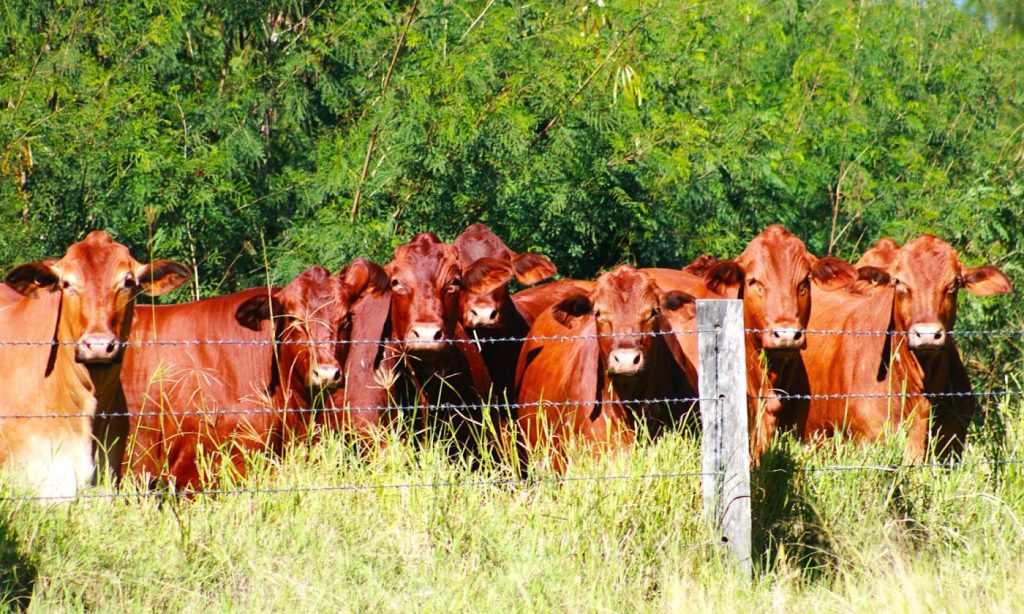
Overview
Leucaena is a plant that inspires passion.
Positive passion: Among those graziers who have planted and grazed leucaena, there was unanimous agreement that it provided major production benefits when grown on suitable soils and managed effectively.
Producers reported productivity increases ranging from two to four-fold, compared to unimproved grass alone, due to increased carrying capacity, liveweight gain, and shorter finishing times to achieve market specifications.
Producers commented that leucaena extended the productive grazing season beyond that achievable with grass alone. Its longevity, once established, meant that establishment costs were amortised over 30-40 year production life.
One stand, originally established in 1978, continues to provide valuable production nearly five decades later.
Leucaena was used across a wide range of enterprises including backgrounding for feedlots and heifers for breeding, stud cattle production, and finishing operations. Planting leucaena was found to be more economical option to intensify an enterprise than the alternative of purchasing additional property.
Negative passion: To others, notably Central and Northern Queensland Shire Councils, leucaena is a weed that is spreading and needs to be controlled.
Leucaena infestations in coastal and riparian locations have historical origins with seed probably originating from Papua New Guinea. However, further inland where extensive areas of improved varieties of leucaena have been planted, there was spread between rows of leucaena and from paddocks to adjacent roadsides where there was no grazing to afford control.
Adoption
It is hard to estimate the total area of leucaena planted in Queensland. The properties visited represented a substantial area of leucaena across central and south-east Queensland, ranging from about 100ha on newer enterprises to more than 4500ha on long-established operations.
Several producers were continuing to expand their plantings, while others considered their current area sufficient and were focusing on managing existing stands. Nevertheless, total grazed area remains well below estimated potential.
Discussions with seed companies indicated yearly sales of up to ten tonnes of leucaena seed – mostly Cunningham and Wondergraze varieties, depending on season. In addition, there would be small amounts of seed harvested for personal use.
Several barriers to wider adoption were identified.
- Leucaena systems require intensive management, not only during the establishment phase but through the decades-long life of a leucaena pasture.
- A significant barrier was the high establishment cost, combined with the delay before full production is achieved. Many producers considered the two-year establishment period a deterrent, particularly during periods of financial uncertainty.
- Many graziers lacked the farming skills, equipment and experience required for successful establishment. Leucaena is not a “plant and forget” feed source.
- Concerns regarding weediness and potential spread continue to discourage some graziers from adopting the technology.
- Cultural and behavioural factors have influenced adoption. Older graziers may be more reluctant to plunge into a long-term intensive labour and management pasture.
- Properties with mixed cattle and cropping enterprises were able to plant leucaena following a winter crop as an effective entry point; conversely, properties without this capability faced lower establishment success.
A variety of extension approaches have worked in the past. These include short courses, producer field days based on successful demonstrations, media articles, increased interaction between Government and University personnel and producers to enhance learning, and production of explanatory manuals and fact sheets outlining best practices.
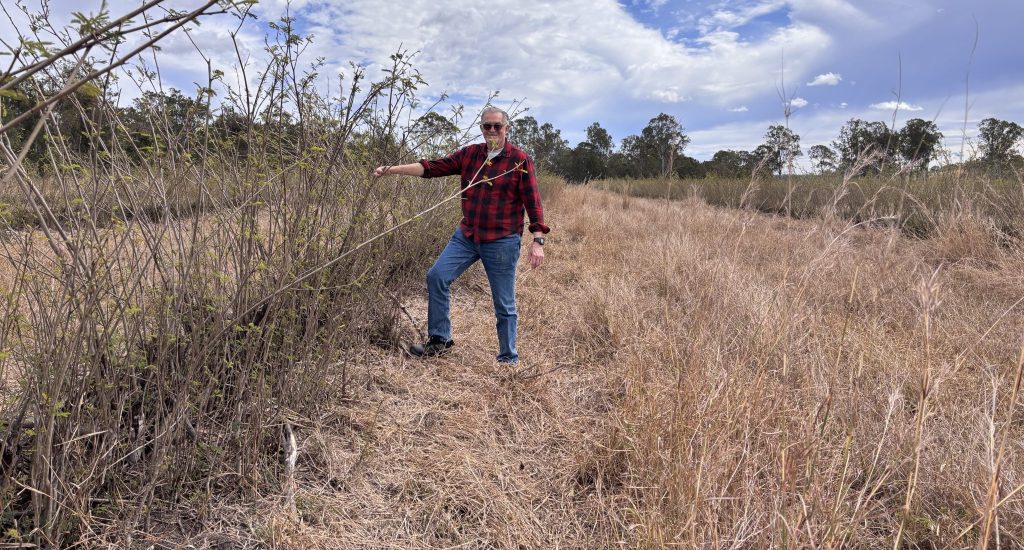
While showing the effects of winter, this well-grazed leucaena north of Calliope carries green shoots that keep animals in good condition
Establishment and management practices
There are well understood guidelines and procedures for establishment and management.
Unsurprisingly, many graziers have made innovations to address challenges such as control of excess height growth and managing grass cover due to the vigorous growth of leucaena.
Establishment
Successful establishment was consistently described as the most critical stage in developing a productive leucaena pasture. Growers emphasised that leucaena establishment required farming skills and associated planting / cultivating equipment, attention to detail and patience, with full production often taking two years or more to achieve.
Site selection was considered particularly important. Deep, fertile soils produced the best results, while heavy clay soils with restricted root penetration limited productivity and persistence.
Frost-prone creek flats were considered suitable for the Tarramba cultivar as its tall habit is controlled by winter frost and it recovers rapidly in spring. Otherwise, Cunningham and Wondergraze were the preferred cultivars.
Uptake of Redlands has so far been limited due to lack of seed and lack of promotion. The potential of this cultivar for improving productivity of poor coastal zone native grass pastures is huge.
Full cultivation and seed bed preparation was more successful than plantings into cultivated strips in existing grass paddocks due to improved moisture available to young leucaena seedlings.
One grazier achieved success by planting into raised beds to prevent water logging on low-lying land and to capture moisture on sloping land. An additional advantage was improved growth due to the deeper topsoil in the raised beds.
Row spacing and importance of grass inter-rows
Row spacing generated some of the most diverse opinions among producers, reflecting differences in environments, management systems and production objectives.
Most properties used row spacings of around 8-10 metres, although some growers were considering wider spacings of up to 15 metres. The key issue underpinning these decisions was the importance of maintaining productive grass between the leucaena rows.
Producers observed that cattle frequently grazed available grass before fully utilising the leucaena and that inadequate grass production limited overall carrying capacity.
One grower reported that, even with 10m row spacings, cattle depleted the grass before exhausting available leucaena forage. As a result, wider row spacings are being considered to maintain productive grass cover.
Not all producers considered grass within the planted rows to be critically important. On some larger plantings, cattle had access to extensive grass areas outside the leucaena planted area. Consequently, some producers were comfortable with narrower spacings despite gradual thickening of the leucaena rows over time.
Height management
Height control was one of the most important ongoing management challenges. Grazing alone does not control excess height.
Several producers advocated early cutting of young stands to encourage stooling and branching. Although this temporarily slows growth, it was considered beneficial for developing a bushier and more productive plant architecture.
Routine mechanical cutting of mature stands was widely practiced using a wide variety of machinery, from large forestry mulchers to smaller tractor-mounted slashers. Some growers aimed to chop leucaena annually, sometimes reducing plants almost to ground level. Others undertook major height reduction every three to four years.
The benefits of regular cutting were strong regrowth following chopping, improved accessibility for grazing cattle, increased leaf production and reduced seeding. Heavily overgrown stands, when finally cut, produced particularly vigorous regrowth, suggesting that ‘out-of-control’ paddocks can be restored to productive paddocks.
Grazing management
Grazing management varied considerably between properties.
Many producers recognised the benefits of rotational grazing, particularly where short grazing periods were followed by extended rest periods. This approach promoted more uniform utilisation of both grass and leucaena while maintaining pasture persistence.
Others relied on semi-continuous grazing systems and achieved satisfactory performance without formal rotations, although a period of rest and recovery was essential.
This variation suggested that leucaena can successfully operate within a range of grazing management frameworks, although rotational grazing is regarded as best practice.
Environmental Issues
Weediness
Within grazed paddocks, most producers observed that establishment of young seedlings in inter-row areas was controlled by heavy grazing.
However, roadside infestations were a genuine concern. There are significant populations along roadsides adjacent to established plantings, where the absence of grazing allowed seedlings to survive and establish.
Interestingly, the more than 40-year-old leucaena paddocks at Brian Pastures Research Facility had minimal spread beyond paddock boundaries as surrounding areas were regularly grazed.
This can be the solution to prevent roadside leucaena establishment. Graziers planning leucaena should ensure that there is a well grazed barrier or corridor between the plantings and roadside fences, and other ungrazed areas.
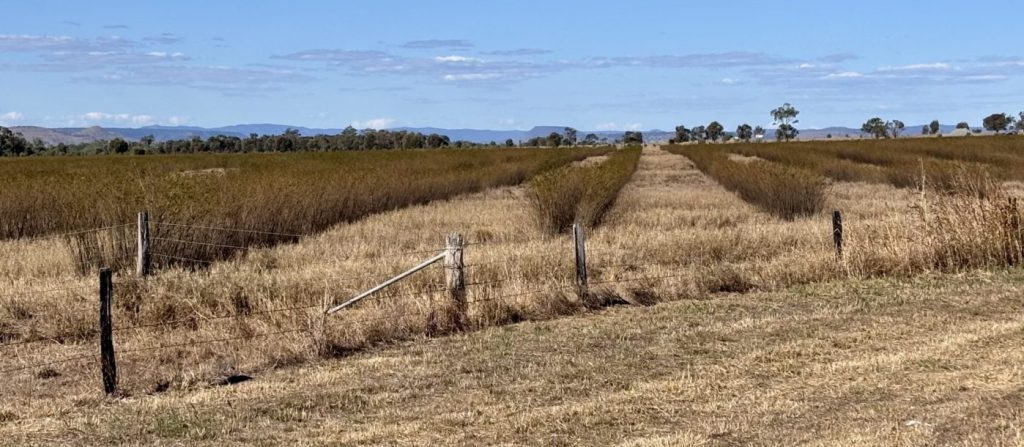
Well-managed leucaena stand between Biloela and Banana, showing the effects of winter.
Reduction in methane emissions
In addition to animal production benefits, leucaena significantly reduces methane emissions while maintaining high animal performance. Research has shown that cattle consuming diets containing around 40pc leucaena can produce around 20pc less methane due to bioactive compounds in leucaena that suppress methane formation in the rumen and improve feed utilisation.
At Brian Pastures Research Facility, an MLA/DPI project is exploring the combination of 20m wide-spaced double tree rows of spotted gum with grass/leucaena rows in between. This strategy has the potential to diversify income as well as increase GHG reduction through methane reduction and carbon sequestration.
Conclusions
Grazier interviews and property inspections demonstrated strong confidence in leucaena as a highly productive and profitable pasture system when established in suitable environments.
Producers continue to innovate in response to ongoing challenges. Examples include:
- Improved establishment practices: Planting following full cultivation and thorough seedbed preparation resulted in better leucaena growth than strip planting into existing grass paddocks. Further improvements have been achieved by planting leucaena into raised beds.
- Management of excess growth: Producers are using a range of cutting and mulching equipment to control excessive plant height to maintain productive, leafy leucaena rows. The optimal timing and height of cutting remain subjects of ongoing discussion and experimentation.
- Balancing leucaena and grass: Grazing and planting strategies are being adjusted to maintain an appropriate balance between leucaena and grass within paddocks, while also limiting the unwanted spread of volunteer leucaena plants.
Unfortunately, there has been limited progress in increasing adoption of the leucaena grazing system, despite the overwhelmingly positive experiences reported by producers.
Greater effort is required from private, government and university agencies if the northern Australian beef industry is to fully-realise the potential of well-managed leucaena to intensify production, improve profitability and reduce emissions.
This article really plays down the weedy aspect of Leucaena. Leucaena can be a terrible weed everywhere in Queensland from Cairns to Ipswich. Have a look along the most northern end of Lake St Cairns between the edge of the mangroves and the road. Go for a drive along major roads on the southern suburbs of Brisbane, leucaena fills many creek flats, roadside verges and any waste ground. Visit Limestone Creek where it runs behind the DPI’s building on the northern edge of Rockhampton. I remember a friend cutting leucaena for tomato stakes from there 40 years ago. From memory there were leucaena plants 6 inches in diameter and 30 feet tall. I realise that many who read this will be incensed by my comments, and respond accordingly, but the truth about this plants weediness needs to be told, and heard.
Jeff I have read this article and I am not incensed at all As I drive around eastern QLD . I am amazed just how much roadside leuceanea there is and in a lot of cases it obviously it has not escaped from established plantations . It certainly is an issue for Leu growers because there will be pressure with regard the roadside escapes from commercial plantations obviously the source being through the fence . Leuc is an outstanding grazing option and I don’t know in the tropics and subtropics that there any other option that will come within a bulls roar for animal weight gain . This a great wake up call from Max and I believe wise heads should start discussion . I can’t see a solution but hopefully there maybe who can Greg Brown Tolga N Q
Jeff Watson is correct. Leucaena can be found along coastal Queensland from Cairns to Brisbane. However, the origins of these infestations is not grazier plantings. As mentioned in my article, the likely source is Papua New Guinea due to the historical trade movements of people across Torres Strait. Leucaena is pandemic in tropical countries including The Philippines, Southeast Asian and South Pacific countries following its arrival from Mexico and Central America centuries ago. In most of these countries, local farmers have made use of its wood for building, poles, and stakes and, most importantly, its foliage as forage for their livestock.
It is important to appreciate that despite its ubiquity, leucaena does not invade undisturbed ecosystems. But where ecosystems has been disturbed, opening up space, leucaena will gladly occupy that space. Thus along the entirety of coastal Queensland, where we humans have massively disturbed the native habitat with our road networks, towns, and urban centres, leucaena has been able to occupy these areas, along with many other exotic plants. This is not new.
What is new, is the so far limited appearance of leucaena thickets further inland, in our agricultural region, where it can be found along roads adjacent to large scale plantings for beef cattle production. Such spread needs to be managed in the way recommended in my article. The potential value of leucaena pastures to expanding and intensifying our tropical beef industry is incalculable.