
IT’S a nation of weather contrasts this week, with handy rain across large parts of Victoria, southeastern NSW and into South Australia over the past week seeing slaughter cattle supply dwindle in that region, while conditions continue to deteriorate in Queensland and northern NSW.
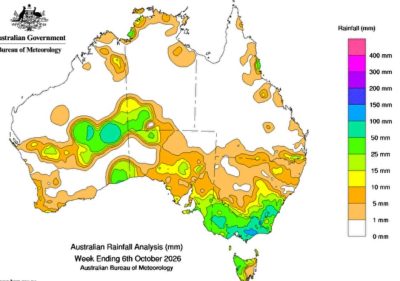 As this BOM rainfall map for the past seven days shows, virtually all of Victoria has received at least 25mm, with large areas in the state’s south and east registering 50mm or better – in places as much as 90mm. While not season-defining, it’s been enough to restore some confidence for the back half of spring and early summer in producer-land, making slaughter cattle procurement a little more challenging.
“Without that rain, the spring season was going to finish by the start of November, but now it will go right through into December. It’s a fairly big game-changer in that sense,” one Victorian cattle buyer said this morning.
Fortunately yesterday’s Public Holidays in NSW, Queensland and South Australia has reduced demand for slaughter stock a little this week, with only a handful of plants (like Teys Rockhampton) working the public holiday.
The large Bindaree Beef export plant near Inverell is on a week’s break this week, related to a new boiler installation, but clearly timed to accommodate the low cattle/meat cycle as well.
Qld grids mostly steady
Most direct consignment grids in Queensland and southern states appear unchanged this week.
Queensland export processors appear wary about letting priced bookings extend too far forward, for fear of being left with cattle that look expensive if the slaughter market starts to really slide as a result of further dry weather supply pressure. Some operators spoken to for this report currently hold bookings for this week and next week only, as part of their desire to stay ‘current.’
As a result, there’s been little sign of changes to direct consignment slaughter grid offers in Queensland this week.
Quotes kills in southern parts of Queensland for kills in coming weeks show 720c/kg on heavy cows and four-tooth grass bullock, 800c/kg (810c available on some grids for no HGP). Central Queensland rates are 20c behind those figures.
We’ve heard reports of a flat grid on heavy cows at rates considerably higher than that this week from one second-tier southern Queensland processor, but they’re unconfirmed at this stage.
Most Queensland exporters appear keen to try to pull rates back further to try to align better with an export meat market that is in the doldrums – but moderate cattle supply to this point has not allowed that to happen, while retaining kills at close to optimum levels.
With some clear exceptions like the state’s far west, where slaughter and feeder cattle are now exiting in droves (see references below) the rest of Queensland has not yet produced the big surge in spring turnoff that some had anticipated earlier.
Heavy movement from Queensland’s north to south, west to east
Queensland’s Morven rail-head and trucking depot in the state’s west is experiencing heavy demand at present, with regular rail services from western Queensland to processors further east, plus a percentage of northern cattle spelling at the yards on their way south to processors or feedlots. An incredible 130 decks of cattle rolled into and out of the yards over 36 hours on Wednesday, followed by 72 decks trucked out Thursday, and 24 decks of Bulloo Downs bullocks loaded onto rail Thursday night. We’ll follow up with a more detailed account in the next couple of days.
Southern states
After some falls of 20-30c/kg a fortnight ago, we’ve seen grids steady this week in parts of southern NSW, with offers of 760c for cows and 830c on four-tooth ox. Similar price offers are being seen in eastern parts of SA.
In Victoria, large export operators had sought to reduce over the hooks rates on better quality MSA-type grass steer 0-4 teeth from their previous level around 920c/kg to 900-880c to better reflect the poor trading conditions in most export beef markets – bot only got to around 900c before the rain impact slowed supply, Beef Central was told.
Some Victorian plants are back to four day rosters this week (no public holiday there), as a result of local rain.
National slaughter yet to lift
There’s been some delays in the issuance of the NLRS weekly national slaughter reports recently, but as of the most recent report for week ending 25 September, there was no sign of an uptick in headcount, heading deeper into spring out of the traditional winter lull.
The week ending 25 Sept saw a national slaughter of 142,765 head, the lowest full week (holiday impacts excepted) since the January shoulder period at the start of the year. The week before, ending 18 September, was little better at 143,482 head, with an average of 143,400 for the past four weeks. Compare that with the same four-week period last year, averaging 149,625 head, a drop of more than 4pc.
Comparing the same processing weeks this year to last year, the current year has not killed more cattle than last year since the week of 5 June, and remains miles away from the weeks above 160,000 head recorded back in April and May.
HAVE YOUR SAY