
While some processor livestock contacts have been difficult to reach this morning, the impression we’re getting is that there have been some rises in Queensland direct consignment offers in what is now shaping as a very difficult procurement period through to Christmas seasonal closure.
One large multi-site export company has lifted its Queensland grids 20c/kg on cows and grass steer, taking offers in southern parts of the state to 770c/kg on good heavy cows and 860c/kg on four-tooth heavy grass steer.
 Another large competitor has not officially lifted offers, but may be doing some deals on attractive numbers on the sidelines, Beef Central understands.
We can confirm that a number of large Queensland export plants are dropping at least one production day this week, as the impact of earlier rain lingers. JBS Dinmore did not operate yesterday, and the same applies further north.
“It’s survival mode now for what’s left of the year. Bring on Christmas,” was the comment from one regular Queensland slaughter cattle buyer contact.
He said early closures might be toyed-with in coming weeks in NSW/Queensland, but his company had not yet gotten to that point. “But it would be almost inevitable, if there’s further rain,” he said.
Central Queensland plants are also heavy challenged for supply this week, with at least one operator dropping two days last week and more this week due to access difficulties. Central Queensland sheds are typically 10-20c behind southern Queensland this week in grid offers.
One large southern Queensland export plant is now looking at the prospect of four-day weeks until Christmas closure, around 18 December.
Some plants continue to rely on grainfed slaughter to build a foundation for weekly production, but the challenge remains finding cows and grass steers to supplement them.
 Southern states processors appear to have now departed the Queensland cattle market for the year, with pickings looking decidedly slim compared with only three or four weeks ago, and northern operator prices rising to the point where the freight home has become too much.
One northern contact said recent rain had had a significant setback effect on local downs country cattle, already in slippery condition. In a couple of cases, Optiweigh units had picked up weight loss of 40-50kg, as cattle sat in wet paddocks and started to chase short pick. It will take some weeks for those cattle to just get back to pre-rain weights.
Further south, there’s been 20c/kg rises on some grids in eastern regions of South Australia, while southern NSW grids this week appear mostly unchanged. One large southern NSW grid is this week showing 890c/kg on four-tooth grass ox (no HGP) and 810c/kg on good heavy cows.
With the current very flat export meat market environment, most processors are electing to drop days, rather than chase cattle ever-higher through pricing, knowing that there’s negative returns at the end of the rainbow.
When there’s a good margin in the offering, it’s not uncommon during tight wet weather supply periods like this to see processors lifting grids twice in a week to flush out some killable cattle, but current meat prices are making that challenging.
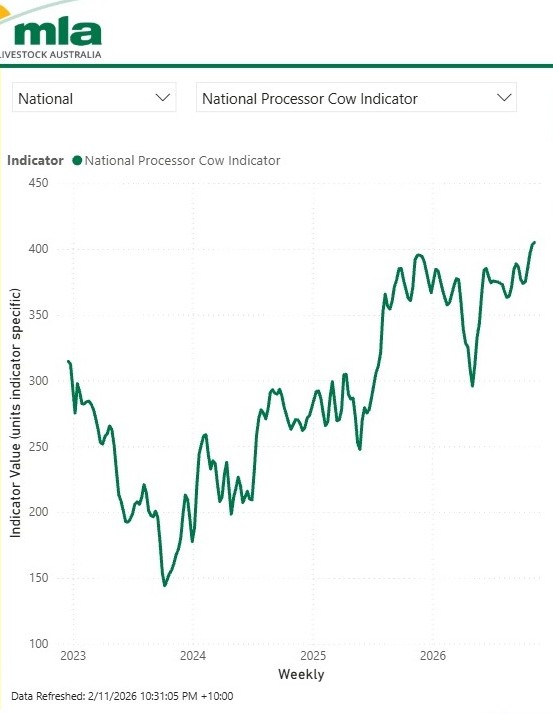
NLRS Processor Cow Indicator 2023 to date. Source NLRS
The saleyards channel is often the first to react when big rain events like this one happen.
MLA’s NLRS Processor Cow indicator has hit new record highs this week, reaching 406c/kg yesterday (see graph). The indicator is built on saleyards transactions among cows +400kg liveweight, measured in c/kg liveweight.
The rise since the onset of rain has been spectacular, lifting 35c/kg in the past three weeks. The previous record high at 397c/kg was seen back in November last year.
Significantly, the head-count represented in the processor cow indicator has declined sharply since rain started to fall. Yesterday’s figure of 406c/kg was based on turnover of 4600 cows transacted over the previous seven days at NLRS reported yards. A week earlier, numbers represented for the same indicator were well above 7000, and two weeks before that, up to 8200. At the bottom of this year’s processor cow market back in April, when cows fell below 300c/kg (see graph), average weekly representation peaked well above 16,000 head.
The current shortage of slaughter cows, combined with higher prices to secure them, is being reflected in export meat sales.
“Higher cattle prices in Australia have in turn impacted meat offerings from Australian packers in the US market last week,” Len Steiner’s Weekly Imported Beef Market commentary said last week.
“US cow prices have come under pressure as US packers struggle with order flow. It is not unusual for lean beef prices to be lower in the fourth quarter. This year’s decline, however, has been the biggest in over a decade.
Since July, the price of 90Cl cutter cows in the US is down 22pc. The last time we saw a similar price decline was about a decade ago. But different from that year, when cow herd rebuilding and lower feeder cattle prices, this year the decline is more a function of higher imported beef supply, slowdown in food service sales and lower prices for competing products,” Steiner’s report said.
Despite the recent decline, however, we still think the price risk for lean beef prices for next spring is skewed to the upside, especially if pasture conditions improve vs. the extremely poor conditions this year.
The spread of imported beef to domestic has been slowly narrowing but so far the trend has been similar to previous years, Dr Steiner said.
HAVE YOUR SAY