
EXPORT beef processing plants all the way from North Queensland to southern NSW will miss production days this week and/or next week, as the first real impacts from the recent big rain event take hold.
As blue skies again start to appear after a fortnight’s persistently wet weather, the BOM seven-day rainfall map to 9am this morning shows a sea of green across Queensland, Victoria, the eastern half of NSW and southern region of SA. Large parts of Central Queensland have received 50-150mm and better in places. The eastern half of the NT has also received unseasonally early wet season rain. Add rain that fell prior to 20 October – substantial in some regions – and the map below would be looking even more luxuriant.
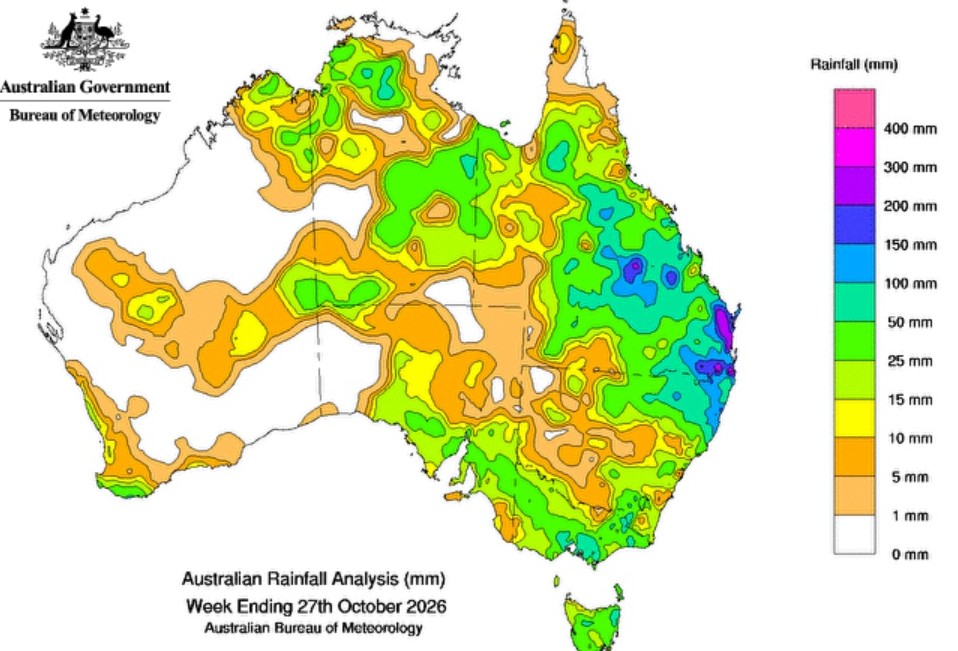
BOM rainfall – past seven days
For some grazing regions in Queensland, it’s been the best start to late-spring/early summer in decades.
The most immediate impact is in cancellation of deliveries of slaughter cattle already booked for kills this week, due to wet paddocks, impassable roads or both. That has put pressure on kill rosters, and while there’s some substitution taking place, some sites are clearly struggling to raise a kill from day to day, and the impact would continue into next week, one large export processor told Beef Central this morning.
That will be reflected in national and state slaughter tallies for weeks ending 30 October and 6 November.
Grainfed cattle help moderate impact
Offsetting that is the gradual encroachment of grainfed kills in many plants’ weekly throughput, as the industry continues to expand numbers on feed. Feedlots tend to be located on better, all-weather roads, and avoid the challenges of gathering stock from paddocks, providing a solid ‘basis’ for weekly rosters for many beef processing plants closer to the coast. Once, many of those same plants killed predominantly (or in some cases, entirely) grassfed, leaving them much more exposed during wet times like this.
On top of that, China coming back on line for the 2027 quota year is pushing even more grainfed cattle though the system presently, insulating further from the current weather impact.
 Beyond the immediate slaughter cattle access issues, many producers in Queensland/NSW fortunate enough to have received meaningful rain will now ‘put the cue in the rack’ for the balance of 2026, electing to add weight to remaining cattle for turnoff during the early stages of 2027.
An early start to the season like this will inevitably be reflected in average carcase weights seen during the first quarter 2027.
But for livestock buyers trying to fill slots for Queensland and central/northern NSW kills between now and Christmas seasonal holiday break, it could be a tough old grind, unless prices go up yet another notch.
Early season closures?
Already, given how widespread and impactful recent rain has been, people are asking questions around the possibility of early shut-downs for meat plants as Christmas draws near. If conditions had stayed dry, most processors’ seasons were likely to close 18 December, but give the shortage of cattle that’s now looking likely, expect to see more operators – especially those more heavily reliant on saleyards cattle – do their last kill shifts Thursday 11 or even 4 December, and last boning shift the day after that.
Lack of profitability in export meat markets is only likely to hasten those decisions.
‘Wet weather money?’
While at times like this in the past processors have been prepared to splash some ‘wet weather money’ around to motivate suppliers who can access some cattle to put a consignment together, current meat pricing means that’s not likely this time.
Beef Central is aware of a few private ‘incentivisation’ deals going on to keep chains moving, but nothing that’s reflected in public grid prices.
Qld grids lifted earlier
Most direct consignment grid prices in southern Queensland are unchanged this week, but that comes on top of 10-20c rises that happened a week or two earlier, in anticipation of the rain.
Most northern plants are now very current, with space available in a matter of days in some cases.
Competitive direct consignment quotes seen for kills in southern Queensland plants in coming weeks have four-tooth grass ox 840c (some quotes plus or minus 10c for HGP cattle) and heavy cows 750c/kg.
Central Queensland plants are either 10c or 20c/kg behind those rates.
In southern Australia, some grids rose 10c/kg last week. One large southern NSW grid is this week showing 890c/kg on four-tooth grass ox (no HGP) and 810c/kg on good heavy cows. Eastern regions of South Australia are showing 850c/kg on steers and 790c/kg on cows.
In the grainfed market, Queensland processors offering forward contracts for February delivery are now offering 900c/kg, the best money seen in at least 12 months and now close to the record highs seen three or four years ago.
Saleyards channel
The saleyards channel continues to react to the rain event with smaller yardings and prices sharply higher in many selling centres.
Early reports out of Roma sale this morning, where a larger offering of 4160 head was yarded, saw prices considerably stronger for all categories – up 15-35c in places. Yearling steers +480kg sold from 460-530c/kg to lotfeeders with grown steers 500-600kg from 402-478c/kg to processors. Score 3 and 4 cows +520kg sold to 420c/kg.
Southern states processor operators are less evident in Queensland saleyards in recent weeks, as supply builds closer to home. Some think that buying trend may now have more or less come to a close for the 2026 season, as southern operators shop closer to home, given the enormous freight bills that currently apply.
HAVE YOUR SAY