
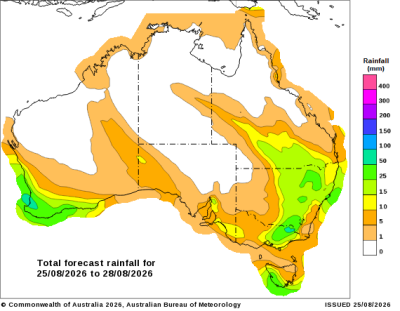
FORECASTS of 15-50mm of rain in coming days across the eastern half of NSW, Victoria and southern Queensland may slow slaughter cattle supply for a period.
 The BOM forecast (see image below) follows similar rain outcomes over the past week in areas further west, extending across to Central Australia, which have delayed deliveries for some processors for a period. For other vendors, the prospect of rain may delay sale decisions for a few weeks.
As the slaughter season heads towards spring, its starting to look like a fairly orderly slaughter cattle post-winter turnoff cycle is emerging. The mild winter experienced across large parts of eastern Australia has not impacted feed to the normal extent, and significant cattle areas like Queensland’s Channel Country and Central Australia received good winter rain, and appear to be holding cattle back for later delivery.
See today’s separate Channel Country seasonal update.
Some Qld grids ease again
Continued deterioration in international and domestic meat trading conditions have driven 10c/kg falls in some Queensland export processors’ direct consignment slaughter grids early this week.
The China tariff impact, pushing more Australian beef into the US and other markets at the same time that Brazil is lifting tonnage into North America, have made life difficult for meat sales balance sheets. On top of that, some consumer push-back is being seen on high red meat prices in the US, as it is in Australia.
 Recent currency movements haven’t helped, with the A$ hitting US72c this morning – its highest level since a brief spike in early May. Prior to that, the A$ had not been this high since 2022. A higher A$ value dilutes the competitiveness of Australian beef in global markets.
Current Southern Queensland processor over-the-hooks quotes seen this morning have heavy cows on 660-670c/kg and grassfed four-tooth ox on 740-760c. Some of that cow money looks well behind comparative saleyards rates, raising questions about whether those operators already hold solid bookings into mid-September.
One ‘outlier’ southern Qld export processor still shows 720c/kg on best cows, but that’s for cattle from tick-free areas only, where the logistics/dipping hassles are reduced, and may be subject to adjustment soon.
Central Queensland plants are 20c/kg behind those rates, due to the freight differential.
In southern states, there’s little change evident in over-the-hooks rates this week.
Best direct consignment quotes seen in eastern regions of South Australia and southern NSW this morning for heavy cows on 760c/kg and grass four-tooth heavy grass steer 830c. MSA yearling steer in eastern SA was back to 910c/kg last week, having fallen from 940c only four weeks ago, with heavy cows 790-800c on some grids.
Kill numbers highest since 1978
Last week’s release of quarterly and financial year ABS data provided some useful measures of recent processing performance.
Close to 9.6 million cattle were processed nationally in 2025–26, the highest financial-year total since 1978. The result highlights the scale of cattle available to processors and the capacity of the Australian supply chain to handle historically high throughput, while cattle markets have remained comparatively strong, MLA senior market information analyst Emiliano Diaz said.
Queensland drove much of the June-quarter increase, processing 1.083 million head, or 43pc of the national kill. This was 13.9pc higher than the March quarter and 7pc above the same quarter last year. It was Queensland’s strongest June quarter since 2015 (drought turnoff year) and one of the state’s largest quarterly slaughter totals in more than a decade.
NSW slaughter reached 572,500 head for the quarter, up 11.7pc year-on-year, while Victoria processed 587,000 head, up 8.8pc.
Beef production was even stronger, with Queensland processors accounting for 355,529 tonnes, NSW 171,257t and Victoria 171,059t. All three states recorded their highest quarterly beef production since at least 1972. Each also set a new financial-year production record.
The fact that all three major eastern processing states reached records at the same time highlights how broad-based the lift in cattle supply has been, Mr Diaz said.
First-half slaughter remains ahead
As the NLRS weekly slaughter figures have been showing, national slaughter released by ABS for the first six months of 2026 was 6.9pc higher than the same period in 2025.
However, weekly slaughter has started to moderate. NLRS figures tracked above 2025 levels through much of the first half, but since the end of June national throughput has averaged 2pc below the corresponding weeks last year.
The export environment has become more complex, with safeguard quota volumes for Mainland China and Korea now filled. This is expected to redirect some Australian beef towards markets including Japan, the US and South-East Asia rather than necessarily reduce underlying demand.
Female turn-off reaches record
The June quarter also recorded the highest number of female cattle slaughtered since 1972, at 1.387 million head. Females accounted for 55pc of total cattle slaughter, the highest quarterly female slaughter rate since June 2020, MLA reported.
This reflects a strong seasonal element to female turn-off. With many spring-joining herds, pregnancy testing occurs through autumn, with empty, older or lower-performing cows then culled before winter. This avoids carrying unproductive females through a period of slower pasture growth and higher supplementary feed requirements, lifting female supply through May and June.
More recent NLRS weekly data suggest that trend is easing, with female slaughter gradually declining from its May peak alongside the broader moderation in national throughput.
Saleyards channel:
The recent trend to smaller yardings continued across major selling centres early this week.
Gunnedah yarded only 1200 head this morning, down 720 on last week. The market was dearer overall. Young cattle to the trade as well as prime grown cattle were limited. Yearling steers to feed were considerably dearer making from 480-598c to average 577c. Score 2 cows to the processor were 25c dearer, making 300-350c/kg, while score 3s held firm to make from 340-379c. Prime heavy cows were marginally cheaper to make from 380-405c.
Tamworth numbers sank to just 715 head with renewed optimism on the back of some rain over the weekend with more predicted. It was a mixed quality yarding of predominately cows and yearling types. Prime grown cattle to the processor were limited and topped at 520c/kg. Score 2 and 3 cows to the processor were 15c cheaper, with 3s making from 340-370c and prime heavy score 4s 5c cheaper from 375-398c.
Roma yarded only 5684 head this morning, slightly down on last week, with the anticipation of some predicted showers. A preliminary report said the market was dearer by 10-30c/kg across the board (preliminary report only, with cows yet to sell). Yearling steers 330-400kg made to 496c to lotfeeders and 564c/kg to backgrounders. Steers 400-480kg averaged 535c, while those +480kg went against the trend, easing 20c/kg. Grown steers 500-600kg sold from 410-454c/kg, while bullocks +600kg rose 20c/kg to make 471c/kg to processors. Full Roma report tomorrow.
HAVE YOUR SAY