
EVERY second conversation in the cattle industry this month seems to remark on the mildness of winter conditions this year, with many susceptible cattle areas yet to see a frost.
The effect, in some cases, has been to push cattle processing commitments back, as cattle continue to gain weight at a time that they would normally be starting to slip.
Northern processor cattle buyers’ phones inevitably start to ring soon after a sequence of three or four good frosts, but there’s been none of that this year.
A buyer contact driving through the Richmond district in North Queensland earlier remarked on how fresh the country still looks, and we received similar feedback an hour earlier out of the Clermont region. Both are frost prone in a typical year.
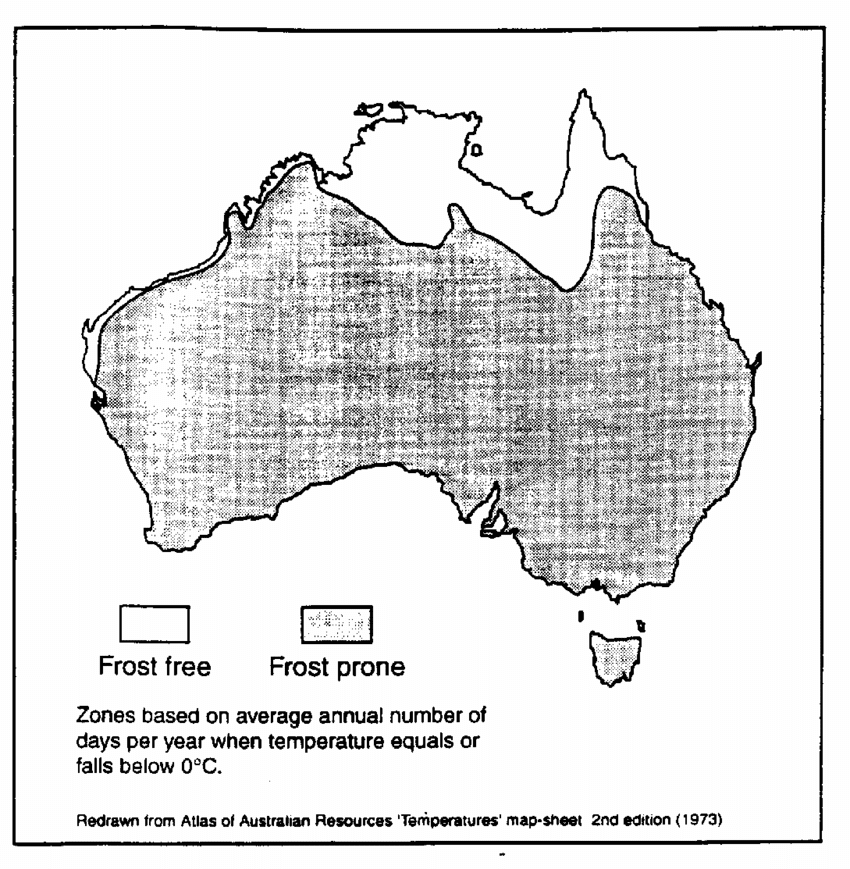
For reader interest, here’s an old (1973 vintage) map of frost-susceptible areas in Australia. The footprint is a lot larger than what many might expect, but whether it is as large today is open to question.
 As a result, some Queensland processors are anticipating a lift in the supply rhythm in coming weeks – especially as slaughter prices have slipped 50-60c/kg carcase weight in the past month, with the best of the money now in the rear-vision mirror. Late August through September is now being earmarked as a period of higher turnoff activity in Queensland.
Delays in delivery of Central Australian cattle as country dries out after recent rain may add to that congestion heading into spring, one processor said. Saleyards numbers are also on the rise, with +11,000 at Roma today and +8000 booked for Dalby tomorrow.
Some direct consignment grids soften again
Some, but not all Queensland export processor direct consignment grids have softened again this week. Falls of another 20c/kg are evident on some sheets.
Best offers seen this morning from competitive exporters in the state’s south have heavy slaughter cows on anywhere from 690c to 720c/kg, while four-tooth heavy grass ox is anywhere from 770-800c/kg on some grids). One of those at the upper end of that range indicated they will review the numbers later in the week.
Central Queensland plants are typically 20c behind those rates.
Best forward contract offers on flatback 100-day grainfed ox for November delivery in Queensland were quoted this morning at 885c/kg.
Southern states show no significant over-the-hooks changes this week, but some operators admit they are now looking hard at the numbers. Some of the Central Australian delayed wet weather cattle now starting to move may stimulate a downwards movement.
Best quotes seen in both eastern regions of South Australia and southern NSW were heavy cows 780c/kg and grass four-tooth heavy steer 850c. Some of those quotes were down 20c on a fortnight ago.
Rates of processing in sharp decline
As reported last week, there’s been a sharp drop in national beef processing activity over the past fortnight.
 The NLRS national slaughter report for the week ending last Friday (10 July) continues the recent downwards trend, with adult cattle kill at 146,985 head. That’s down about 8300 head or 5pc on the same time last year.
The past four weeks’ national kills have averaged 151,000 head, compared with close to 162,000 for the previous four weeks (excluding one holiday-shortened week).
Processors in southern states, and indeed as far north as Southern Queensland, have dropped working days or shift numbers recently, as supply tightens and margins no longer stack up.
Saleyards numbers trending higher
There’s an upwards trend in numbers offered through major selling centres early this week.
Gunnedah yarded 2100 this morning, up about 18pc on last week. Prime cattle numbers were limited. Most major buyers were present for an overall cheaper market. Yearling heifers to feed were considerably cheaper making 486-580c to average 555c/kg. Prime grown cattle to the processor topped at 440c/kg. Score 2 and 3 cows to the processor improved on quality and made from 366-390c/kg. Prime heavy cows were 5c cheaper making 390-415c/kg.
Roma yarded 11,500 this morning, up almost 1800 on last week. Cows were yet to sell, but a preliminary report said the market was softer for most categories. Buyers took advantage of the quality and large runs available and prices responded accordingly. Feeder steers +480kg sold to 564c/kg, grown steers 400-500kg from 417-476c to lotfeeders, and bullocks +600kg made to 450c/kg. Full Roma report tomorrow.
Wodonga yarded only 800, with cows making up half the yarding. Heavy steers and bullocks were limited in each agents run. Heavy steers and bullocks made from 440c-548c/kg. In the cow sale, quality was outstanding and bidding gained momentum. The bulk of the heavy cows improved 14c/kg, with the well finished types ranging from 415c to 435c/kg. Leaner cows less than 520kg and with some cover gained back 26c to average 391c/kg.
Tamworth yesterday yarded 1328, similar to last week. There were very few pens of prime heavy weight cattle to pick from in a market where feeder cattle were sought after. Yearling steers to feed up to 400kg were over 30c dearer and made from 572c to 656c/kg. The heavy feeder steers were cheaper to make from 470-598c, while yearling heifers to feed were 15-20c dearer across the board. Prime grown cattle to the processor reached 428c/kg. Score 2 cows to the processor were 20c cheaper and made 320-369c/kg. Score 3 and 4 cows held firm, with 3s making 366-392c and 4s 395-416c/kg.
HAVE YOUR SAY