
Source: The Protein Sovereignty Index
DESPITE producing far more food than it consumes, Australia’s reliance on imported fuel, fertiliser and crop chemicals has prevented it from achieving the highest rating in a new global protein security report.
The Protein Sovereignty Index ranks countries according to their population’s ability to sustain affordable access to enough protein to meet nutritional needs – even through disruption to production, trade and critical inputs.
It offers a different approach to assessing food security, which has traditionally been measured in calories.
The report was produced by Full Circle Biotechnology, a Thailand-based company that develops alternative feed proteins from agricultural and food by-products.
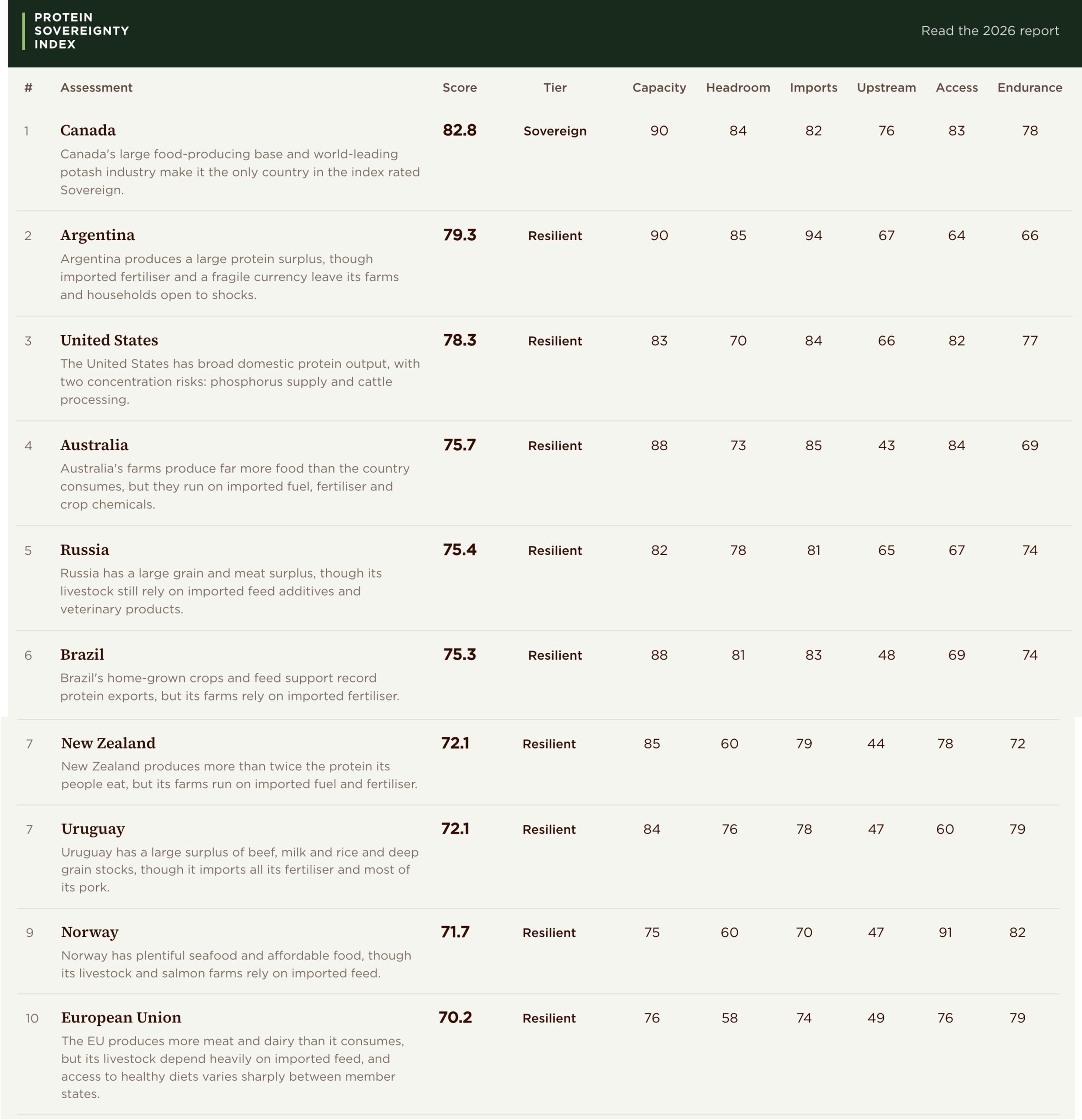
Of the 43 countries, blocs and regions assessed, Canada was the only one to achieve the highest rating of “sovereign”.
Canada’s large food-producing base and surplus production of nitrogen fertiliser and potash give it considerable room to supply households through a trade disruption, the report said.
Australia ranked fourth overall, behind Canada, Argentina and the United States.
Argentina, the United States, Australia, Russia, Brazil, New Zealand, Uruguay, Norway, the European Union and Ukraine were rated “resilient”.
The “exposed” group included the UK, China, the rest of Europe, India, South Africa, Indonesia, Vietnam and the Oceania and Pacific region excluding Australia and New Zealand.
Countries rated “dependent” included Japan, South Korea, Egypt, Nigeria and Ethiopia, while the Gulf states were rated “critically exposed”.
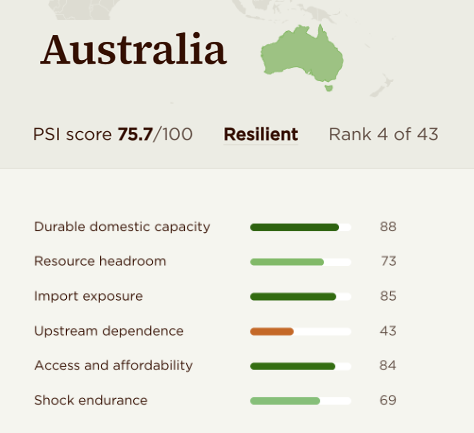
The report noted that Australian farmers produce more than three times the beef and sheepmeat used domestically, while poultry production slightly exceeds local demand.
That production base gives the country room to supply households even when exports are disrupted.
Seafood and pork were the main exceptions, with imports meeting 73 per cent and 38 per cent of domestic supply respectively.
However, Australia’s more serious dependence was on the inputs underpinning farm production.
In 2023, net imports covered 83 per cent of nitrogen fertiliser use, 47 per cent of phosphate and all potash use.
Australia also refines only about a fifth of the fuel it consumes.
“The 2026 disruption drove up urea prices and prompted the government to secure additional shipments, but the 340,000 tonnes arranged by late June were small beside the 3.85 million tonnes imported in 2024,” the report said.
“Farm output remains substantial; a prolonged input shortage would make the next harvest more costly and less certain.”
The report also found that most Australian households could afford a healthy diet, with 3.2 per cent of Australians unable to do so in 2024, citing FAO and World Bank data.
Top 10
To read the full report click here
HAVE YOUR SAY