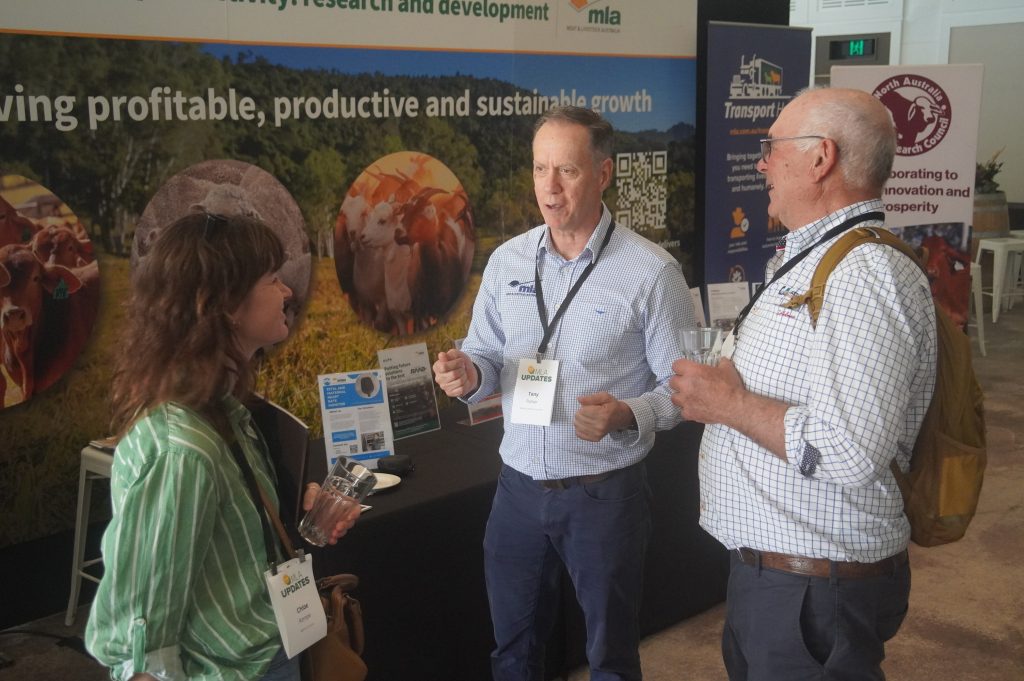
MLA’s program manager for grassfed productivity, Tony Parker, centre, with Victorian beef producer David Allen from Mortlake, and Chloe Kempke from pasture seed developper Agrimix, in the R&D showcase area at yesterday’s AGM
CATTLE Australia will press on with its efforts to secure a $1 rise to the grassfed cattle transaction levy, following a 54.13 percent vote in support from industry members that was finalised during yesterday’s MLA annual meeting in Townsville.
The level of support reported from the vote fell well below the expectations of many in the audience, and signs of a potential tough result were seen just a few minutes earlier when a surprising 61.75 percent of goat producers soundly rejected their own levy rise proposal, to 90c.
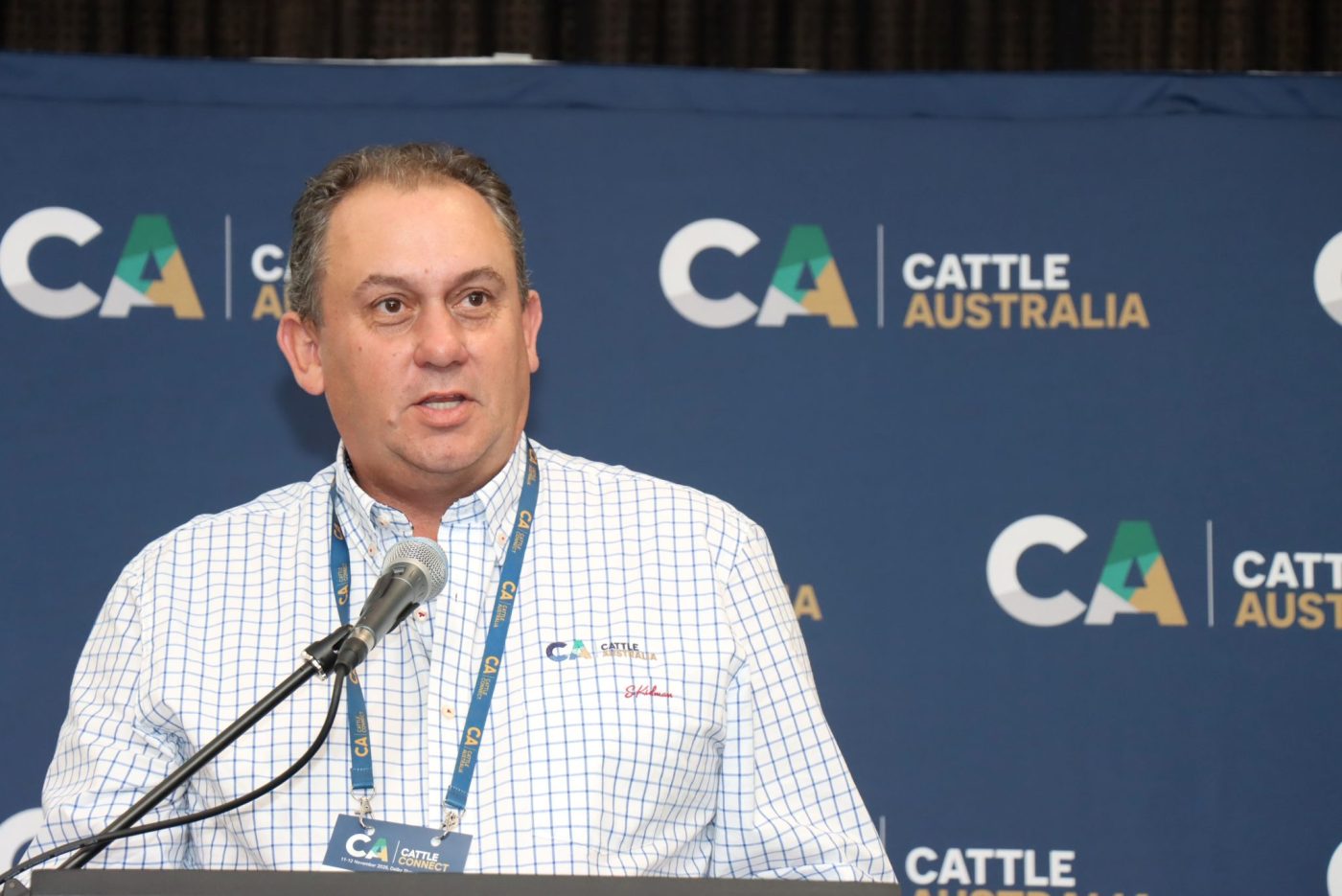 In a post-mortem discussion with Beef Central soon after yesterday’s result was tabled, Cattle Australia president Garry Edwards remained upbeat.
“It’s human nature to want more people to have voted for a cause, but this result remains a majority mandate. There’s been Federal Governments that have been elected on minority mandates,” Mr Edwards said.
“In the modern (social media) environment in which we live, this is a massive outcome,” he said.
“Legislation says we needed one more vote than 50pc, and we got substantially more than that.”
“It would have been nice to have won with a 95pc majority, but that’s not how elections necessarily work.”
“We’d always like to see an even stronger level of support, but at the end of the day, the communication, consultation and engagement CA has to do on the levy matter does not end here – it continues. This is not the end, it’s the start. Ultimately, when we get to July next year, there will be a further briefing provided to the department, to the levy payers, and to the relevant ministers. They will be recommendations about whether a change should go ahead, or not. What today’s result does, is give CA the mandate to demand the transparency and accountability that’s the industry been after.”
“The mandate has been given to CA to proceed; it’s now our job to continue doing this.”
Mr Edwards said there was more work to do before going to the minister with a request to consider a $1 rise next year (see details below).
He said confusion remained evident among some stakeholders leading up to the vote.
“One levy payer I spoke to told me he had voted no to the resolution two weeks ago, because he thought it was to be implemented immediately. He did not understand that it would not be activated until 2028, but by the time he learned that, voting had closed.”
 There were also clearly some problems occurring with the voting register and errant voting packs prior to the vote – apparently related to issues like changing voter email addresses. MLA evidently had to reinforce staff to manage inquiries as Sunday’s remote voting deadline neared last week. One large corporate levy payer is known to have missed out on the chance to vote, having encountered voter pack problems.
Mr Edward said there had been a lot of social media since the resolution was circulated six weeks ago that had focussed on the $1 increase figure – not the actual process or what it was to be used for.
“There’s been a focussed campaign done to distract people, asking questions about the increase, and not the process,” he said.
“It’s this clickbait mentality of society of seeing the picture, and not necessarily reading the text that explains the detail.”
He said if there had been any ‘protest vote’ yesterday, it had been about the inaccurate perception that MLA would be the principal levy funds recipient.
“What we have attempted to do around the structure of this, is deal with that in advance. That’s what we’re going to have to do between now and next July, when the levy deadline closes (see details below).
“In my opinion, in some areas the focus in the levy matter has been (wrongly) on the levy recipient body – not the process behind it. Other groups have obviously been focussed on the changes – but the changes are about putting power back in the hands of levy payers, not necessarily having it in the hands of governments or associations.
“It’s very clear when engaging with some levy payers who start talking about the changes meaning more money will go to MLA, that they have not understood the full brief.”
Cattle Australia issued the following statement after yesterday’s voting result, mapping out its plans from here :
Grassfed cattle levy payers have voted for change, backing the Cattle Transaction Levy review resolution at Meat & Livestock Australia’s Annual General Meeting in Townsville today.
It is the first time in 20 years that grassfed producers have had a say to change their levy and where and how it is invested. Cattle Australia thanked every levy payer who got involved and had their say, including around 1000 producers who shared their views during the review.
“Producers asked for accountability, and they asked for greater industry representation and today they voted for it,” Cattle Australia Chair Garry Edwards said.
“It’s their levy, they have given Cattle Australia a mandate to progress change, and today they set the terms for how it’s invested. This puts producers back at the centre of determining the direction of their own levy investment.”
Under the resolution, every levy-funded program must justify and publicly report the value it delivers to producers before 1 July 2027.
The levy will not rise unless those reforms are delivered in full by 1 July 2027. If they are, the levy will increase by $1 per transaction, to $6, from 1 July 2028. There is no change to the cost of the levy before then.
The increase is dedicated to the priorities levy payers identified during the review: residue testing, biosecurity, independent integrity systems and a stronger voice for industry. A minimum of $0.60 per transaction will go to greater industry representation, improving industry and producer capability and defending the industry, with open reporting on every dollar.
The resolution also provides for a structural review by the end of 2030, followed by a full review every 10 years with a check at five years.
“The vote is the easy part. Now the reforms have to be delivered, and producers will see every step of it,” the spokesperson said.
“No reforms, no increase. That hasn’t changed.”
Cattle Australia will report back to levy payers regularly on how the reforms are tracking ahead of the 1 July 2027 deadline.
HAVE YOUR SAY