
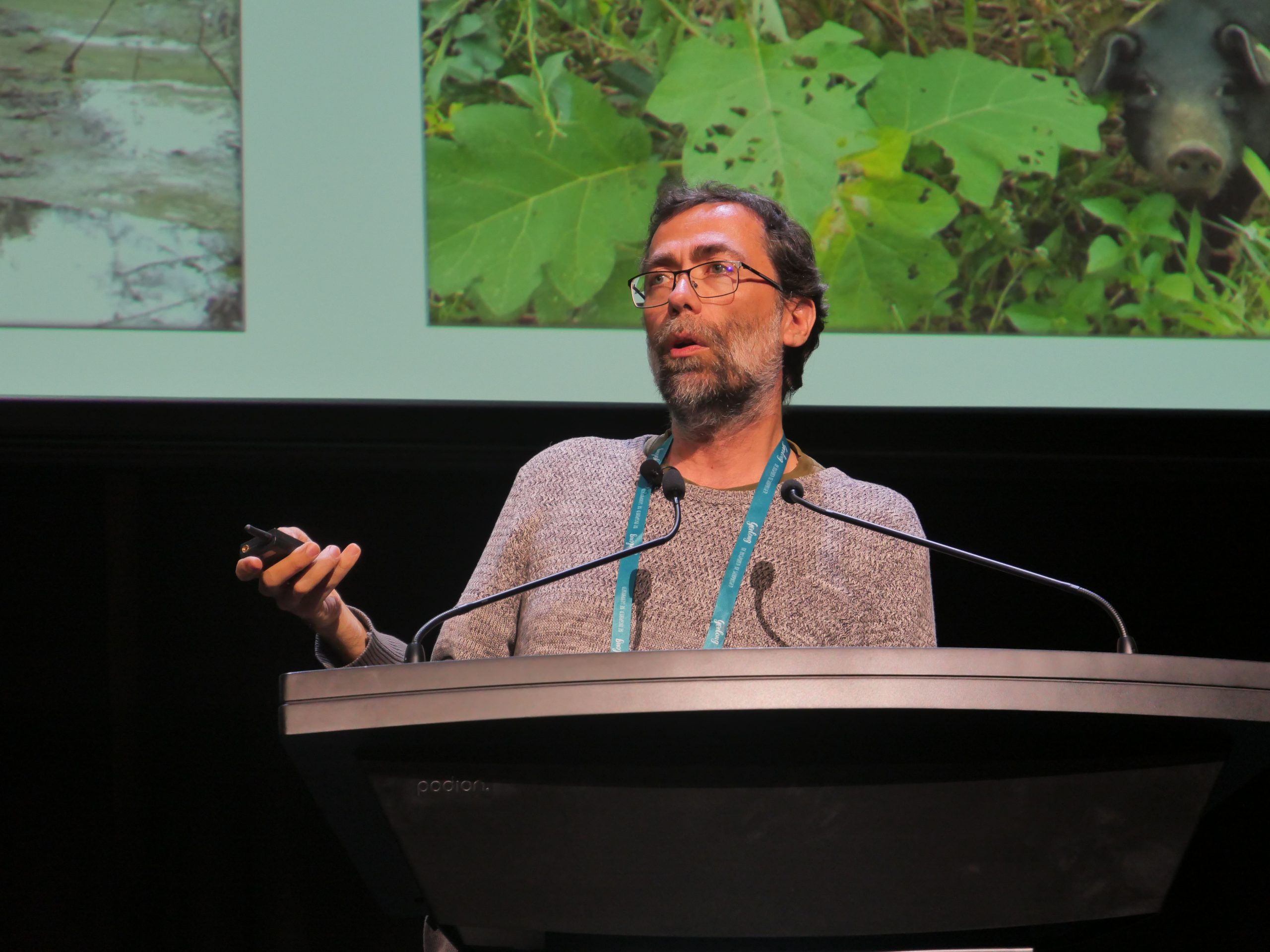
Dr Pablo Manzano from the Basque Centre for Climate Change in Spain.
WHAT would happen if grazing cattle were suddenly removed from the Australian landscape?
A presentation from Spanish rangelands ecologist Dr Pablo Manzano at last week’s Societal Role of Meat Conference in Geelong directly challenged assumptions that the results would be as environmentally favourable as the industry’s critics might claim.
“Very often we think that nature is forest, and it’s a closed canopy forest, and we think that livestock is inherently a destructive force in those ecosystems,” he said.
“So that no matter what we do with livestock, it’s going to harm nature. That’s a misconception that we have.”
Before the arrival of domesticated livestock, the world had a lot of wild herbivores that were performing many functions in their ecosystems.
“The ecosystems adapted to these actions of the herbivores, and now it is livestock that are overwhelmingly having this role,” Dr Manzano explained.
“And this is pretty important because when we are talking about, for example, the landscapes here in Australia, I think it’s a very good example.
“The savannas in the north, but also more temperate landscapes here in Victoria, many nature conservationists believe that the ideal system is closed canopy forest.
“And actually, evidence when measuring biodiversity, when measuring ecosystem function, shows that when we have this action of livestock and when we achieve a structure of the landscape that looks more like a savanna, then we are having way more healthy ecosystems.
“it’s in evidence every summer when we have unhealthy ecosystems, we have something that substitutes the herbivores, which is fire.
“And this happens in Australia, this happens in Europe, this happens in North America and it’s the big warning that nature is giving us on the consequences of losing livestock.”
He recalled a previous gathering of international scientists where officials showed an image that depicted “all kinds of environmental havoc related to livestock”.
However, he said a group of rangelands ecologists in the room spoke up to point out that the image “didn’t make sense”.
That was because the negative effects depicted in the diagram also “have a positive counterpart if you do things well”.
“And this depends on whether livestock is doing things that resemble nature and that nature has adapted to or not,” he said.
“For example, I like to talk about this concept of intact ecosystems. Intact is a word, a Latin word that comes from untouched, but actually, we have evidence in ecology that nature needs to be touched.
“It needs to be disturbed in order to be functional, and that’s the example of the savannas.”
Would methane emissions automatically be eliminated?
Dr Manzano also challenged the view that removing grazing livestock would automatically eliminate all methane emissions from the same area.
Conventional greenhouse gas accounting often did not account for emissions that might occur naturally in the same landscapes in the absence of domestic livestock.
To illustrate the point, he cited research published in 2023 comparing the wildlife-dominated Serengeti ecosystem with a neighbouring Maasai pastoral landscape in Tanzania.
According to Dr Manzano, the study found no net difference in the emissions being compared between the natural and livestock-grazed systems.
Dr Manzano also offered a comparative example of methane emissions from rice paddies in Spain’s Ebro Delta.
“This is again a very interesting case because rice is a little bit like livestock.
“It is a system that imitates wetlands, and wetlands are very valued in climate policy because they can stock a lot of carbon, yet they emit a lot of methane.
“But this methane doesn’t count because it’s natural.
“Whereas in the case of rice, this methane does count because it’s artificial.
“What we found out is about 60 percent of the rice paddies that we analyzed in the Ebro Delta in Spain, 60 percent of the methane that they emit is natural and inevitable.
“So that if we restore that to a wetland, it will emit that methane.”
The challenge of changing perceptions
Dr Manzano said a major challenge for livestock researchers was communicating complex ecological science to the wider community.
Negative claims about livestock’s environmental impacts could often be expressed in simple terms, while explaining the potential benefits of grazing required consideration of multiple scientific disciplines.
Dr Manzano said he believed the positive link between livestock and good environmental outcomes was backed by “very solid science” and practical examples, but the issue was “that it’s very challenging to deliver this message to society”.
“I believe the main problem that we have now regarding environment is not a scientific problem. It’s not even a political problem because many politicians will acknowledge what I’m saying. It is a social perception problem,” he said, adding that communication was needed to draw attention to these issues.”
HAVE YOUR SAY