
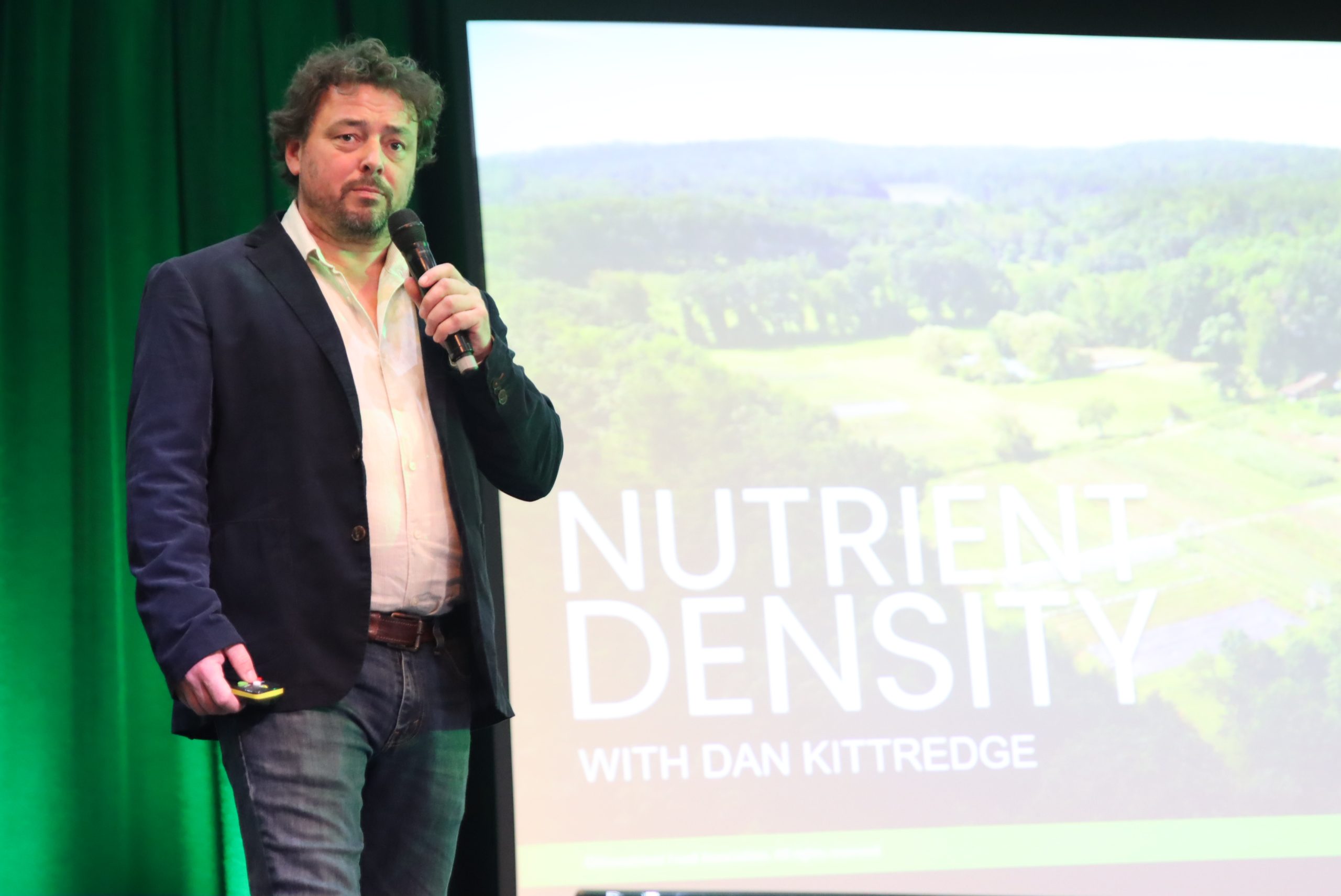
Dann Kittredge addressing the Cattle Connect 2026 conference in Wagga Wagga.
NEW research into the nutritional composition of beef is revealing enormous differences between individual steaks, challenging conventional assumptions about grassfed and grainfed production and raising the prospect of a new way to measure and reward beef quality.
It’s amazing what you can learn when you measure things.
US farmer and researcher Dan Kittredge has been on a journey of measurement and discovery in the food industry for much of his career, and what he has discovered is challenging conventional thinking about food quality, human health and the farming practices that most influence them.
The founder of the Bionutrient Food Association, who coined the term nutrient density to describe variations in the nutritional calibre of food, has spent years investigating why apparently identical foods can have vastly different nutritional profiles.
His organisation has established a network of laboratories to test foods from around the world and developed a prototype handheld meter capable of assessing certain nutritional characteristics using light.
Through that work, his team’s research has identified enormous variations in the nutrient content of foods that look virtually identical on supermarket shelves – including beef.
And some of the most surprising results have come from analysis of the nutritional differences between grassfed and grainfed beef.
Addressing the recent Cattle Connect conference at Wagga Wagga, Mr Kittredge outlined the results of research which involved sourcing steaks from four continents, including Australia.
The analysis found substantial differences in the concentrations of vitamins, minerals, fatty acids and other compounds between individual samples.
Some nutrient concentrations were tens to hundreds of times different from one steak to another.
The findings also challenge conventional wisdom suggesting that grassfed beef is always nutritionally superior to grainfed beef.
While grassfed samples averaged somewhat higher on the researchers’ nutrient density scale, both the highest and lowest-scoring steaks were grassfed.
Grainfed beef generally showed a narrower range of nutritional scores, with considerable overlap between the two production systems.
“There’s a lot of grain fed that’s got a lot more good stuff than a lot of grass fed, and vice versa,” Mr Kittredge told producers.
He said the findings raise important questions about how beef quality is defined, how it can be influenced and improved through management, and whether producers may eventually be able to be rewarded for the nutritional value of the beef they produce.
How Dan’s focus progressed from organic farming to nutrient density
Mr Kittredge’s interest in nutrient density began on his family’s small farm in Massachusetts, where his parents were involved in the early organic farming movement.
Later when he established his own small organic farm, he found himself battling pests and diseases while trying to make a living.
He began questioning why plants growing naturally in surrounding fields and forests appeared healthy, while his cultivated crops were being attacked.
 “My conclusion was that maybe organic wasn’t that much better. Maybe it was good not to use chemicals, but there’s more to it.”
That realisation led him to study biochemistry, microbiology and agroecology, exploring subjects well beyond his own farming knowledge.
For example, he said, he began learning about the role of trace elements in biological processes, including cobalt in vitamin B12 and microbial function, molybdenum in nitrogen fixation, and boron in calcium availability.
“It took maybe two years of modulating practices, integrating insights that had come out that were from outside of the things I learned growing up,” he explained.
“The pests were gone, the diseases were gone, my cost of production went down, my profitability went up, and I was making a living working part-time farming, which I’d never heard of anybody ever doing.”
He began sharing those experiences with other farmers through workshops and conferences, which eventually led to the establishment of the Bionutrient Food Association in 2010.
“Our thought was if we could help people who buy food at the point of purchase at the grocery store to choose between the three bags of carrots available to you, or the four choices of apples, or the two potatoes, and if you knew that one was 20 out of 100, one was 40 out of 100, and one was 80 out of 100 from a nutritional standpoint, my proposition is most people would choose the 80 and leave the 20 on the shelf.
“Our thought was if we could align the science, the connection between nutritional value, and give that capacity for people to measure and choose at point of purchase, we could pull through the supply chain an incentive to focus on nutrition instead of volume, because right now farmers get paid on volume, aesthetic, uniformity, and volume, not nutrition.
“So that was the vision.”
Measuring differences
The association began developing methods to objectively measure nutritional differences between foods.
From 2017, it established a research program that collected approximately 10,000 crop samples from farms, supermarkets and farmers’ markets across multiple continents over several years.
Samples were tested for a range of nutrients, while researchers also collected soil samples and information about farming practices that produced each sample.
The results revealed striking variations in nutrient concentrations within individual crop types.
In carrots, for example, the researchers found four-fold differences in sulphur concentrations, eight-fold differences in phosphorus, approximately 20-fold differences in polyphenols and around 40-fold differences in antioxidant measurements.
Similar patterns were identified across other crops, including wheat, oats, potatoes, blueberries and apples.
The research also sought to determine what was driving those differences.
According to Mr Kittredge, the data did not show consistent relationships between higher nutrient levels and individual crop varieties, geographic regions, organic certification, regenerative labels or particular practices such as no-till farming and cover cropping.
There was no clear difference between soil types or climate zones. The results even tested the assumption that food bought straight from a farm would be better than food from a grocery store.
“Farm, 118 samples, three in the top 20 percentile. Who’s heard that the grocery store is bad? 110 samples. Actually, the best sample in the whole data set is at a grocery store. Fresh in the garden is definitely good for you, right? 79 samples, none in the top 20 percentile.”
“Maybe not all of you all identify with being part of the food movement, but there’s oftentimes this identity thing: We’re organic. We’re better. We’re local. We’re better.
“We’re not seeing it here in data. Just not seeing it…
“What that means is farmers operating on scale are not doing worse than the other people who are supposed to do better.
“… the point is, none of these certification labels or individual practices either correlate with nutritional variation.”
So what explains the difference?
“The only thing that we found that correlated with levels of nutrition in food was the level of life in the soil,” he said.
“The more microbes functioning in the ground, the more nutrients of the plant.”
He said the findings highlighted the importance of overall biological system function, rather than relying on individual management practices, production labels or operational size as indicators of nutritional quality.
What happened when they measured beef?
The association then turned its attention to beef.
Working with scientists led by Utah State University in 2021, it designed a research project to investigate whether connections could be established between soil health, farming management, animal diets, the nutritional composition of beef and ultimately human health.
The study involved farms across Australia, North America, South America and Europe.
Participating farms supplied steak samples from three animals, together with soil, fodder and rumen samples, and information about their management practices.
Researchers assessed soil characteristics, plant material, rumen microbiology and the chemical composition of the beef.
More than 575 nutritional compounds were initially examined in each steak, before the analysis was narrowed to approximately 150 compounds as the project progressed.
Mr Kittredge said the results demonstrated significant variation in the nutritional calibre of different pieces of beef.
Among the fatty acids examined, some showed differences of more than 500 times between samples.
Large variations were also identified in vitamins and minerals, with some measurements differing by hundreds of times.
It was also noted large differences in the concentration of an individual compound did not necessarily translate into an equivalent difference in overall nutritional value or health benefit. Establishing which compounds mattered most to human nutrition, and how they should be weighted, was a central part of ongoing research.
Grassfed versus grainfed analysis shows some surprising results
One of the most significant findings for cattle producers was the degree of overlap between grassfed and grainfed beef.
Mr Kittredge said the researchers had initially hypothesised that cattle consuming diets closer to those they evolved to eat would produce nutritionally superior beef.
But the results proved more complicated.
While some nutrients, including omega-3 fatty acids, tended to be higher in grassfed samples, the overall distributions of many compounds overlapped substantially between the two production systems.
“There’s this whole dichotomy about grass-fed good, grain-fed bad. Anybody heard that one?” he asked.
“Not what the data seems to show.”
The research team has since developed two proposed nutrient density scoring models, one involving 30 nutrients and another using 10.
Under the scoring approach outlined at the conference, grassfed beef produced both the highest-scoring sample, at 100, and the lowest, at one.
Grainfed samples ranged from three to 95.
Grassfed beef averaged somewhat higher overall, and only four of the 25 highest-scoring samples were grainfed.
However, 16 of the 25 lowest-scoring samples were grassfed.
“The best and the worst were both grass fed,” Mr Kittredge said.
His interpretation was that grassfed beef displayed a much wider spectrum of nutritional quality, while grainfed beef tended to be more consistent and clustered towards the middle of the range.
For producers, the findings raise the possibility that management within each production system can influence the nutritional composition of beef produced.
It was also emphasised that the research remains subject to review and has not yet been published, with feedback currently being sought.
Could nutrient density become a new measure of beef value?
Mr Kittredge said the association has developed a prototype handheld sensor using spectroscopy, which has about the same dimensions and weight as a television remote control.

Mr Kittredge holds his prototype handheld nutrient density meter.
He said the unit emits a flash of light which allows it to estimate chemical characteristics of a food product at which it is pointed, and had demonstrated the ability to estimate selected compounds such as polyphenols, antioxidants and protein.
Mr Kittredge said had a prototype cost of approximately US$375 per unit.
The next challenge is to establish scientifically validated measures of overall nutrient density and develop instruments capable of assessing those characteristics in products such as beef.
Mr Kittredge envisages a future in which a carcase could be assessed at the processing plant and assigned a nutritional quality score.
That information could then potentially be carried through the supply chain, allowing consumers to distinguish between beef products on the basis of measured nutritional characteristics rather than relying solely on marketing claims or production labels.
Ultimately, he believes similar technology could be incorporated into smartphones, enabling shoppers to assess the nutritional quality of individual products in supermarkets.
He described the work as a starting point for a much broader scientific conversation, rather than a definitive measure of nutritional quality.
“This is not the be-all and end-all definition. This is the first step.”
HAVE YOUR SAY