
SOCIAL media hysteria in Australia earlier this year over the re-admission of imported beef from the United States after a 20-year ban has proven unfounded, with total trade over the past 13 months barely enough to fill a tray-back utility.
Data obtained by Beef Central tells the story, confirming that imports of US beef and offal into Australia have been extremely limited in volume, since access was officially re-opened back in late July last year.
The current near-record high cost of US-produced beef due to a national beef herd at 70 year lows made it obvious to many that US beef would struggle to find a place in the Australian consumer market – with the possible exception of a few high-end steakhouses looking for a novelty ‘point of difference’ menu item.
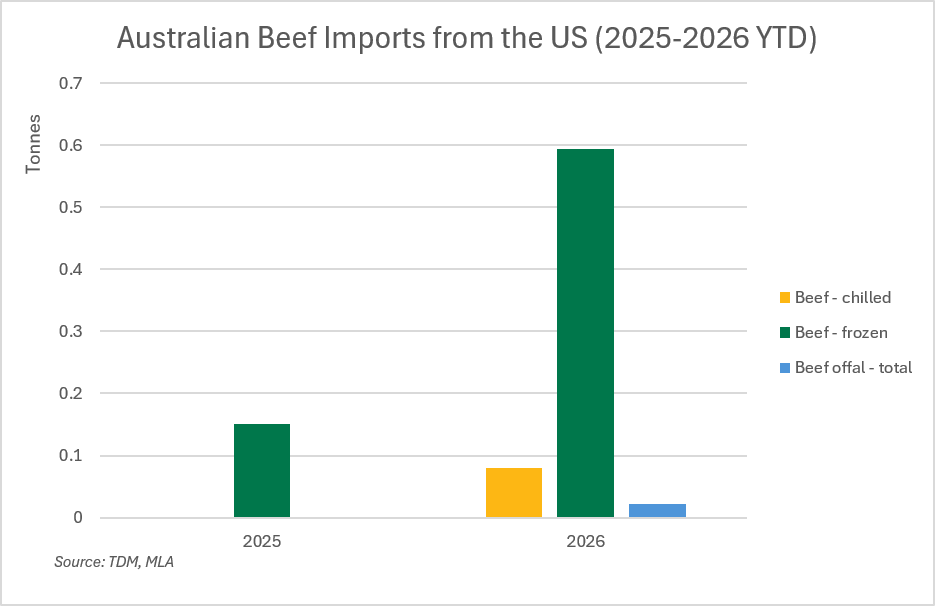
As this graph shows, total US beef imports last year reached just 150kg – all frozen. For calendar year 2026 to date, frozen volume has reached just short of 600kg, with chilled totalling about 80kg and offal, 20kg.
That means since the trade resumed a year ago, all US beef and offal imports have totalled less than 850kg. That does not even fill the tray in a one-tonne ute.
US beef had not been seen on these shores since a ban was imposed during 2003 after BSE was discovered in the US beef herd.
While US beef has technically not been banned from Australia since 2019, country of origin labelling requirements ensuring that beef did not come from cattle bred in Canada or Mexico prevented it from being eligible for export to Australia earlier. The re-opening in trade announced back in 24 July last year allowed for expanded access to include beef sourced from cattle born in Canada or Mexico which is legally imported and slaughtered in the US.
US exporters had to be able to demonstrate full traceability back to the farm-gate to enter Australia – in line with Australian industry requirements.
What remains a mystery in early trade is why frozen volume has exceeded chilled, by a considerable margin. Earlier, it was assumed that premium USDA Prime grade steaks produced from chilled beef would be the primary target of importers, for use on a few high-end restaurant menus.
Given the volumes listed above, it’s likely that less than 250 such steak portions have been sold in the past 13 months.
“An historic win”
Back when the trade resumed in July last year, US president Trump proclaimed the move as an “historic win for American Ranchers.”
“We are going to sell so much to Australia because this is undeniable and irrefutable proof that US beef is the safest and best in the entire world,” Trump proclaimed on Truth Social. “The other countries that refuse our magnificent beef are in notice.”
US beef was initially banned in 2003 following an outbreak of Bovine Spongiform Encephalopathy, which can lead to the fatal human brain disorder Creutzfeldt-Jakob disease.
At the time that access was restored last July, National Cattlemens Beef Association president Buck Wehrbein said, “For 20 years, US beef was denied access to Australia while Australia exported $29 billion of beef to US consumers. The lack of two-way, science-based trade has been a sticking point for many years, and we are pleased that President Trump has successfully opened the Australian market to American beef.”
“NCBA has spent decades working to correct this trade imbalance and we are proud to have a President who is willing to fight for American farmers and ranchers, expand export markets, and fix unfair trade agreements across the world,” Mr Wehrbein said.
“The US is the gold standard for safe and delicious beef, and we have some of the highest animal health and food safety standards in the world,” said NCBA executive director of Government Affairs Kent Bacus.
“Opening the Australian market to American beef will benefit our producers at home, while also offering Australian consumers the opportunity to enjoy our high-quality beef. We greatly appreciate President Trump delivering another win for America’s family farmers and ranchers.”
BBQ celebration
The US Consulate in Sydney celebrated the restoration of US beef access with a barbecue event in February this year. Beef Central attended, and wrote this report.
“Where’s the US beef? Now in Australia!” the consulate wrote in one of its posts on the topic.
https://www.facebook.com/share/r/19LTPPi913/
“We welcomed the arrival of US beef through a special launch highlighting the range, value, and quality of American beef. Through this historic trade win, we are supporting American farmers and bringing America’s bounty to the world!” it wrote.
The consulate’s Facebook posts were bombarded with anti-US beef sentiment – some of it ill-informed or simply zenophobic – mostly questioning the food safety, quality, or simple economic sense in importing US beef. The common message was that Australians just aren’t interested in foreign beef.
However many missed the key point that as a supporter of free-trade principles, it is beholden on Australia, as a massive exporter of beef to the US, to provide equivalent access for US product – provided it meets our scientifically-based expectations around food safety, and traceability integrity.
Some US citizens also weighed-in on the Consulate’s Facebook posts, asking questions like: “Why are we sending beef to Australia when we have a beef shortage here?”
One of the un-answered questions about the small volume of US beef that is arriving on these shores is whether any of it was produced using the growth promotant and muscle-building agent ractopamine – widely used in the US beef industry, but not registered for use in Australia. Some say this represents an unfair production advantage.
- Beef Central wrote this report back in July last year on the likelihood of US beef trade into Australia : Sums show US beef exports to Australia would makes zero financial sense
How insanely short-sighted is this trade?
US production costs will shift, as will ours, over time, and more US beef may come to our shores. Beef is fine – but not the spread of disease. How can we be 100% confident no disease will ever be imported? Anything less than 100% is not acceptable. Even the “ute-load” puts our industry at risk!
pResident trump will soon be announcing another ‘historic win’ in opening up the sale of high quality American snow to the Eskimos ….