
If you are a young person starting out in the beef industry, then you could have done worse than listening to Tim McGavin’s speech at last week’s Young Beef Producers Forum in Roma.
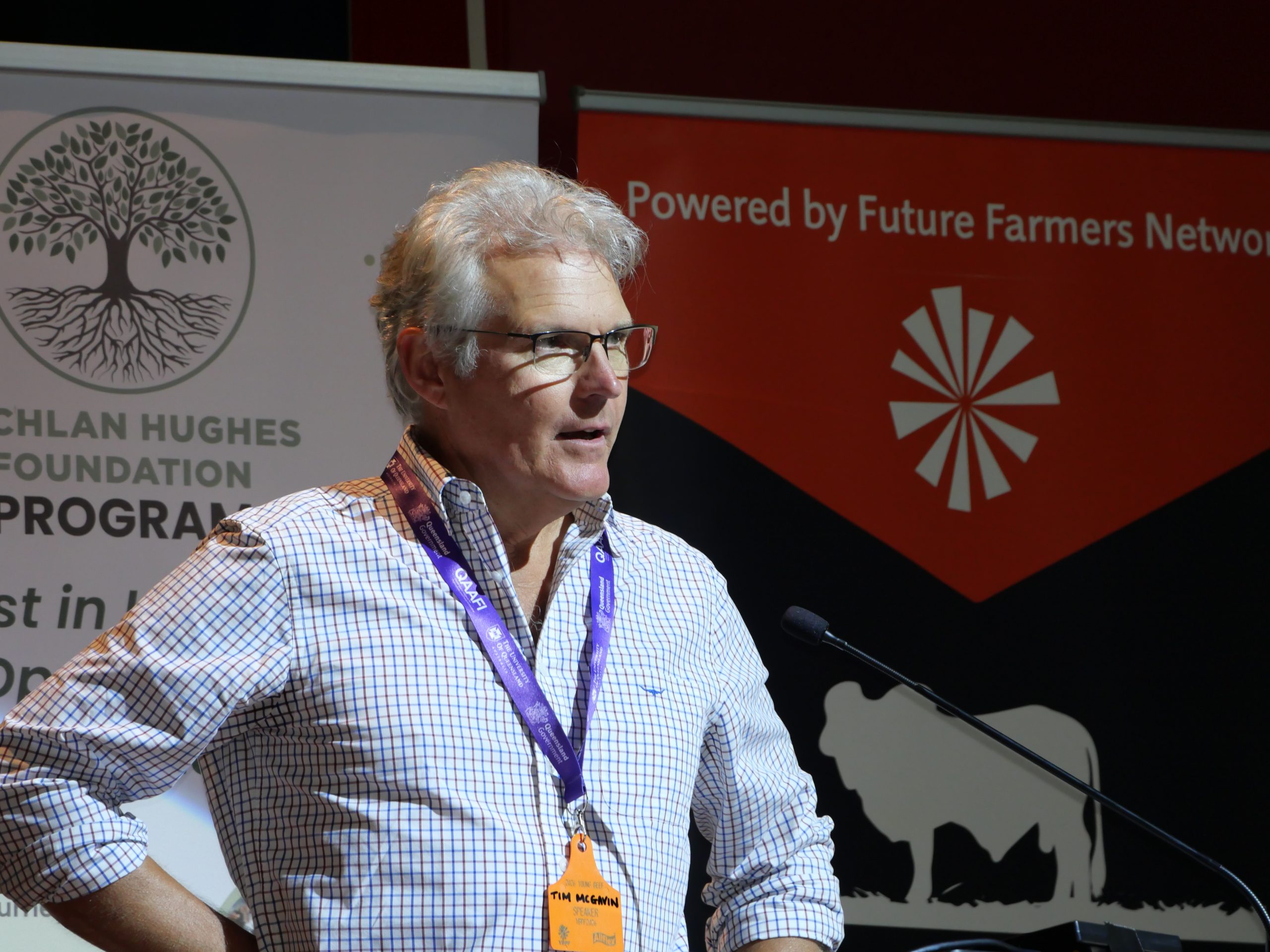
Tim McGavin presenting to the Roma Young Beef Producers Forum.
Tim’s speech was a logical extension of last year’s event, which heard his older brother Rob McGavin’s story of building the billion-dollar olive oil business Cobram Estate. (which was in Beef Central top 10 most popular stories last year)
In a speech that combined humour with some tough realities, Tim ran the crowd through the life lessons he learnt in going from a western Queensland kid who had enjoyed a few good times in Roma to building Laguna Bay, an investment fund management company that now manages almost $1 billion of agricultural assets.
Tim is the founder and chairman of Laguna Bay, whose funds owns a majority stake in Allied Beef in partnership with James McLean and has interests in dairy in Australia and NZ (milking 12,000 cows in each operation), oysters, almonds, turf, stone fruit, cropping and wine, and he is also a co-founder and director of listed energy company LGI.
But as Tim told the crowd, while the numbers on the outside might look impressive, the life lessons learnt along the way were more valuable to someone trying to make their way in the industry.
You are in a good industry
The first life lesson was that the people in the crowd were going into an industry well suited to the current economic times.
“You guys are in the right place. You are in a real industry with real assets which is highly correlated to inflation,” he said.
“If you can convert your cash into something real, whether it is cattle, land or just buying a house, that will serve you well during inflation.”
School marks are irrelevant
Rob and Tim both come from a station at Barcaldine and were largely raised by their father after their mother died when Tim was six. It was an upbringing that included a healthy scepticism of the education system.
In Rob’s speech last year, he spoke about how their father was always of the opinion that school should not get in the way of a good education, which meant many days of primary school were missed and holidays from boarding school were spent working blisters back into the school-softened hands.
Which leads well into Tim’s second life lesson, “school marks are irrelevant”.
“I really struggled at school. I was as dumb as dog shit and failed everything, particularly mathematics,” he said.
“I actually didn’t think I could count and then when I put myself through Marcus Oldham at the age of 24, after six gap years, I was getting 98 percent for accounting.
“The lesson there is that your school score is just totally irrelevant, no correlation with your ability at all. If you find something you want to apply yourself to and you like it, then the sky is the limit.”
He said the evidence backs up this point “studies show that IQ contributes about 20 percent to success. Too much IQ can do you in.”
Some of it is just luck
While there has been plenty of hard work and strategic thinking along the way, Tim said some parts of his success have been down to luck, especially with his family.
 “I think there is a bit of luck in who your family are and I got lucky there. In my case, Rob is one of the smartest, wisest, most generous people I know and we are just best friends,” he said.
“We ring each other all the time and we are constantly sounding ideas out with each other.”
He said it was important to recognise when you are lucky.
“I think having a positive mindset and just never playing the victim. If you hear yourself or hear one of your mates playing the victim, give them a kick in the pants because that will do you in.”
Smart people sometimes lack judgement
After leaving school and doing some work in the Kimberley, Tim moved home to start an aerial mustering business, just in time for the 1990s wool crash.
He explained how the floor price scheme was created and blew up in a way that was extremely hard on the people involved.
“You could not sell sheep and the government was sponsoring a program where they would pay you $6 a head for a young sheep and $2 a head for cast-for-age older sheep – and you would have to shoot them,” he said.
“So, I shot tens of thousands of sheep in western Queensland and it was really depressing.”
Tim said it was worth taking the time to read about the wool crash and learn some of the obvious lessons from the policies of the time.
“If something doesn’t really make sense, it’s probably not going to be sustainable,” he said.
“Smart people on committees, and in Canberra, could still get things badly wrong.”
Get succession on the table somehow
With wool crash and corresponding drought making western Queensland a tough place to live, Tim and Rob were keen to get out of the area. Tim went to Marcus Oldham College, where both brothers are still closely involved today, with Rob chairing the College Council.
They then bought their first vineyard in South Australia for $250,000, with their father letting them use the property at Barcaldine as collateral to borrow the money.
“That gave us a big head start in life and the big lesson there is succession. If it is not on the table already, you need to get it on the table somehow and if you can’t get it on the table you probably need to look elsewhere – or at least threaten to,” he said.
Vineyards were a completely new area for both the brothers.
“We didn’t even have a wine glass,” Tim said.
“But we did case studies at Marcus Oldham and Rob’s wife was living on a winery in South Australia. Through that connection we were able to establish the vineyard.”
The vineyard was a successful venture, doubling in size each year using 100pc debt and retained earnings.
Good contracts were key to the success of the vineyards, they signed 15-year deals with some of the big family wineries that paid per acre rather than on the volume of grapes, with minimum prices and premiums if the quality was right.
“We would get the upside when the quality was good and there was no downside because we were paid per acre, which meant there was no delivery risk,” he said.
“Very hard to do that. I have only seen a contract like that once in my life since.”
While their time in grapes was extremely successful, wine grapes started to become oversupplied in the late 1990s and the McGavins decided to trade out of vineyards.
“Thank God we did that because we would both be broke now if we decided to hold on instead of trading out of it,” Tim said.
You need to talk about mental health
By the time Tim was in his late 20s/early 30s, he had gone through the grim job of shooting sheep and onto the success of the vineyards.
He also hit struggles with anxiety and depression at a time when everything seemed to be going well, from the outside.
“It wasn’t the polished Instagram version, it was the real version where your mind becomes the enemy and you lie awake at night, you catalogue everything you have done wrong, who you have offended, where you have fallen short, who you have let down.
“You basically compare your inside to everyone else’s outside. I didn’t talk about it at all, I was pretty good at hiding it and work killed the pain. But I talk about it now because the cost of not talking about it is too high.”
Finding meaning and purpose
Tim says self-awareness and mental strategies to deal with stress and setbacks are critical. He also told the crowd it was important to find a purpose in life.
“One of the best books I have ever read is a book called Man’s Search for Men, it was written by a Jewish Holocaust survivor in World War Two and he was a psychologist,” he said.
“He realised among all the atrocities that he was living through an experiment. He worked out that the people who lived through the Holocaust in those concentration camps were the ones that had meaning and purpose in their life.
“It didn’t matter how small that was. If you are were a smoker, your meaning and purpose was trying to find cigarette butts, if you had family there, your main purpose was keeping them alive.”
He said the organising committee of young beef producers was a good example of people working hard for a purpose.
Finding your edge
Having traded out of the vineyard, Tim looked to an experience he had with his first boss to start thinking about his next venture.
The late John Dunnicliff, who pioneered a lot of water development on Beetaloo Station in the Northern Territory, had sold Isis Downs to Consolidated Pastoral Company and had explained to Tim how the wool crash was coming.
“He sold that property for a record price. Values did not move for about 25 years after that,” Tim said.
“He sat me down in 1989 and said ‘cash will be king because the wool industry is going to blow up, artificial prices do not work’ and then he explained how that is going to work. I didn’t listen, of course, because I was too young.
“But I really wanted to understand how you can be that smart and how you can have such a good understanding of economic cycles.”
Tim studied for an MBA at Macquarie University in Sydney and had been trading wool futures, which was reasonably successful.
Being “young and dumb”, he decided he wanted to experience more of the world and went to Chicago to study futures markets on the Chicago Mercantile Exchange (CME).
He set himself a trading budget and decided to short US live cattle futures which were trading at record highs – essentially betting that cattle prices were going to drop.
But the market moved in the other direction, mad cow disease was detected in Canada in May 2003, leaving a shortage of cattle in the market and prices rose limit up (maximum price for a trading session) for 14 consecutive sessions. The margin calls came to 120pc of the budget Tim had set himself.
“The lessons there are really simple. Do you have an edge in what you’re doing or do you not? And clearly, I didn’t have an edge in that, I was shit at it and when you find yourself in a hole, sometimes you need to stop digging, which I did and I never went back,” he said.
Tim said he always had an interest in investing and had spent enough time around good agricultural businesses to know where he could back good people and good assets. That became the basis for Laguna Bay.
“We don’t own all those assets,” he reminded the crowd.
“Laguna Bay puts its own money in alongside the institutions that invest with Laguna Bay and part of what the business earns depends on how well those investments perform.”
Learn how to pick yourself up
Tim said he has been lucky to observe a lot of high performers in his life and had taken a keen interest in what makes people tick.
Something that clearly made Tim tick was knowing that a lot of high performers are not particularly gifted in anything.
“I am not naturally talented at anything. I genuinely cannot point to one single thing I was born good at,” he said,
“I wasn’t the smartest in the room, the fastest or the most gifted. But here I am talking to you so there is hope for everyone.”
He used a quote from Warren Buffet’s business partner in Berkshire Hathaway Charlie Munger, who said “it is easier to avoid stupidity than to chase brilliance”.
“You don’t have to be a genius. You just have to make fewer bad decisions than everyone else. That is the whole game,” Tim said.
“If you take full responsibility for yourself, your life will be a sum of all the decisions you make.”
He said time management and discipline were a big part of that. Doomscrolling could chew up plenty of time and, as Tim pointed out, we all have the same number of hours in a day as Elon Musk.
- That interest in what makes people tick led Tim to set up Marcus Minds with Marcus Oldham College. It’s a free online program for anyone wanting to get more out of themselves, and it covers some of the things he spoke about in Roma, from dealing with self-doubt to making better use of your time. Marcus Minds
HAVE YOUR SAY