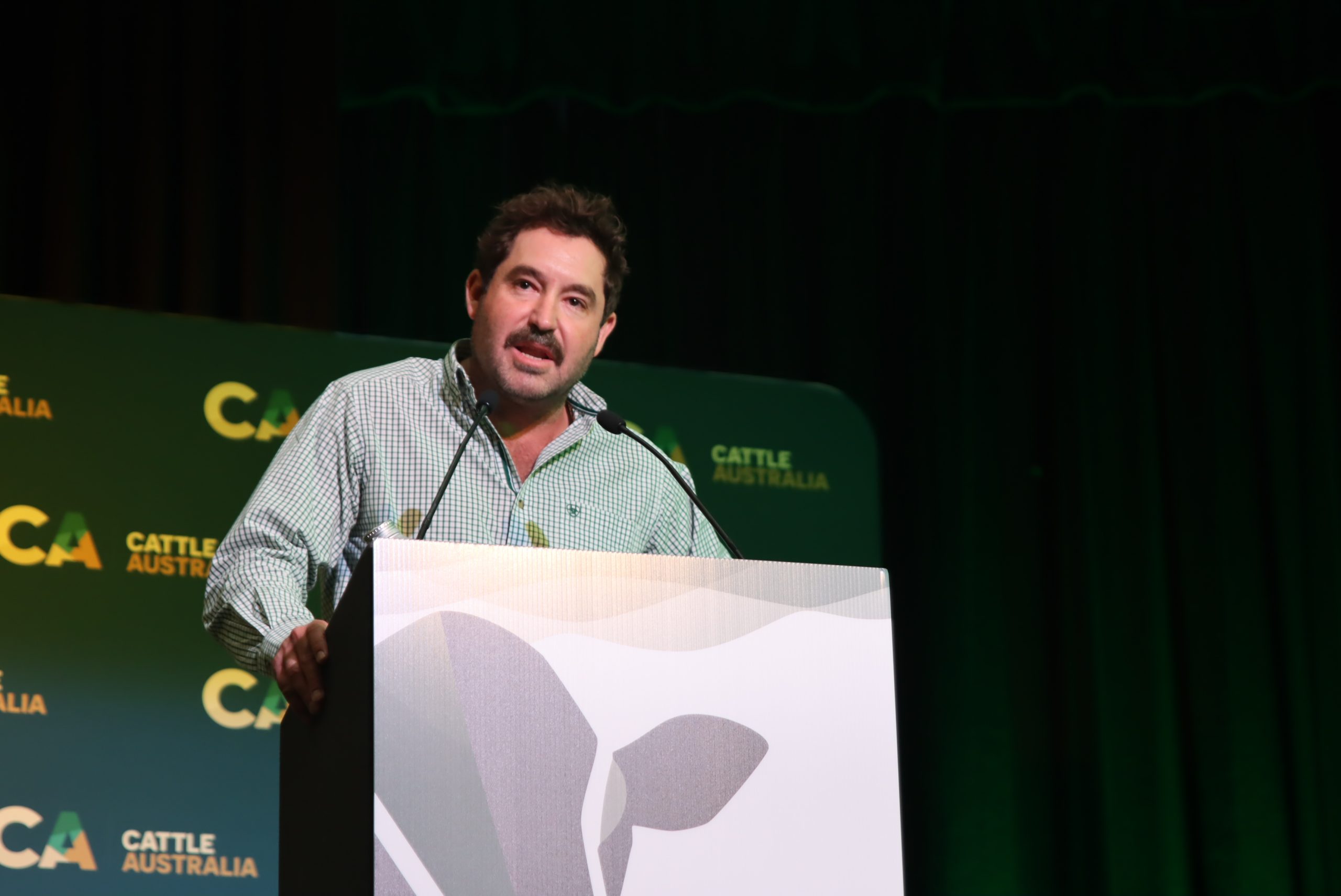
Not long after taking the stage at Wagga Wagga to update the Cattle Connect 2026 audience on the cattle transaction levy review last Friday, committee chair Bryce Camm paused to reflect on what the experience had meant personally.
“I guess when they’re giving out jobs in life, taking on chairing the levy transaction review committee is definitely not one of those ones that you stand up and beg to take on,” he said.
“And having had the opportunity to lead this process on behalf of the committee and our industry, I can also tell you I now fully comprehend why we probably haven’t done this in 20 years as well.”
But take it on Cattle Australia did.
Over seven weeks, members of the review committee, the Cattle Australia board and staff attended meetings at 33 locations across Australia, including small district halls and gathering places little known outside their local communities.
Cattle Australia CEO Will Evans attended all 33 meetings – about 25,000km of air and road travel in seven weeks according to our rough calculations.
The review committee could have chosen to concentrate its consultation in a smaller number of larger regional centres. Instead, it made a deliberate decision to take the conversation to many places including those where industry representatives don’t typically turn up, Mr Camm said.
“You know, no one holds consultations at the Oasis Roadhouse north of Charters Towers, or the Buckland Community Hall west of Springsure, and you don’t typically turn up in Moree talking about the cattle transaction levy.
“We did that on purpose because it’s time that this industry got back to focusing on the people who are the heart and soul of it, and that is grassfed producers, and taking the conversation to them to find out and hear from them and involve them in this.
“I made the comment about the 20 years earlier, but it has been one of the biggest detriments in this process that we haven’t looked at this in so long, because people have kind of forgotten about what the context is of the levy, how it works, its architecture, what we’re trying to do with it, why it ever existed.
“And I really thank you know the committee and Will for the way that they stepped through those consultation processes.”
So what was achieved?
Mr Camm said for many producers, the first question was always how much was the committee planning to increase the levy.
But he said the review process was never intended to start with a quantum figure.
He said the committee’s starting point was to look at the fundamental reasons for having a levy and and what those funds were intended to achieve.
It was noted during the review process that if today’s levy was to have the same buying power as it did when the $5/head levy was first introduced in 2006, it would have to be raised to $8.26/head now.
But Mr Camm said the review rejected that approach, pointing to some perspective offered in a conversation with a veteran industry leader.
 “I had the opportunity to sit down with David Crombie, a previous chair of MLA and who was involved in previous reviews, and his reflection to me was: anyone that’s talking to you about the time cost of money in the levy probably hasn’t thought about why we have a levy, because the investment or the quantum of what we might have generated in the past shouldn’t determine what we need in the future.
“And I think it’s really important.
“These are socialised funds to meet a specific need of meeting the investments required, where we have market failure, or where we have to make investments on behalf of the industry that individual businesses or individual producers cannot make on their own.
“So that whole conversation about whether it should be linked to inflation and those types of things, we the committee rejected those because we think it’s prudent to look at what are the requirements into the future, and what’s the level of the levy that exists around.”
In assessing the levy he said the committee considered five principles comprising the value being delivered by the existing levy, the flexibility to direct funding towards different priorities, potential new and emerging investment needs, the timing of future reviews and the resourcing of industry representation.
It was clear from feedback that producers wanted to have more flexibility to adjust levy streams.
The review found some existing programs warranted closer examination to determine whether they still address a market failure and justify further funding.
Biosecurity was another recurring topic as the committee travelled around the country. The review recommended more strategic industry levy investment in biosecurity, but also emphasised the point that cattle producers should not be expected to fund all of their own biosecurity protection through their levies.
The Government also had an important responsibility to protect national borders and maintain the biosecurity framework for the nation as a whole.
Another clear message was that the industry should not wait another 20 years before having reviewing the levy again, Mr Camm said.
Aligning future levy reviews with the development of the red meat industry’s strategic plans made good business sense.
“To tie having the conversation around our strategic direction and what are the big, bold things that this industry and our other protein partners want to take on in the red meat space in the next 10 year horizon, and then having a conversation about how best you match the levy investments to support that, I think is really smart business.”
Looking back at the industry’s achievements, Mr Camm pointed to the eradication of brucellosis as an example of a major challenge tackled collectively, one that had helped create opportunities for cattle producers, particularly in northern Australia.
The question now, he suggested, was what the next major challenge might be, and whether the industry had the structures and funding in place to pursue it together.
The review recommended that a series of reforms be completed before a proposed $1-a-head levy increase could take effect from July 2028. These include a detailed assessment of program areas and the creation of a dedicated funding stream and independent board for the Integrity Systems Company.
“We’re asking for all of that work to be done by July 2027,” Mr Camm said.
“If this is supported through the vote in November, and then if that was to be the case we would support the levy being increased by $1 by July 2028.”
During his presentation Mr Camm also acknowledged MLA’s openness, transparency and engagement during the review process.
Making the industry’s voice stronger
Mr Camm told the audience the committee’s recommendation also aimed to provide more clarity for producers on how their industry is promoted and defended.
“Too often we get told about who can do what job and what levies can be spent on and everything else.
“This is really unashamed clarity of investment of funds to defend our industry and advocate for our industry, and putting that funding in cattle producer’s hands – that is its not out somewhere else.
“It is putting cattle producers front and centre of that story, I think is really really important.”
Funding allocation charts showed during his presentation proposed around 60 cents being directed towards industry representation, capability, education and defence in future.
Asked what that would look like, whether the funding would flow directly to Cattle Australia, and how it would be used, Mr Camm noted that it was not all new money.
“I guess in the committee’s work of proposing the 60 cents, it does look a lot at the comms and industry development or capacity building programs and investments that currently sit within MLA, and looks at that as a holistic area.
“So the work is still in front of us, it’s not necessarily about that funding all coming to Cattle Australia, but it is saying that this is really core and important work for our industry that that we need to manage with a dedicated allocation, and that that it needs to be ensuring that it’s front and centre.
“I think the conversation on where certain aspects of that program sits in collaboration with MLA is really the conversation between now and July.
“We’re not about rebuilding wheels that already exist, but at its heart and soul, the cattle representative body should be driving the conversation that delivers the outcomes for promoting and advocating for our industry, and it is that funding that we we think is required to ensure that we’ve got strong programs in that.”
‘It’s cattle producers’ levy’
After a year-long levy review process launched at the Cattle Connect 2025 conference in Dalby, Mr Camm said the next step was now in the hands of the producers who paid the levy.
With the review culminating in a vote of levy payers at the MLA AGM in Townsville in November (levy payers can cast their vote now online – see details here) he encouraged producers to engage with the recommendations, take part in the debate and urge others to have their say.
“For all of you in the room today, I really encourage you, please, please vote, please hassle your neighbor to vote, get on social media and encourage them to vote, because this is our levy. It’s not the government’s levy. It’s not MLA’s levy. It’s cattle producers’ levy.
“And this organisation and the people on that committee have done the work to give us the opportunity to support or not support those recommendations.
“Get involved in the debate because that’s important. We all pay the levy, and now is our opportunity to have a say about that.”
BALLOT DETAILS
Ballots close 3.30pm (Qld time), Sunday 22 November, ahead of the MLA AGM in Townsville on Tuesday 24 November.
Levy payers don’t need to be MLA members to vote. Voting packs were sent in October by email or post. Check junk folders and letterboxes for mail from Meat & Livestock Australia Limited. Non-members should look for the subject line “Grassfed Cattle Levy Ballot 2026”, and MLA members for “2026 Annual General Meeting”. No pack? Call MLA on 1800 023 100 or email membership@mla.com.au. You don’t need to be a member to request assistance.
More information: https://www.cattleaustralia.
I think that the large cattle producers could pay more; small producers with small herds pay less
we operate 2 companies and 3 family members are registered primary producers all have cattle registered brands and paying levy.
Only 1 company has received a voting ballot. we have tried to contact Computorshare with names ABNs and contact emails … no reply.
Is this a genuine vote or a managed one?
Hi Rod
If you call 1800023100 they should be able to help you. Computershare is just the online platform for voting
Being a vehement supporter of democracy, I would like to point out when the inaugural CA Board was put in place on less than 5% of grass-fed levy payers, I wrote to the board asking, “Could the board forward the number of votes received by each person who nominated for the board before the weighted voting system was applied and then the total number each candidate received”. After a 12 month hassle I was told you are not a member of CA so you can’t have that information. I pointed out that when compulsory acquired money from MLA and RMAC was used to keep a voluntary organisation functioning “We have a serious problem with democracy”. Now that the review process is coming to a close it appears there are 3 main points, a detailed assessment of program areas, dedicated funding stream and an independent board for the Integrity Systems Company. What is the criteria for voting, is it one vote per grass-fed levy payer or is the weighted system be enacted, I haven’t seen any reference to being a member of CA. There is enough wriggle room in those 3 assessments to have the dollar applied which is not only a 20% rise but more importantly it is approximately $13 million from the industry. Democracy is being denied again.
Given ROMA QLD is named the largest selling center
wouldnt this be a place to hold a discussion?????
It’s a 20% increase – to fund what incremental activities exactly? 20% more activity or just more expensive existing activities? It seems this isn’t known, hence the need for this 12 month program of work. As for biosecurity, it seems we have so many feral animals whose control is inadequate, that biosecurity measures within supply chains are increasingly likely to be rendered ineffective at some stage. The article above says the levy is currently used to address market failure – what failures exactly and if they exist why aren’t other regulatory bodies, like the ACCC for one, addressing them. I’m not convinced the case has been made to warrant a levy increase. It may be a per head levy but at the end of the day it feels like just another tax coming out of a producer’s bottom line – it’s a government mandated scheme afterall.
It seems that as of today (28th Oct) that there are still a great number of producers/levy-payers who are completely *unaware* of the opportunity to vote before the 22nd of November.
The time frame to spread awareness is short.
Can anyone confirm if there has been ANY attempt to *directly* contact eligible levy payers who are *not* members of any industry organisation?
(aka, vast majority of levy payers)
And if so, by what means?
(email, post etc)
Thankyou.
Hi Michelle
You can call 1800023100 or membership@mla.au (regardless of if you are an MLA member)
With the long established $5 apparently needing to increase by 65% to $8.26 to meet equivalency today, its also worth noting the increase in value of the levy stream over the same timeframe due to increased number of transactions. The MLA Annual report for 2005-06 noted $80 million in levies income (grass, grain, sheep and goats). Recent levies income totals $128 million, a 48% increase from 2006. The proposed $1.00 increase in the levy obviously recognises the added income from increased transactions and would help return the levy income to a similar buying power to 2006. Sheep levies are also a significant contributor to the package and need their own review from time to time.
if those number represent the amount recieved No increase Needed
is ther a balance sheet to show responsible spending o results avhieved that benifit the levey payers
Biosecurity is a joke Fire Ants for one