
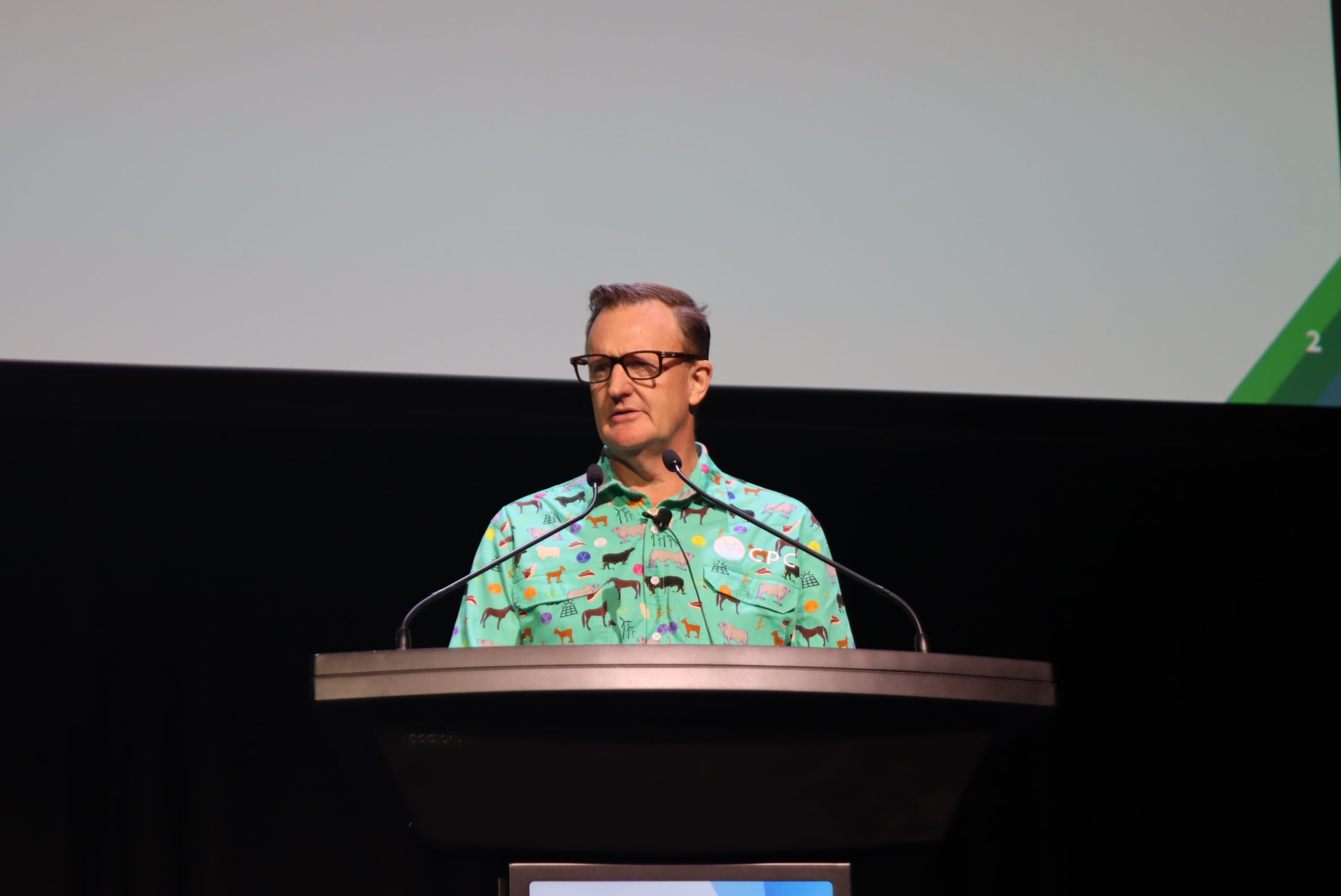
CPC CEO Troy Setter addressing the Societal Role of Meat and Livestock Conference in Geelong this week. The loud shirt was more than just a bold fashion choice (see more detail below).
FROM helping Indigenous children in remote Australia access nutritious food to providing Indonesian smallholder farmers with a pathway out of poverty, one of Australia’s largest cattle businesses is demonstrating how livestock production can deliver benefits to society far beyond the beef it produces.
When Consolidated Pastoral Company CEO and director Troy Setter addressed a gathering of international scientists at the Societal Role of Meat and Livestock conference in Geelong earlier this week, he had slides filled with impressive cattle production statistics to share.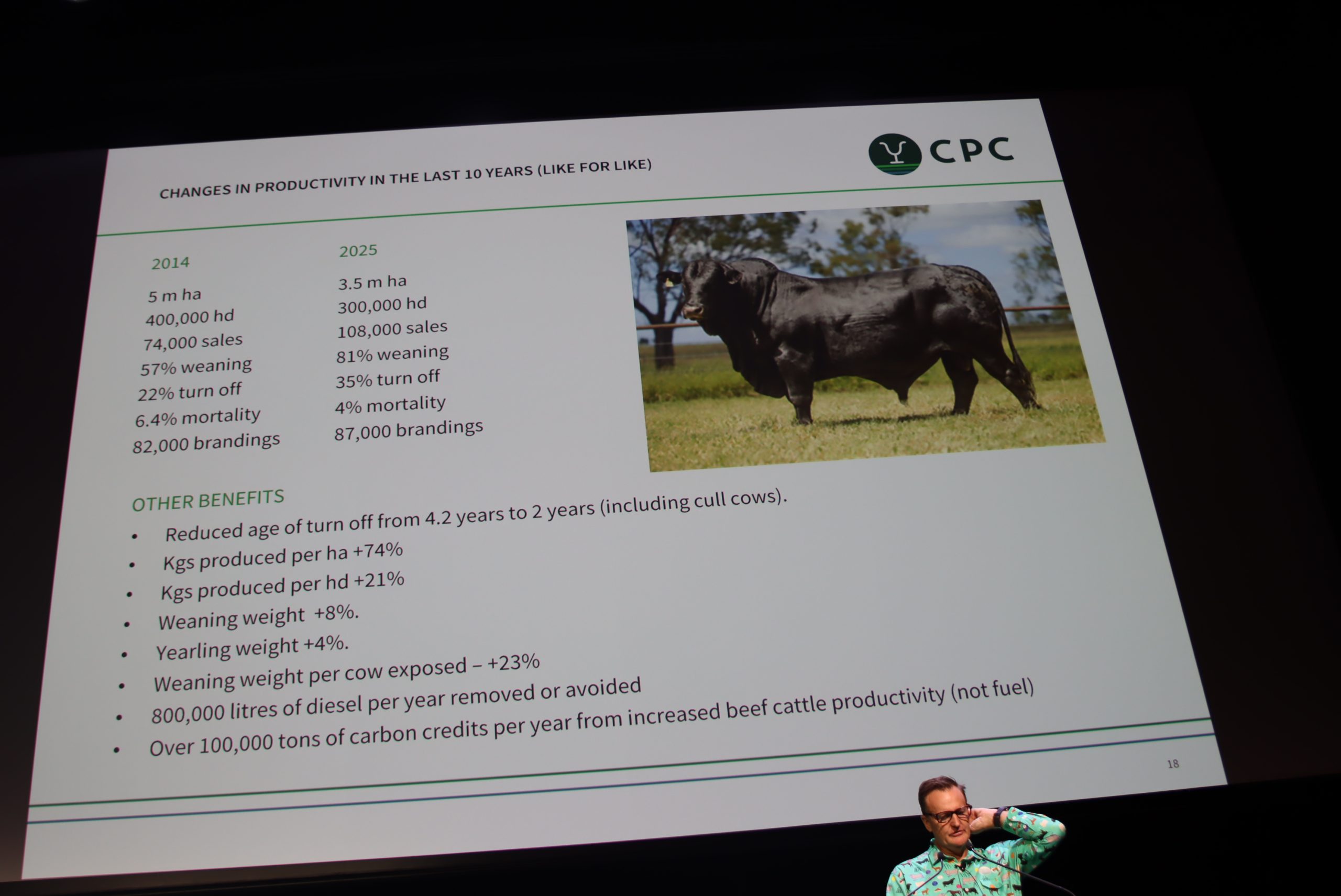
As the above slide shows, over the past decade, CPC has substantially increased the productivity of its northern Australian cattle operations, producing more beef from fewer cattle while reducing emissions and improving land management outcomes.
But some of the most attention-grabbing details of the company’s work that was shared with the global conference were not even directly related to cattle production.
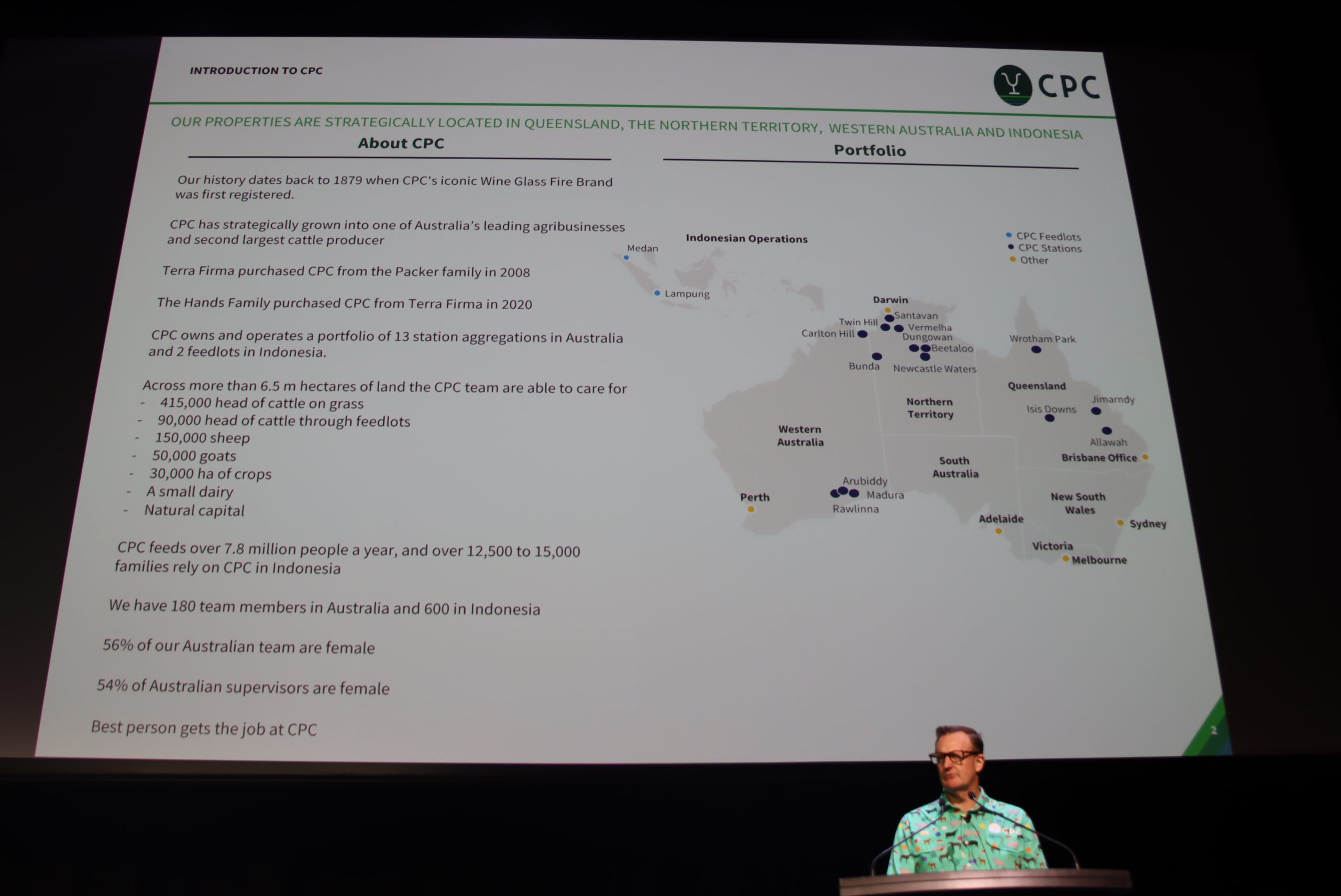
CPC traces the history of its famous wine-glass brand back to 1879 and today operates around 13 cattle stations across northern Australia, including three Indigenous-owned stations managed through partnerships or leases with Traditional Owners, and two feedlots in Indonesia.
The vast operation runs approximately 415,000 cattle on grass, and has diversified into sheep, goats, cropping, dairy and natural capital projects.
But beyond its agricultural activities it also strives to make a meaningful difference to the lives of the communities it touches.
This includes helping Indigenous children on remote northern Australian cattle stations learn to grow vegetables, collect eggs and prepare nutritious meals.
In Indonesia CPC provides families who previously owned virtually nothing with access to cattle, training and mentoring, a program that has enabled those families to build assets, buy land, establish homes and send their children to school.
Helping Indigenous communities improve nutrition
CPC’s engagement with Indigenous communities extends beyond employment and cattle station management into food education and nutrition.
With support from Meat & Livestock Australia, the company has organised cooking courses to help community members prepare food and understand balanced diets.
One CPC director had also forgone directors’ fees for several years to help establish community vegetable gardens on cattle stations.
Chicken sheds have been incorporated into the projects, providing fresh eggs while teaching children responsibility through the daily task of caring for poultry and collecting eggs.
Mr Setter recalled one particularly confronting experience.
“It was pretty sad this year, though, that we had 12-year-old girls that live on our station that had eggs for the first time.”
“Malnutrition is not just a Southeast Asian problem; it’s an Australian problem, and the opportunity with agriculture is really significant.”
Cattle providing pathway out of poverty
Mr Setter told the conference the business produces the equivalent of approximately 7.8 million beef meals annually, including offal, while an estimated 12,500 to 15,000 Indonesian families depend on its operations for their livelihoods.
 “What keeps me awake at night, apart from staff safety in Australia, is those families in Indonesia,” Mr Setter said.
“We are absolutely committed to them.”
CPC has developed a smallholder cattle program in which participating farmers receive a pregnant cow, with calves returned to CPC. Cows are replaced at the end of their productive lives and farmers also receive ongoing coaching and mentoring.
“Just about every farmer we’ve had in the program had zero assets before they started with us,” he said.
“They couldn’t put their children through school. They didn’t own a motorbike and were doing piece work and living with family. There’s several hundred farmers that have gone through this program, and it’s not easy to say the least.
“We’ve set up mentoring programs, but the ability of cattle and livestock, we see that now happening with goats as well, for people to then get a motorbike, then build up some equity, then get land, get a house, and put their children through school, is unbelievable.”
Closing the loop in Indonesia
Livestock in CPC’s Indonesian feedlot operations also provide a circular role within the local agricultural system, Mr Setter explained.
Much of the feed used in the company’s feedlots comes from byproducts from human food production, including cassava chip (bark) and other materials supplied by local small holder farmers, while the manure the feedlot cattle produce is returned to surrounding cropping enterprises.
Mr Setter said CPC’s Indonesian feedlots generate approximately 60,000 to 80,000 tonnes of manure annually, virtually all of which is returned to farmland, mostly free of charge.
He also revealed that CPC feeds approximately 5000 to 6000 buffalo annually sourced mainly from Indigenous communities in northern Australia.
“Most people wouldn’t know that that CPC does this,” he said.
“There’s significant environmental benefits from getting the buffalo out of national parks, and then providing nutritional, low quality, nutritional food for people in Indonesia is is really important.
“They also rice straw, rice straw being burnt in Southeast Asia is a bit of a challenge.”
Another lesser-known part of CPC’s Indonesian business is a small dairy operation that provides milk and cheese to approximately 8000 children each day.
“It’s really upsetting to see the malnutrition challenges that Indonesia has, but they’re the same as the UK has.
“So we think about malnutrition from not enough calories or low quality calories or calories that aren’t exactly helpful, it’s great to see the Indonesian government trying to get behind using animal products to improve nutrition.”
Big changes in 10 years
Mr Setter also outlined the productivity improvements CPC has achieved across its northern Australian operations.
Using a like-for-like comparison of properties over the past decade, he said the business had reduced cattle numbers from approximately 400,000 to 300,000 and the land area involved from five million to 3.5 million hectares, while increasing cattle sales.
Weaning rates had improved from 57 percent to 81 percent, annual turnoff rates from 22 percent to 35 percent, and the average age of cattle at turnoff, including cull cows, had fallen from 4.2 years to two years.
Mortality had also declined.
Mr Setter attributed much of the improvement to better management, early weaning, disease control and stricter animal selection.
The improvements had enabled CPC to reduce emissions associated with its cattle production, he said, generating an average of more than 100,000 tonnes of carbon credits annually through the beef cattle herd methodology.
The business had also removed or avoided approximately 800,000 litres of diesel use.
CPC is now intensifying its focus on feed conversion efficiency, methane production, fertility and heat tolerance, including selecting cattle carrying the slick-coat gene.
He said CPC was also working to improve pasture composition, soil cover, water infiltration and carbon sequestration while maintaining productive grazing systems.
Its natural capital projects include habitat protection for threatened species, landscape regeneration, improved fire management and trials using crushed rock byproducts from mining to increase soil carbon sequestration.
On some properties, goats are being used alongside cattle to manage weeds and vegetation.
He said the industry gets beaten up pretty heavily by environmental activists from time to time that have a view about about native grasses, but said he believed that in reality the industry had a very good story to tell.
“I think one of the proudest things our industry can talk about is a reduction in dust storms and the improvement in in soil cover that we’ve actually achieved by both native and introduced plant species producing beef, sequestering soil at the same time is really exciting.”
Serious message behind crazy shirt
Mr Setter, donned in a loud green short emblazoned with cattle pictures, also used the opportunity to draw attention to another topic close to his and CPC’s heart.
“You might say why is Troy wearing this crazy shirt up here,” he said.
“This is CPC’s mental health shirt. it’s so important.
“Farmers have some big challenges in Australia and globally.
Farmers have felt depressed, and about two thirds of those have experienced anxiety. Close to half of Australian farmers have thought about self-harm or suicide, and about a third of those have attempted self-harm or suicide, which is just shocking.
“35pc of Australian farmers know a farmer who’s taken their own life.
“So I don’t mean to start on a such a downward topic, but I think it’s actually absolutely critical that we embrace the support of the society in meat around farmers and agriculture. We’re all in this together.”
He said one of the things that had hit him recently was the decrease in confidence that farmers have experienced about how the Australian people think about them.
“And I think as we talk about what we do in agriculture, how we engage with our industry and how we challenge our industry, but how we also deal with detractors, it’s important that that we think about the impact on farmers because we all take our job so seriously.
“We sat down a couple of years ago and thought about the Sustainable Development Goals and how the CPC fit into those, and we hit 12 of them.
“We get criticised in agriculture about not being part of sustainable development and what do we do for the world. We are probably one of the leading industries for having a positive impact, and I think that’s something that that we should promote more.”
HAVE YOUR SAY