
A Queensland feedlot is helping an Australian start-up with antimicrobial resistant expertise to fight a common cattle disease.
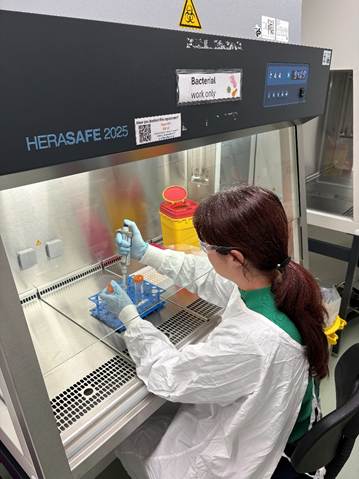
AgriCureX scientist Dr Miranda Pitt prepares bacteria collected from cattle with bovine respiratory disease for phage hunting. The work is helping researchers identify phages that may one day provide a more targeted way to manage bacteria linked to BRD.
Led by Professors Jon Iredell and Ruby Lin and CEO Belinda Vassallo, the team from AgriCureX, based at Sydney University’s Knowledge Hub, is hoping to develop an alternative to antibiotic use in animals.
Using their experience with phages to successfully treat human respiratory disease, they are looking to fight a similar illness – bovine respiratory disease (BRD) – a common problem among cattle herds, especially calves.
Predator-like phages can identify and overcome infection caused by these bacteria without harming the host animal – human or cattle or any livestock.
Feedlot staff are collecting samples from cattle for the research. They are taking nose swabs from the animals to assess the occurrence of bacteria causing BRD.
Professor Iredell has been working on phage therapy with international affiliates since 2007.
He said: ”Phages are viruses that specifically target bacteria without causing harm to humans or animals. They are the most abundant entity on earth and are found wherever there are bacterial populations, including in cattle. They have been used successfully as antiseptics for more than a century in human medicine.
Prof Lin said: “Due to the rise of antimicrobial resistance, phages have enjoyed a renaissance in modern medicine to treat difficult-to-treat infections.”
The feedlot sampling work is overseen by veterinarians and supported by co-funding from MLA.
The sampling technique is similar to what humans underwent with COVID nasal swabs. Staff take the samples from the cattle during a normal yarding , without requiring an additional muster.
The scientists are hoping to collect samples from more than 500 feedlot cattle and about 200 from beef properties, to give a variety of geographical conditions and breeds.
The sampling will continue throughout 2027. The integrated data will inform the feedlot how to handle infection control and help AgriCureX scientists formulate phage cocktails to treat the cattle with BRD. The first small pen trial is scheduled to start in mid-2027.
The company is developing a genomics-led platform to tackle BRD. Prof Lin explained: “Historically, the narrow host range of many phages made it difficult to predict whether a particular phage would work.
“However, today, whole-genome sequencing and improved bioinformatics provide much more information. Sequencing can help identify the bacteria, distinguish closely related strains and pinpoint genes associated with antimicrobial resistance. This creates the possibility of a more precise strike rate.”
MLA is supporting the work and said the project was a strong example of collaboration between producers, researchers and industry.
An MLA spokesperson said: “ It can help address antimicrobial resistance while supporting the health and productivity of Australia’s cattle industry.
“By collecting samples under practical feedlot conditions, the research will generate valuable information about the bacteria associated with BRD and help guide the development of more targeted approaches to disease management.”
They should be able to access the swab data from the MLA BRD Initiative in 2012 ( from memory) that was gathered from 13 feedlots australia wide , the data was done thru gatton uni