
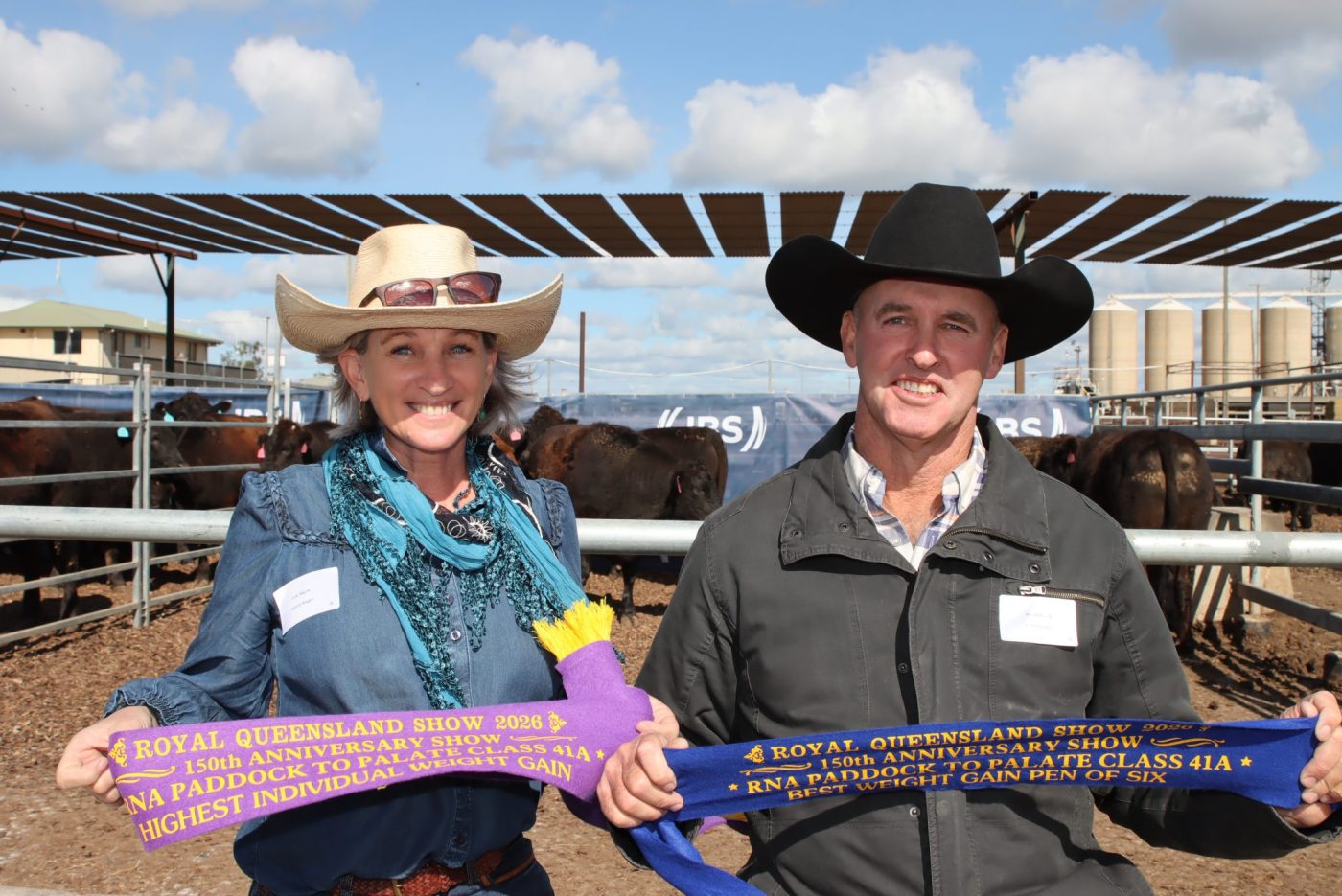
Vicki and Shane Mayne
A SMALL family-owned Queensland Wagyu operation has punched above its weight to take the first major honours in the inaugural Wagyu crossbred class of the RNA Paddock to Palate competition.
Kireina Wagyu, operated by Shane and Vicki Mayne near Chinchilla, took first place in the weight gain section of the newly-created Class 41A Wagyu Crossbred section, with their pen of six steers recording an average daily gain (ADG) of 1.33kg/day.
In second place with an ADG of 1.2kg was Red Hill Lands and in third place was Leeton Grazing with an average ADG of 1.13kg.
In the Class 39A Wagyu Fullblood and Purebred weight gain section, a pen of six steers exhibited by Leonard and Darren Henschell from Dalby, took first place with an ADG of 1.15kg, with the Maller family’s Hamilton Park Pastoral Company pens taking both second and third places with ADGs of 1.12kg and 1.1kg.
The RNA introduced separate fullblood and crossbred Wagyu classes for the first time this year, acknowledging the different production systems and feeding requirements between the two.
For Kireina Wagyu, the result draws attention to a small but dedicated operation heavily focused on genetic performance and carcase value, which underpins its own well-supported direct-to-consumer beef marketing pathway.
Vicki said competitions like Paddock to Palate were invaluable for smaller operators like themselves with 140 breeders who are seeking performance feedback on their breeding direction.
“For us, being a smaller breeder and commercial operation, we don’t have the numbers to play with so to speak, so a competition like this is able to help us just to ensure that what we’re doing with our genetics and our breeding program is on track.
“We actually can compare against those that have been in the industry for a lot longer than us and have had some remarkable success.”
Kireina Wagyu specialises in grassfed Red Wagyu beef marketed directly to consumers in Brisbane and southern Queensland, processed through local abattoirs and butchers.
Despite being a small operation they use all of the tools available for them to guide their breeding decisions, which also includes DNA and genomic testing of their cattle through the Australian Wagyu Association.
Vicki said they use the tools to strategically select for traits including oleic acid, tenderness and freedom from recessive genetic disorders.
 “One of the things we are looking for, we’re strategically selecting breeders on the fatty acid composition, so we test for the SCD gene to see that we’ve got Double Alleles there,” she said.
“We utilise as much as we can and use genomics testing for tenderness as well.
“It just helps us to get there sooner rather than later.”
Their winning F2 steers were bred from an Akaushi Red Wagyu over a Santa Gertrudis cow base, before being joined back to fullblood composite and Akaushi Wagyu bulls.
Vicki said the Santa Gertrudis influence brought hybrid vigour into the program, with strong family roots behind that breeding direction.
Shane’s father, the well-known western Queensland cattleman Ray Mayne of Green Hills, Tambo, built a highly regarded Santa Gertrudis herd that regularly topped Roma sales.
The Maynes said that splitting the Wagyu division into fullblood and crossbred classes was an important step forward for the competition.
“It was definitely the right move,” they said.
“You have just got to feed differently from purebred fullbloods to what you do your crossbred cattle, and because you have got so much more hybrid vigour you have got to really manage that.”
Vicki said they were focused on balancing weight gain with carcase and eating quality traits, recognising that weight, yield and consistency remain key commercial drivers.
“At the end of the day we’re all paid on weight, we’ve been able to show that through utilising the paddock to palate competition over the last few years we always sit up as one of the highest value carcases, we may not be the highest marbling but with that weight, yield, we’re certainly punching above our weight.
“Our biggest focus is on carcase data. We just want performance and carcase data, as much as we can get.”
Vicki said that dealing directly with customers was another great source of feedback on the direction of their breeding decisions.
“We’re getting really great feedback from our customers. I think because we are using the genomics testing for the higher levels of monounsaturated fats in them, our animals carry at least one copy of the SCD gene and we’re certainly now pushing for the majority that are carrying double Alleles so that has a lower melting point, a lot nicer eating experience and mouth feel.”
Knowledge is power. Thankyou
Congratulations Shane and Vicki! Well deserved win. Your understanding of how important the end carcass is through selling the product, combined with a wealth of experience with what works well in the paddock; plus your passion for what you do is great to see👍
Well done Shane and Vicki!