
GRASSFED and grainfed cattle levies reached record revenue levels last financial year, according to Meat & Livestock Australia’s annual report for the year ended 30 June, released on Friday.
Total annual livestock levy income (covering grassfed beef, grainfed beef, lamb/mutton and goat) reached a record $128.3 million last financial year – with big advances in both grass and grainfed beef levy streams largely responsible.
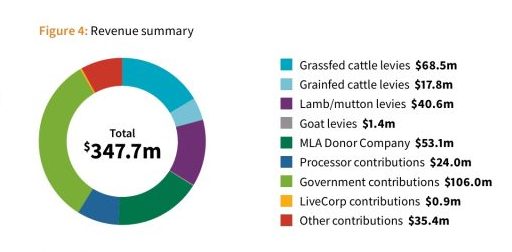
Total grassfed beef levies last year reached $68.5 million, up 11.2pc on the already-high previous year, and 18pc higher than the most recent five-year average.
Grainfed beef levies showed a similar trend, driven by the continued expansion in cattle numbers on feed. The grainfed levy stream last year reached a record $17.8m, up 15.6pc on the previous year and 20pc higher than the past five year average.
In contrast, lamb and mutton levies contracted last year, in line with flock size changes. Total lamb/mutton levies reached $40.6m, down 5.6pc on the previous year, but slightly higher than the five-year average. Goat levies were the largest seen in at least the last five years, at $1.4m, up 7.7pc year-on-year.
 MLA’s annual report said total levy income from all species last financial year reached a record level of $128.3m, up $7m or 5.8pc on the previous year.
“The uplift was largely underpinned by cattle levies, which benefited from a subdued herd in the United States, strong export volumes more broadly, and increased capacity in Australian feedlots,” the annual report said.
Cattle slaughter volumes during the period were the highest level since 1978.The result was partially offset by a $2.4m decrease in sheep levies, where several consecutive years of subdued rainfall had impacted on supply.
On top of the $128.3m in livestock levies generated last financial year, MLA raised a further $106m in government matching contributions, which increased by $18.5m or 2pc as a result of increased R&D activities, particularly via the MLA Donor Company. A further $113.4m in revenue was generated last year through ‘other’ work (mostly private sector co-contributions to R&D work).
So total revenue last year (levies plus government and private sector contributions) reached $347.7m.
Expenditure
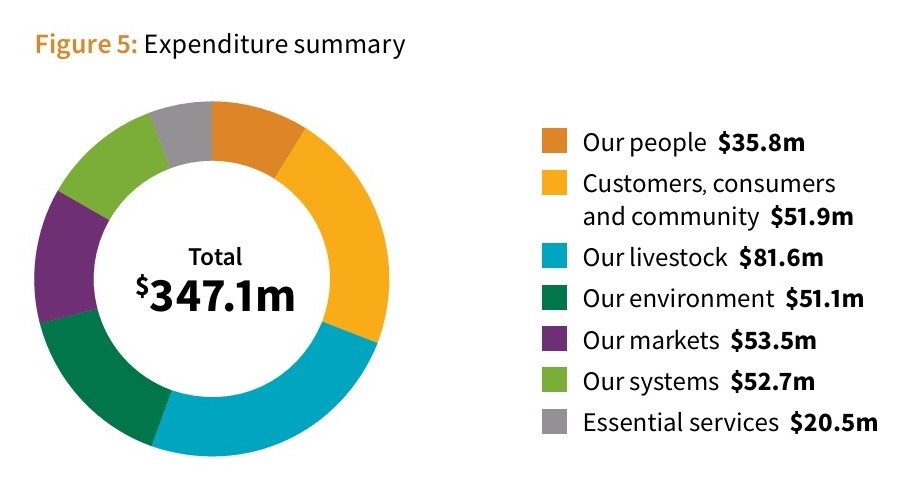
On the other side of the ledger, MLA’s total investment expenditure last year increased by 23pc to $347.1m. The uplift was primarily attributable to R&D investment, which increased by $53.8m or 29.4pc to $237m as a result of increased investment in the NLIS platform, animal wellbeing research and inaugural investments via MLA’s Livestock Technology Fund program. The total investment includes matching funds from the Australian Government and other grants.
In 2025-26, MLA completed or terminated 221 research contracts worth $148.5m. These included 68 MDC contracts, contributing a total value of $90.5m. During the year 289 new R&D contracts were commenced, totalling.$215m. As at 30 June, there were 483 active R&D contracts worth $565.6m.
Marketing, market access and insights investment last year of $110m increased by 11.2pc, reflecting the higher level of marketing levies available for investment, which have been focused on promotional activities both domestically and in overseas markets to grow demand for Australian red meat and livestock. The majority of this investment was ineligible to be matched with funds from the Australian Government.
MLA membership
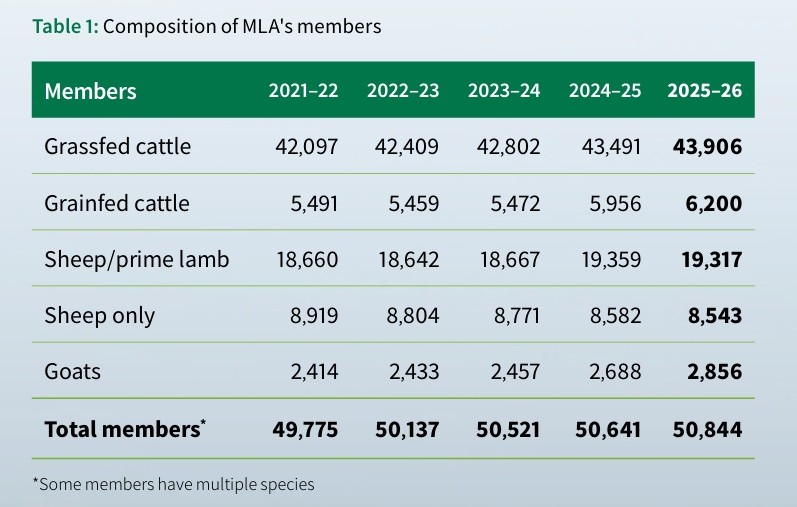
MLA membership (voluntary and free to all levy-paying livestock producers) has continued to grow, reaching 50,844 members as of 30 June this year.
The table below shows the composition of MLA’s members.
- Click here to read the 2025-26 MLA annual report summary
HAVE YOUR SAY