A STRONG lift in beef sales value on a $/kg basis was one of the underlying factors behind record first half operating profit for the Australian Agricultural Co announced this morning.
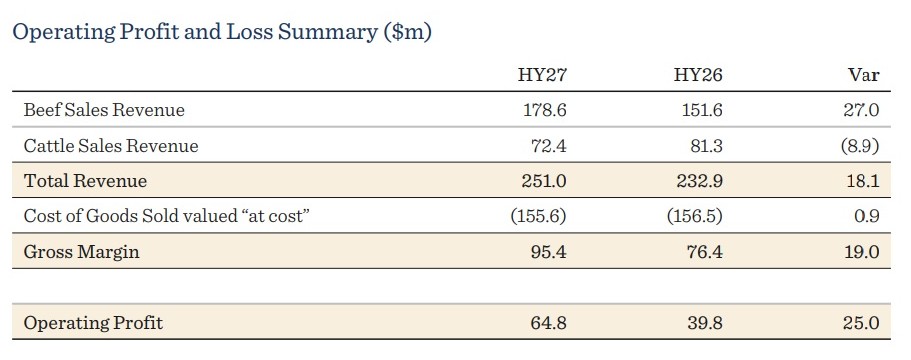
For its half-year ended 30 September, the nation’s largest beef producer delivered a first-half Operating Profit of $64.8 million, up 63 percent on the comparative period last year.
Total revenue (branded beef sales plus cattle and other forms of income) rose 8pc to $251 million compared with last year, with beef sales revenue grew 18pc to $178.6. Contributing to the strong beef sales revenue rise was a 10pc lift in average price to $20.39/kg, and a 5pc lift in volume.
Reflecting higher fuel and transport prices and other factors, cost of production lifted by a sharp 24pc to $3.04/kg.
Underlying momentum in beef
In reporting to the market this morning, AA Co said strategic global allocations, improved brand equity and underlying momentum in demand for premium beef had strengthened margins, partly offset by increased costs from geopolitical disruption.
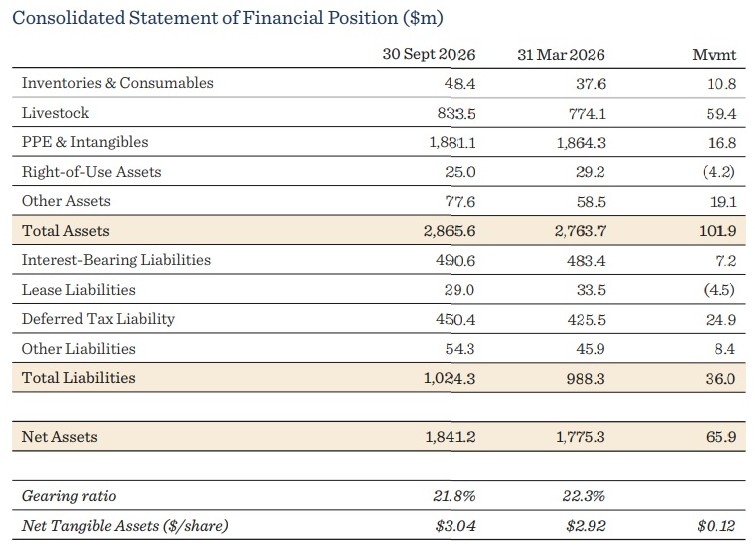
Statutory Net Profit After Tax was $60.8 million, compared with $82.2m a year earlier, as stronger operating earnings were outweighed by a lower unrealised herd market value gain of $70.5m (versus $94.7m this time last year).
Herd value (measured every six months, as opposed to annually for property value) was assessed at $883m, up $59m or 7.6pc on last year. Net tangible assets increased 4pc to $3.04 per share since 31 March, driven primarily by the uplift in cattle values.
 Managing director and chief executive David Harris said the record result had been years in the making.
“Our deliberate investment in branded beef is allowing AA Co to capitalise on strong demand for our premium product, with profit growth outpacing revenue growth. It demonstrates our strategy is working and creating long-term value,” he said.
 Cattle sales revenue (now only 29pc of total income) decreased 11pc for the half year ended September, versus $72.4m a year earlier, reflecting a deliberate reduction in sale volumes to accelerate AA Co’s herd development.
That was partly offset by 35pc higher pricing on favourable market conditions and mix. Cattle sales volumes are expected to vary as the company continues to develop and optimise its herd, shareholders were told.
Having been impacted by flooding in Northwest Queensland in both 2022 and 2025, AA Co expanded flood refuge infrastructure (click here for earlier story on construction of refuge mounds) to strengthen herd resilience.
“Information to date indicates no further flood-related losses are required to be recorded,” the company said.
US now largest customer
In alignment with broader industry trends showing near record exports to the United States, as the US beef herd labours at 70 year lows, the US was identified as the single largest contributor to AA Co’s beef sales growth during the first half.
The US is now the company’s single largest market, surpassing South Korea, with beef sales to the US up 57pc on 1H last year to $47.5m, supported by a dedicated in-market team, a national distribution partnership and realised foreign exchange hedge gains.
In Asia, Wagyu brand Westholme expanded into premium foodservice markets, with the lower-marbling Darling Downs brand achieved 14pc price growth in Korea.
Within Australia, Darling Downs strengthened its presence through Harris Farm premium retail stores, and 1824 (entry level marbling) increased its margin contribution through stronger pricing and broader international reach, shareholders were told.
AA Co has escaped the worst of this year’s China 55pc tariff impact, doing relatively little business other than Wagyu trimmings into the China market. However there had been indirect effects, the company told Beef Central, because other Wagyu supply chains that were much more reliant on China trade had diverted product into other markets to escape the 55pc tariff, competing directly with AA Co product in those markets.
Challenging international conditions
Beef sales revenue growth was achieved while navigating diverse international trade conditions, which included quotas being filled earlier than usual in Korea and China, and higher distribution costs into the Middle East, Mr Harris said.
“Investment in our brands and customer relationships is paying off, and we see opportunities to further enhance our global distribution network and grow in our key target markets,” he said.
Strategic Execution Better Beef Intensive Wagyu supply chain improvements are lifting quality, while expanded distribution and new partnerships are building brand equity and growth in key markets.
Emissions, sustainability, technology
In other topics discussed in this morning’s briefing, AA Co announced that it has started a beef emissions-insetting trial with industry partners through the Zero Net Emissions from Agriculture Cooperative Research Centre, to test ways to reduce emissions within its supply chain.
The company has also invested in solar-powered ear-tag virtual fencing technology company Drover, with potential applications for improved grazing management and livestock monitoring.
Operating environment
AA Co was well positioned to use its international network to optimise product allocation across markets, while tariffs, safeguards and geopolitical disruption continue to affect trade flows, investors were told.
“While seasonal conditions have supported productivity to date, El Niño and variable rainfall are key watchpoints for the remainder of the year,” the company said.
“AA Co is actively managing costs across its operations, with pressures from interest rates, fuel and input costs,” Mr Harris said.
“We’re continuing to build a stronger, more resilient business, and we’re confident in our ability to execute. Through the rest of FY27, we’re focused on converting demand for our Wagyu into improved margins and cash flow, while continuing to invest for growth.”
See today’s separate item about AA Co’s acquisition of backgrounding property Adalong Station, near Comet in Central Queensland.
- This item will be updated later today, following a subsequent interview with CEO David Harris.
HAVE YOUR SAY