
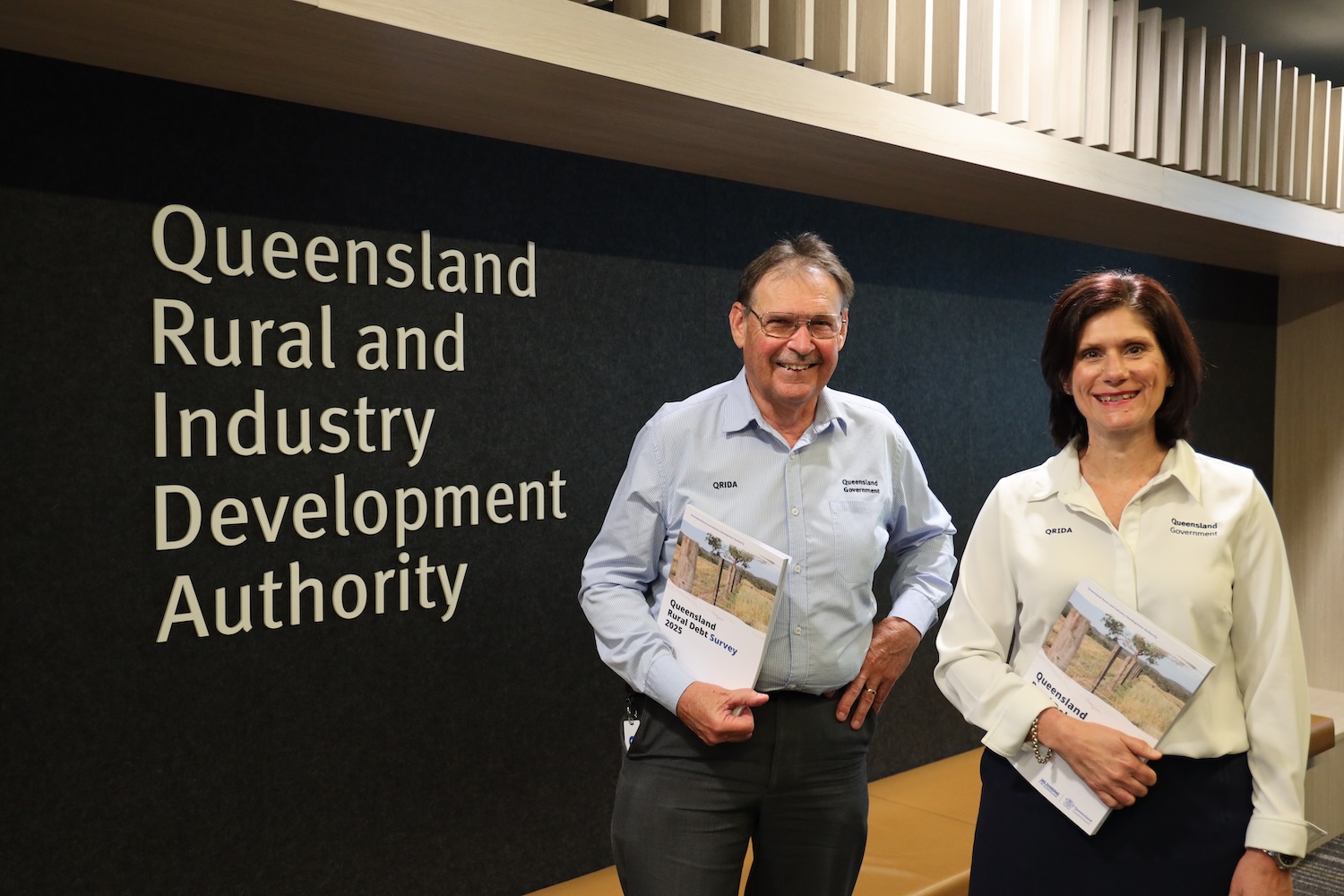
QRIDA Economist, John Gillespie, and QRIDA Chief Executive Officer, Brooke Irwin.
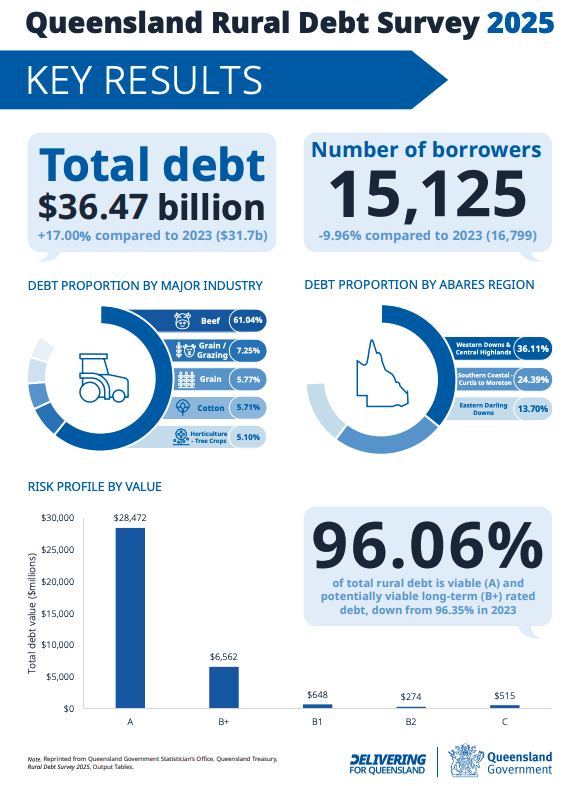
Queensland’s total rural debt has risen to $36.47 billion, up 17 per cent from $31.7 billion in 2023, according to the 2025 Queensland Rural Debt Survey.
At the same time, the quality of total rural debt has remained strong, with 96.06 per cent rated viable (A) or potentially viable long-term (B+), down slightly from 96.35 per cent in 2023.
The average rural debt per borrower was $2.41 million, up 29.95 per cent on 2023, and the number of rural borrowers decreased by 10 per cent to 15,125.
The three major rural debt holding industries were beef, grain/grazing, and grain, which accounted for 73.79 per cent of the total debt reflecting the size and contribution of these industries in Queensland.
Meanwhile, there were several industries that reported a reduction in debt levels, led by marine with a decrease of $33.06 million.
QRIDA Chief Executive Officer (CEO) Brooke Irwin said the biennial survey plays an important role in helping inform government and industry about the financial state of farmers.
“Queensland farmers, like most business owners, rely on debt to invest, expand and diversify their operations,” Ms Irwin said.
“While producers have more debt, the vast majority of Queensland farm debt is categorised as serviceable debt, backed by a new peak in rural land values and improved farm gate prices for most commodities over the survey period.
“Given the flow-on effects of cost-of-living pressures, global conflict and trade disruption, inflation and interest rate rises, the results of the 2025 Queensland Rural Debt Survey demonstrate the resilience of Queensland farmers, with the majority in a strong financial position.”
QRIDA Economist John Gillespie said during the survey period there was a remarkable growth of $2.05 billion in the state Gross Value of Product (GVP) due to improved climatic conditions, with no drought declarations and high global demand for quality Queensland protein and grain.
Mr Gillespie said the beef industry’s increase in debt of $3.26 billion was attributed to a combination of improved farm gate prices and a significant rise in land values.
“As Queensland’s largest agricultural industry and most valuable export, beef’s increase in debt came with a rise in cattle and calves Gross Value of Production (GVP) as well as growth in Queensland’s cattle herd, which accounts for half of Australia’s herd,” Mr Gillespie said.
Mr Gillespie said the three regions that held the highest levels of rural debt with a combined 74.20 per cent were Western Downs and Central Highlands, Southern Coastal – Curtis to Moreton, and Eastern Darling Downs.
“The three major debt regions were consistent with the 2023 survey. This was no surprise as these are large primary production regions with a diverse range of industries, and their debt levels were proportional to their agricultural activities.”
Mr Gillespie noted that while categories of rural debt rated B2 (in danger of becoming non-viable) and C (non-viable) have increased 82.01 per cent over the survey period, these categories only represented 2.10 per cent of the total rural debt.
“For farmers facing financial difficulties, there are free services available such as the Rural Financial Counselling Service and QRIDA’s Farm Business Analysis Assistance (FBAA) program which provides free and independent turnaround advice,” Mr Gillespie said.
“I would like to acknowledge and thank the QGSO for its assistance in undertaking the survey, all rural lenders for their participation and the agricultural industry groups that have generously provided their insights.”
Minister for Natural Resources and Mines, Manufacturing, Regional and Rural Development Dale Last said the survey gave valuable insights into the current climate of Queensland’s farming sector.
“Queensland farmers have retained a strong financial position despite ongoing pressures both here and overseas, including the ongoing war in the Middle East,” Minister Last said.
“I’m reassured by the high categorisation of existing debt and indicators that the State’s producers are expanding their operations.
“We know when Queensland’s agricultural industry prospers, regional Queensland succeeds and the Crisafulli Government is creating the right conditions to support primary producers now, and in the future.”
Source: QRIDA. For more information, read the full 2025 Queensland Rural Debt Survey and interactive dashboard at https://www.qrida.qld.gov.au/queensland-rural-debt-survey
The next Queensland Rural Debt Survey is scheduled for December 2027.
HAVE YOUR SAY