
FORMER Federal Agriculture Minister David Littleproud has urged the cattle industry to revisit an opt-in or opt-out membership model developed before the 2022 Federal election as it considers how to sustainably fund national producer representation through the current Cattle Transaction Levy review.
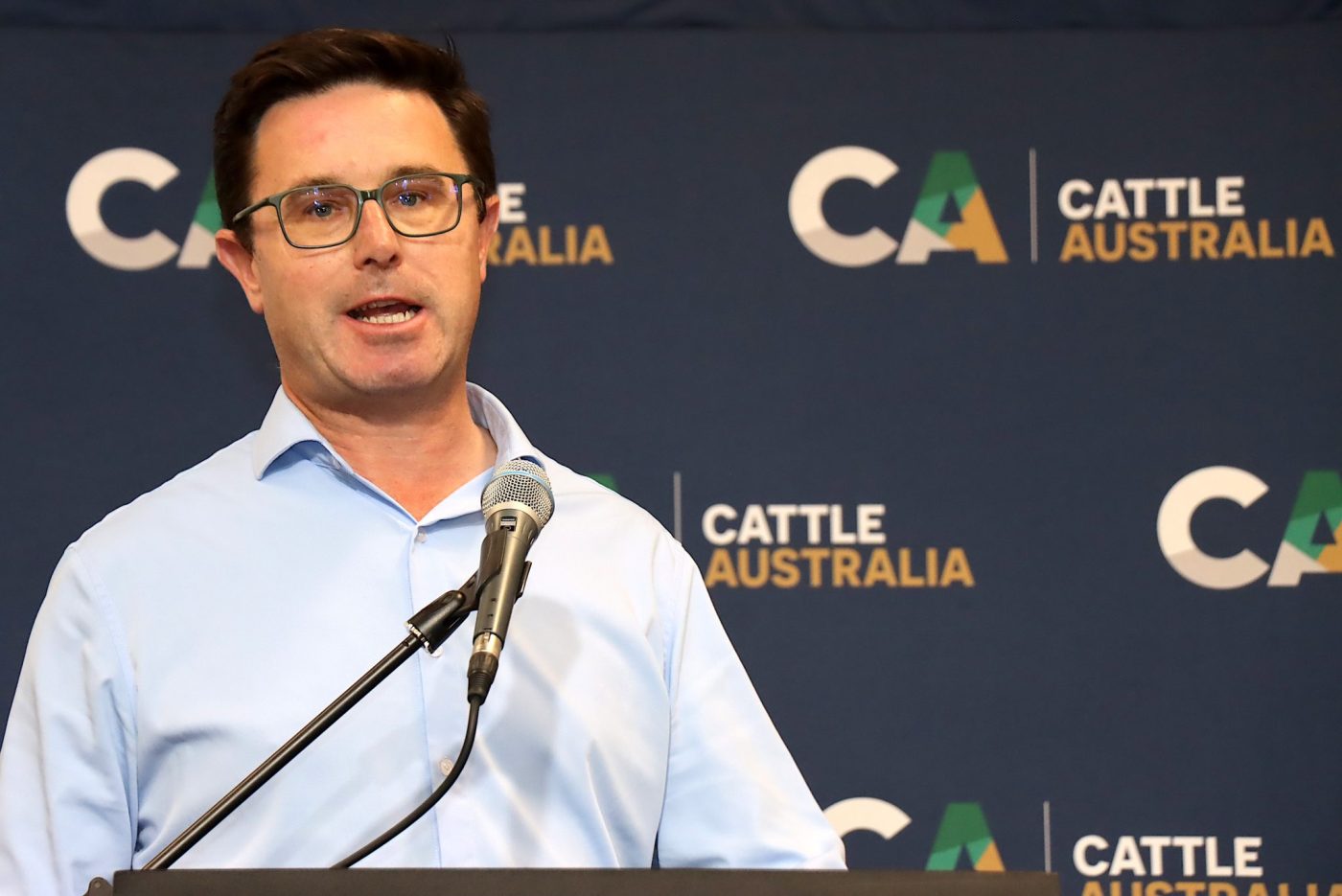
David Littleproud addressing the 2025 Cattle Australia Cattle Connect conference in Dalby.
Mr Littleproud, who as Agriculture Minister played an instrumental role in facilitating industry restructure talks that ultimately led to the formation of Cattle Australia, believes the model remains a more achievable solution than attempting to change legislation which restricts the use of levy funds for agripolitical purposes or industry advocacy.
In an interview with Beef Central, Mr Littleproud said he believed there was unlikely to be scope within legislation for Cattle Australia to receive direct funding from the levy (more on this below).
But he said there was a “workaround mechanically and structurally” that was explored in detail in discussions with the MLA Board in the lead up to the 2022 Federal election, before a change of Government led to momentum towards the proposal ultimately being lost.
The concept involved using the existing levy collection process to facilitate voluntary Cattle Australia membership.
Mr Littleproud said discussions had progressed with the Meat & Livestock Australia Board about establishing an ‘opt in’ or ‘opt out’ mechanism through which levy payers could tick a box on a levy return which would enable them to choose whether to share their details with Cattle Australia for the purposes of becoming members of the organisation.
By giving levy payers the ability to choose whether to share their details with Cattle Australia the mechanism overcame concerns about privacy restrictions relating to levy payer details.
The model also created the potential for producers to contribute a voluntary amount over and above the existing levy towards Cattle Australia membership.
By facilitating a voluntary membership the mechanism would not amount to giving Cattle Australia direct access to statutory levy funding for advocacy.
“So when you sold cattle (on) your vendor declaration we were looking to add a box around membership to Cattle Australia, and what that would include is if you tick that box, it would then give the right for MLA to provide the membership details, the levy payers details, to Cattle Australia and pay for some of it through that mechanism.
“It didn’t take away from the fact that Cattle Australia should always have a value proposition, they have to be able demonstrate to their worth, it is not just through trying to take a clip of the levy, they have to be able to get corporate support as well as get membership through a value proposition.”
Mr Littleproud said the proposal was discussed at a meeting in Darwin at which there had been agreement from the MLA Board “to work constructively with it”.
“We did explore that, and in fact when we lost the election Murray Watt basically allowed the MLA Board to walk away from the commitments that they gave at that meeting in Darwin before the 2022 Federal election”.
Mr Littleproud said he was still considering at that time whether an ‘opt in’ or ‘opt out’ mechanism would be the most appropriate approach.
“But effectively the biggest issue I had was around the Privacy Act and making sure that we worked with MLA constructively to ensure they weren’t in breach of the Privacy Act, but gave an opportunity for the levy payer, ie the producer, to have a mechanism to be able to pay their membership to Cattle Australia and to help fund Cattle Australia.
“(and) still with a value proposition that Cattle Australia had to provide, because either way whether it be opt in or opt out, if people or producers weren’t happy with the conduct of Cattle Australia, well they had an opportunity to rescind that membership.”
Funding the crucial task of national representation remains a key challenge
How to adequately resource national industry representation is one of five principles being considered by the committee overseeing the current Cattle Transaction Levy review on behalf of Cattle Australia.
The issue has been a long standing dilemma for all agricultural representative organisations, not just in the cattle sector.
While cattle producers contribute a significant accumulation of funds through the compulsory $5/head levy paid on the sale of every animal across more than 13 million transactions each year, legislation and statutory funding agreements restrict how those funds can be used, with marketing, research and biosecurity allowed but agripolitical or industry advocacy activities basically ruled out.
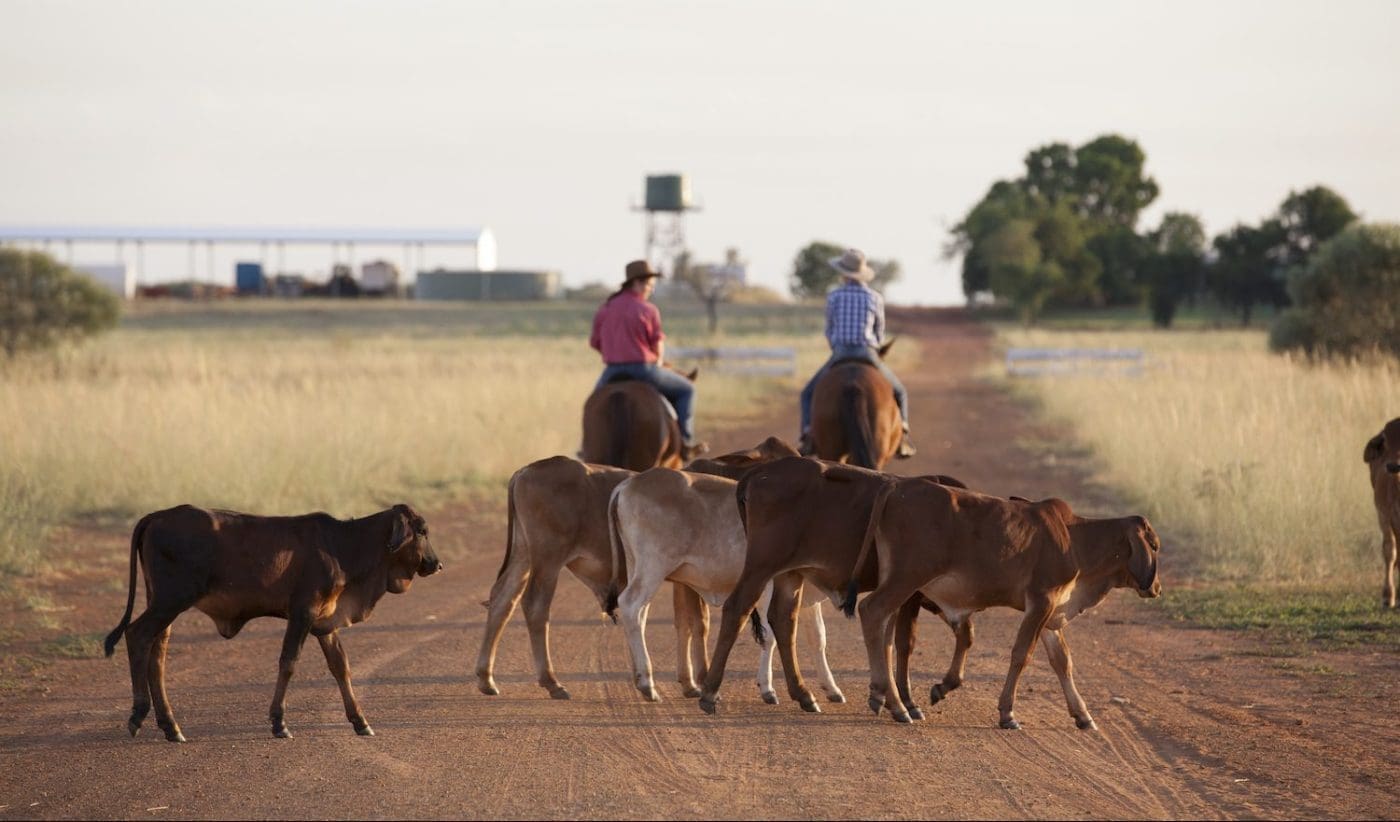 The challenge for a group such as Cattle Australia is how to generate the funding it needs to adequately represent a multi-billion-dollar industry in an environment where many producers believe the $5 levy they already pay is already enough, even though those funds cannot be used for agripolitical activities (as outlined in a 2015 report from a Senate inquiry into agricultural levies) and go to the industry owned service provision company Meat & Livestock Australia for research and development.
And additionally, how to generate the funding it needs to effectively represent the interests of cattle producers without being beholden to Meat & Livestock Australia or the Federal Government for the funding it needs to operate.
In previous years there have been calls by some producer groups for levy payers to pay an additional voluntary levy of 50c/head above the compulsory $5/levy to go towards “empowering national industry leadership” and to resource the industry’s defence against from one-sided public attacks from anti-beef activist groups.
Some producers have also vocally called for the Federal Goverment to “remove the shackles” on how levy funding can be used, seeing double standards in current rules that prevent the livestock sector from using levy money paid from its own pockets for the purposes of advocacy, while environmental groups which receive direct Government funding and tax-free charity status are free to actively advocate against the industry.
Existing rules make direct levy funding ‘unlikely’
Asked if he believed there was scope within current Government rules for a prescribed industry representative body such as Cattle Australia to receive direct funding from the levy, Mr Littleproud said it was unlikely.
In his view using the existing levy collection architecture to enable producers to voluntarily fund membership of their representative body was an effective workaround.
“The way in which to facilitate it is not to change the legislation because that would be very difficult,” he said, “because you’re talking about 15 commodity R&D groups.
“So just because it will fit cattle does not mean it will fit sugar or grains.”
He said the opt in/opt out mechanism was a proactive way to “facilitate a membership and the funding outside the levy”.
“So I was respecting the legislation but I was trying to get MLA to act in goodwill, like CPA (Cattle Producers Australia) and Cattle Council had in coming together, and this had really gone on for too long.
“I imparted my desire for MLA to help facilitate the process of helping the new Cattle Australia to find a way without breaching legislation and without breaching privacy.”
Mr Littleproud said the issue extended beyond the cattle industry because taxpayers also contributed funding to agricultural research and development corporations.
“The Government of the day represents the taxpayer in the contribution, now with MLA it is not a 50/50 contribution, but in some research and development corporations it is 50/50 of the tax paid dollar for dollar,” he said.
“The other issue is, on the other side when you get into lobbying, the Government of the day has never really tried to fund lobby groups or agripolitical organisations if they can help it.”
Mr Littleproud said changing that arrangement would require support through both houses of Federal Parliament and would have implications across numerous agricultural commodities.
“That has always been one of the challenges, when people say ‘let’s just change the legislation’ – not saying that it could never not happen – but firstly all the research and development corporations have got to agree, and then you go ‘well what happens to the prescribed organisation?’ because then you effectively make MLA your lobby group.”
“So you overlay that into every commodity and you might find that not everybody is in agreement.”
‘Power always sits with the levy payer’
Asked whether he still believed an opt-in/opt-out model represented the best way forward for the cattle sector, Mr Littleproud was direct in his response.
“I do,” he said.
“This is the thing, you should empower the levy payer, the producer, to make those decisions, and that is why there is already within the existing Act the ability to determine what the levy should be.”
Onus on Cattle Australia to demonstrate value
Mr Littleproud said any future funding mechanism should not remove the need for Cattle Australia to demonstrate its value to producers.
He said retaining the ability for producers to withdraw their membership was an important accountability mechanism.
“The power always sits with the levy payer to determine if they want to be a member because they believe they’re getting value from that organisation in representing them in holding the RDC to account.”
A strong national voice
Mr Littleproud said achieving a unified national voice under Cattle Australia had been important because competing messages from different representative organisations made it easier for governments not to act.
“When you have two voices running around in a Minister’s ear, and they couldn’t agree, the easiest thing for a Minister is to not do anything,” he said.
“When you have a single body that speaks with authority on industry, and it is very hard for Ministers to ignore it.”
Mr Littleproud credited the industry representatives involved with ultimately achieving the restructure.
“So what CPA and Cattle Australia did, the leadership at that juncture was significant for the cattle industry and it set the cattle industry up with a proper voice.
“So I was prepared to support it, but all I did was facilitate it, they were the ones that did the heavy lifting.”
He said ensuring that representative body remained strong and adequately resourced was important not only for advocacy, but also for holding levy-funded organisations accountable for how producer and taxpayer funds were invested.
“This is the important part of that levy, is that it should always have and the thing I always said as Minister is it has got to get back to value to the levy payer, value to the tax payer,” he said.
“And that is why I think it is important that these prescribed groups are strong, and that the levy payer has confidence not just in the RDC but also the prescribed group that represents them.”
HAVE YOUR SAY