
In this contributed article, scientists Pablo Manzano, Enrike Maree & Peer Ederer argue that a world without cows will continue to burn. The trio are part of the Dublin Declaration, which is about recognising the role of meat and livestock as essential.
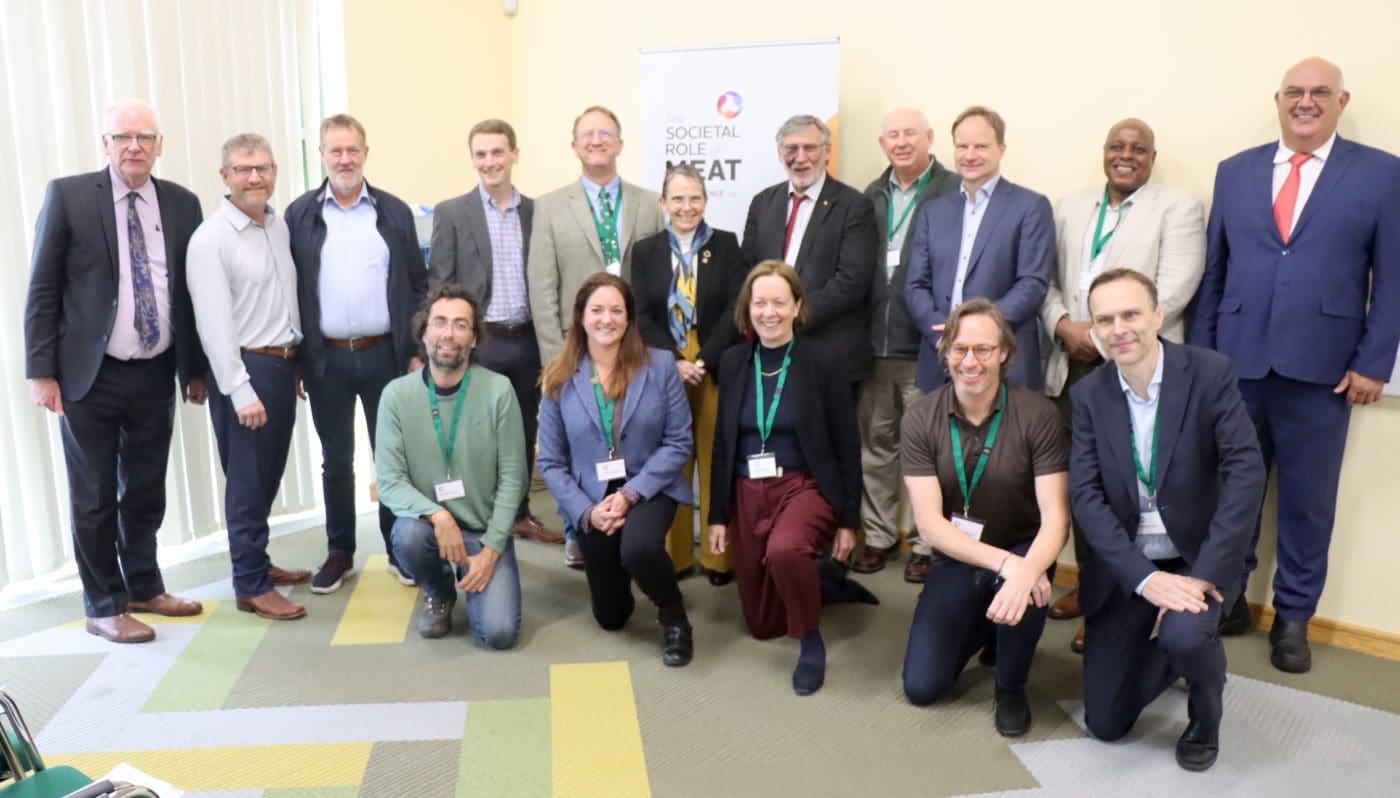
Presenters at the two-day summit on the societal role of meat in Dublin included Declan Troy, Jason Rowntree, Willhelm Windisch, Nick Smith, PeterBallerstedt, Shirley Tarawali, Paul Wood, Neil Mann, Peer Ederer, Max Makuvise, Theo de Jager, Pablo Manzano, Diana Rodgers, Alice Stanton, Bradley Johnson and Frederic Leroy.
THE world is heating up, and we see in the news that wildfires are growing more intense and reaching areas they hadn’t reached before. The conclusion seems obvious: a hotter planet triggers worse wildfires. But is this the full picture? Were there no fires before? Are fires not natural? And are all the changes in fire patterns really due to climate change?
One clue lies in how fire has played an instrumental part in maintaining natural habitats. The Western Cape province in South Africa is an example of this as it is the core of what botanists consider the most spectacular floral region in the world. It is by far the smallest; by comparison, the entirety of Europe, North, Central and East Asia, and North America together form a single Holarctic floral region. Yet the Capensis region hosts extraordinary diversity and plant families found nowhere else on Earth. Perhaps its most distinctive feature is the thin-leaved shrubs known in Afrikaans as “fynbos”, whose remarkable diversity has been shaped over millions of years by fire. By preventing trees from overtaking the landscape and forming closed-canopy forests, these fires have inspired leading scientists to explore how disturbance shapes the living world.
In most of the world’s continents, however, the force that has kept landscapes open for several million years has not been fire but herbivores’ stomachs. Present in very large densities over very long periods, the capacity of bovids, equids, proboscideans and many others to consume plant biomass kept the spread of woody plants at bay, promoting open landscapes where grasses and herbs dominate the surface. The giants of the past, bison, aurochs and tarpans a few centuries ago, then mastodons, straight-tusked elephants, rhinos, diprotodons and giant kangaroos but human expansion, probably accompanied by natural climate changes, drove them to extinction.
Even in areas where some equivalents have been reintroduced, they lack the space and the mobility that would make their action genuinely impactful at the landscape scale. This is why livestock systems that mimic the ecological behaviour of past herbivores are so vital. In severely degraded landscapes that cannot recover on their own, well-managed herds effectively substitute for lost natural processes, supporting biodiversity and ecosystem function.
Another clue lies in Kentucky’s Inner Bluegrass, one of America’s most distinctive landscapes. Gently rolling limestone karst plateau is the secret to everything here: phosphate- and calcium-rich soils grow famously mineral-dense grass, which is why the region became the thoroughbred capital of the world. The same limestone filters the water that made this the heart of bourbon country. Both explain why Alltech’s annual Presidents Club conference, headquartered just outside Lexington, opened this Monday, October 5th, with a tour of a distillery and closed at Lexlive cinema with the award-winning World Without Cows coming home to Kentucky, after premiering in Dublin, London, Los Angeles and New York the month before. Pre-settlement, this land was open woodland and canebrake, savanna-like in places, kept open by large grazers; the bison traces through the region were so worn that the first roads simply followed them. Two centuries of horses and cattle have since maintained what the bison began. The Dublin Declaration Desk knows this documentary well: we were among the very first to see its trailer and facilitated many of its first private viewings in Europe.
But in recent years, food production in developed countries has concentrated on the most productive land, and more marginal areas have been abandoned under the mistaken premise that nature will simply retake them. Many of these landscapes are now experiencing an abnormally low rate of herbivory. Yet the sun keeps on shining and the rain keeps on falling, so plants keep on growing. This means biomass keeps on accumulating, and in ecosystems with millions of years of adaptation to disturbance, leaves are small, spines are frequent and canopies are loose. Such vegetation does not retain water the way a rainforest does. It is highly sensitive to the one disturbance agent that remains once the herbivores have gone, and that can substitute for them: fire.
Fires in California, Australia, Chile or the Mediterranean basin are old news. We have begun to normalise fires in the boreal forests of North America and Siberia. But this summer has seen a step beyond: Western Europe has entered the picture. Some 115,000 hectares burned in France by late July 2026, including more than 42,000 in the Gironde alone, France’s largest wildfire since 1949, forcing the evacuation of around 224,000 people in the largest peacetime evacuation in French history; the fire reached within 15 kilometres of Bordeaux’s suburbs before the alert was lifted on 4 August. In Belgium’s High Fens, around 3,000 hectares burned in August, doubling the country’s previous all-time wildfire record and consuming three-quarters of its largest nature reserve, with fire spreading underground through peat and resisting rain. In Great Britain, an already alarming 23,359 hectares burned in 2026 was itself overshadowed by the 47,879 hectares of 2025, which beat the previous record by more than 19,000 hectares, with moorland, blanket bog and protected SSSI sites all affected.
The problem across all these fires is not only their abnormal extent but their intensity. With this volume of accumulated biomass, fires generate their own weather: pyrocumulonimbus clouds, or fire thunderstorms, that spawn lightning and new ignitions and drive flame fronts across tens of kilometres. Such phenomena had been documented in North America and Australia for years; they were observed in France for the very first time this summer. The soil also burns to an abnormal depth because of the abnormally high temperatures, killing the soil microbiome and preventing any quick ecosystem recovery.
This is the World Without Cows standing at our door. Without cows, sheep, goats and other ruminants the world will burn. The logical inference is then that we need cows to manage vegetation and thereby improve landscape fertility while reducing fire risk, even against a backdrop of climate change.
The available data helps us to understand why this is the case. In ungrazed trial plots in South Africa’s Free State, palatable decreaser grasses are lost entirely, unpalatable increaser species rise by 20 percent, species diversity falls by eight species, and biomass accumulates to 6,760 kg/ha, the highest figure across all treatments; but that biomass is overwhelmingly moribund material. Standing dead tonnage is what a fire ecologist calls fuel. In the adaptive grazing plot, by contrast, veld condition improved by 7.9 percent and species diversity increased by six species. In another South African example where a farmer increased his grazers through ultra-high-density grazing to mimic the natural behaviour of wild herbivores in Africa, he found 9 favourable grasses returning to the ecosystem which were undocumented for decades, contributing to a total of 40 grass and legume species in a single field, whereas the low-density grazing sites holds merely 28 species and excess unpalatable, moribund vegetation.
This is only two of many documented examples across the world where intentional and carefully managed integration of herbivores, increase the aboveground and below ground biodiversity; diversity which translates to resilience and the ability to recover after a disturbance. This does not only apply to open grasslands and savannas but include trees, which may otherwise be seen as the enemy in the fire argument: Silvopasture, meaning trees integrated with grazing in proportion and in context, can lower fuel loads rather than raise them. The science is unambiguous: herbivores have the capacity to mitigate wildfire damage, with practical guidance available for grazing management across fire-prone landscapes.
Adaptive, continuous and rest-based grazing produce measurably different outcomes, but it becomes clear that herd composition, timing and stocking density are fuel-management instruments to be considered as real as any firebreak or retardant aircraft and that if they are not – there are consequences. The effects of removing herbivores run below ground too: the cessation of grazing causes biodiversity loss and homogenisation of soil food webs, eroding the ecological resilience that supports recovery after disturbance. While this does not imply that the 2026 fires were directly caused by destocking in the Gironde or the High Fens, the scientific evidence clearly establishes the underlying patterns and mechanisms.
The rediscovery of grazing as fire management is thus already underway on both fire continents. EU civil-protection practice now formally describes livestock grazing as a wildfire-prevention tool, with fire-break grazing schemes operating in Spain and Portugal. The US Forest Service and Bureau of Land Management are actively promoting targeted pyrograzing on public lands under the 2025 Grazing Action Plan. Natural England’s August 2026 guidance carried the title “Fighting fire with nature: how healthy landscapes reduce wildfire risk.”
Our conception of what landscapes require has to change. On open land, the destiny of accumulating biomass comes down to a choice between metabolism and combustion: mouths or flames. There is no third option. This does not mean we must garden ecosystems; the lands that livestock sustainably graze are not artificial constructions but natural landscapes maintained by traditional knowledge and use, and by our capacity to produce food and resources in places where there is nothing for people to eat directly, yet there is everything for our livestock. Where we have abandoned that logic and turned instead to large-scale afforestation, as in the Landes of southwest France, time has given its verdict. That vast pine plantation, Europe’s largest man-made forest, is not ancient woodland. Until Napoleon III’s 1857 law mandated drainage and systematic planting of maritime pine, the Landes was open, grazed heathland: commons where sheep and cattle ranged freely, tended by the famous échassiers, shepherds who walked on stilts. The monoculture that replaced them, dense with resin and needle carpets, burns like a fuse. The record the 2026 Gironde fire was chasing had been set in that same plantation: 19–25 August 1949, approximately 50,000 hectares consumed, 82 people dead, still the deadliest single wildfire in European recorded history. A monoculture planted on former grazing land has now delivered France its two greatest fire catastrophes, three-quarters of a century apart. Such configurations are not stable, and they will burn when the right conditions arrive; those conditions are recurring.
The land will keep burning, threatening people and their property, as long as policy treats animals as the problem and their removal as the cure. The fires are the land’s reply. We know it because the World Without Cows is not a thought experiment: patches of it already exist, and this summer you could watch them burn on the evening news.
The Dublin Declaration regularly posts science-based articles on a substack page which can be subscribed to here.
HAVE YOUR SAY