
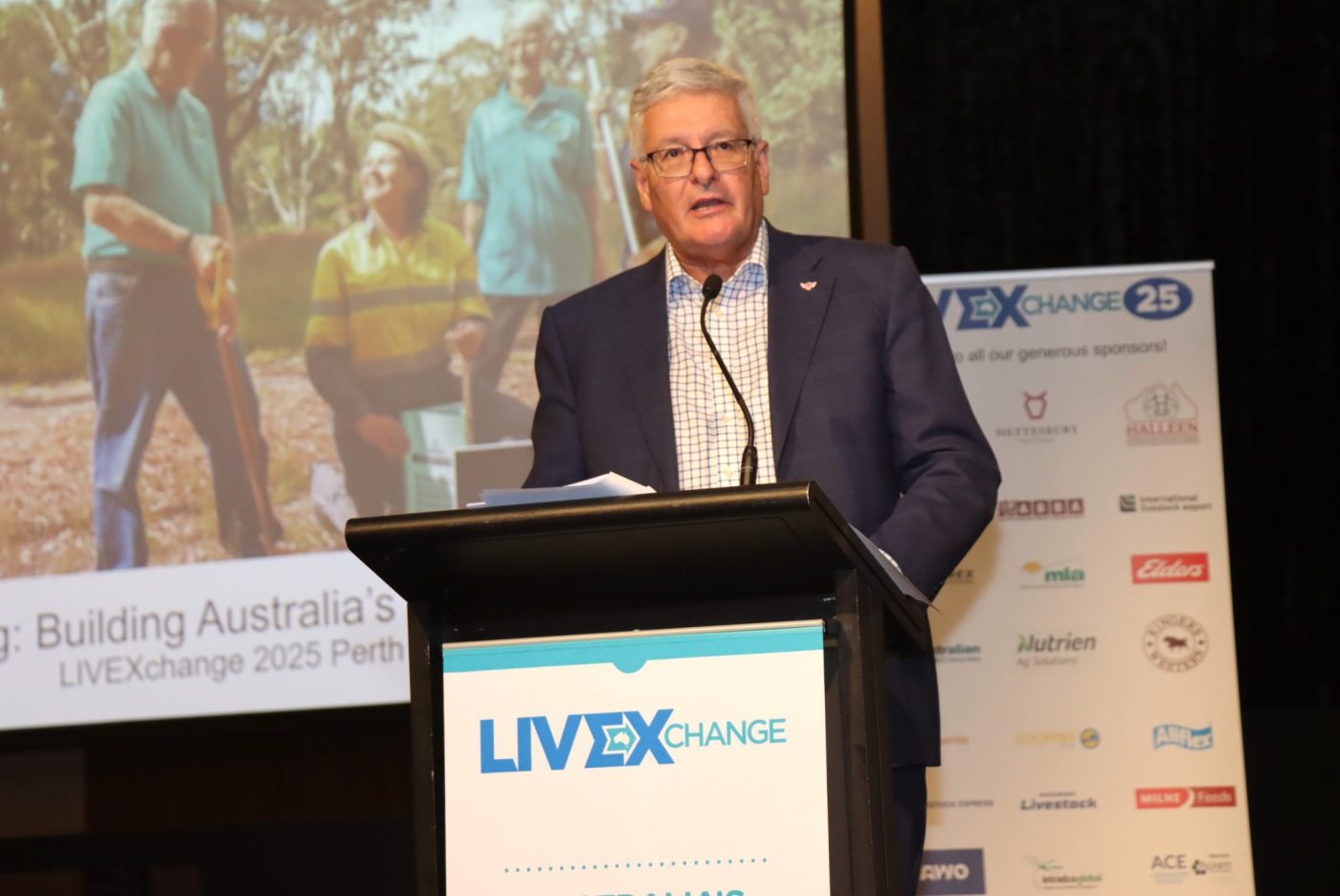
WA Minerals Council of Australia executive director David Parker addressing last week’s LIVEXchange conference in Perth.
FOR years, Australian agriculture has repeated the same mantra at conferences and forums around the country: “We have to get better at telling our story”.
The problem is, we keep saying it – and then leaving the job largely to a handful of passionate volunteers, scattered social-media voices, industry websites and the occasional press release that may or may not cut through the national news cycle.
For the $77 billion red meat sector, it is not so much as a communications strategy as a hit and miss gamble.
Meanwhile, the mining sector – which also operates regionally and is largely ‘out of sight and out of mind’ for most city-based Australians – treats communication as a core business.
As WA Minerals Council executive David Parker put it at the LivexChange 2025 conference in Perth last week, spreading your message effectively is like “dripping water on a stone”.
The mining industry invests continuously on multiple fronts to ensure everyday Australians understand the simple truth that if mining stops, the country stops.
They work proactively to shape perceptions before opponents do, and don’t wait around for others to define them. This ad shown at the conference is just one example of how mining communicates with the general public:
This is not to diminish the tireless work being done in the red meat and livestock sector by producer representative organisations like Agforce and Cattle Australia and the behind-the-scenes and public advocacy they undertake, or the work of levy-funded MLA to create public-facing producer stories and content demonstrating the commitment of tens of thousands of family livestock farming enterprises and the larger corporate-scale producers to responsible land and animal management.
 And nor is the news all bad of course. Community sentiment surveys continue to show strong levels of public trust in farming. At last week’s live export conference, latest national survey data was presented showing that public acceptance and trust in Australia’s live export industry have risen steadily since 2019, with strong recognition of its economic contribution, its role in supporting food security overseas, and improving animal welfare standards. Concerns about onboard conditions have significantly declined, and most Australians now believe the benefits of live exports equal or outweigh the costs. Why? No direct reason was given, but it’s hard to look passed the recent highly visible Keep the Sheep campaign for the role it played in building public understanding of the sector.
But while individual examples can be found, the red meat industry lacks an overall, coordinated and sector-wide communications strategy of the type that mining clearly benefits from.
This leaves a vacuum which in turn is often filled by the loudest and most negative voices.
Like dripping water on a stone, activist groups relentlessly campaign to present a view of cattle producers who cannot be trusted to manage their land, water and animals responsibly.
Read more: A city ad man walks into an NT cattle conference
The latest example of what can unfold when an industry’s story is dominated by someone else has just played out in Federal Parliament.
The Australian Conservation Foundation and other environmental groups have effectively created a perception that vegetation management on Australian cattle properties is unregulated and that tough over-arching Federal laws are needed.
This ignores the fact, as Cattle Australia has repeatedly point out, that Australian producers and landholders operate under more than 136 State, Territory, and Federal vegetation management laws and State Governments prosecute unexplaine illegal vegetation clearing in Australia.
However, an industry that is out of sight, out of mind to most Australians, and not large enough to wield national voting clout directly, is easy pickings for a Federal government most intent on winning urban votes from the Greens.
If the agriculture sector is unable to proactively increase support from city-based Australians who have little direct connection to it, it will remain an easy target for more political decisions driven by perception, not reality.
Australia’s major corporations understand this better than anyone. The nation’s biggest supermarkets and banks – which each have an annual turnover on par with the entire red meat and livestock sector – spend tens of millions of dollars a year on marketing. Not because they think the media and online platforms need the money, but because advertising works. It is predictable, it is measurable and it is a reliable way to directly reach the audiences you need to reach.
The mining sector has demonstrated that relying on chance and goodwill is not enough.
Ag can take a leaf out of its book and take chance out of the equation by investing in strategic, year-round, public communication that reaches mainstream Australians where they are.
Or we can keep hoping our story tells itself.