

Richard Koch, Elders
Author Richard Koch is an ag economist working with Elders as Business Intelligence Analyst.
WHILE the Australian cattle industry has made giant strides forward in many areas in recent decades, one area that has regressed significantly is the provision of critical market information and price transparency in certain parts of the supply chain.
The provision of accurate and timely information is critical to an efficient market and is a key plank in any mature, prosperous, and aspirational industry.
Trusted and timely information on the size of the herd, calf crop, feeder cattle supplies and other key metrics are critical to determine future supply and allow for proper planning.
All too often I have heard agents say: “I just don’t think the numbers are out there” while processors can often hold an alternate view. But without reliable, timely and trusted data, it is a circular argument.
More worrying is the information dichotomy that exists between supply chain participants. The processing industry has almost perfect oversight over producer returns, but as we move up the supply chain, the provision of information becomes murkier.
Feedlots are loathe to provide even the most rudimentary information around feeding margins while processing margins are a ‘black box’.
The USDA’s US lean beef prices, particularly the 90CL cow beef benchmark, is the mostly widely used (and some would say, the only) indicator of our beef’s international value. Historically a reasonably reliable guide to cow and manufacturing steer values, this benchmark is becoming less relevant to heavy steer values as grainfed production and chilled beef production expands.
The US is also becoming less prominent in North Asian markets and now its exports are mainly focussed on large single lines of individual cuts, such as short ribs in Korea, making comparisons with Australian export values difficult.
Japanese fullset prices once indicated what local processors might pay for Jap-ox cattle. As this trade has evolved and our beef exports have become more specialised, export returns, processor margins and their impact on cattle bids have become harder to reconcile.
For most of this year, processors have said international beef prices have not kept pace with rising Australian cattle prices. Without trusted, transparent indicators, the claim lacks evidence, fuelling unfounded accusations that processors are crying poor—this is the double-edged sword of limited transparency.
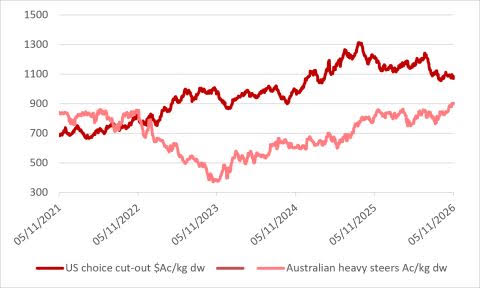
To bring some data to the debate I have compared Australian heavy steers prices to the USDA Choice Grade cut-out (the wholesale value of all cuts from a US grainfed steer). Given that US and Aussie fed cattle are similar, these measures should broadly track each other.
As you can see in the chart below, Australian heavy steers prices mostly track US Choice cut-out values, except in times when supply relatives between the two countries vary significantly.
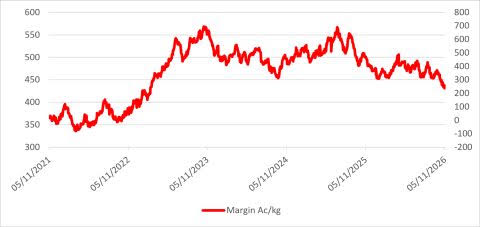
This margin chart on the right backs up processors complaints that margins have fallen this year but also suggest that they are enjoyed a period of relatively attractive conditions through mid-2023 to late 2025.
Industry roundtable?
Perhaps it is time for an industry roundtable where interested and engaged stakeholders can look into where the market reporting deficiencies are, and potentially, do something about it.
Set out below are some possible topics. Some of these may be a bridge to far, but we could cherry-pick the ones that would cause least angst and generate constructive discussion:
- In the absence of any government support, an industry-funded annual census on cattle numbers, cows, yearling steers, feeder steers, bullocks
- Market reports from MLA regional offices overseas, including key price indicators, supply/demand indications markets sentiment. Local herd & production stats
- Import stats from major markets (China, Korea, Japan, US ~ enabling market share analysis)
- Expansion of Steiner reports (it hasn’t changed in 30 years) to include categories other than lean manufacturing meat ie. Australian cuts trading in wholesale markets
- Domestic wholesale market commentary & key indicators. This was a regular report once from MLA
- Mandatory direct to work price reporting on heavy steers, cows and domestic trade cattle
- Paddock feeder prices (Flatbacks, northern Angus, southern Angus, Wagyu)
- Grainfed 100-day contract prices
- Proxy feeding and processing margins
- Grassfed supermarket program yearling cattle prices
- Mandatory weekly slaughter reporting
- Quarterly competitor analysis (South America – slaughter, production, prices, exports).
HAVE YOUR SAY