
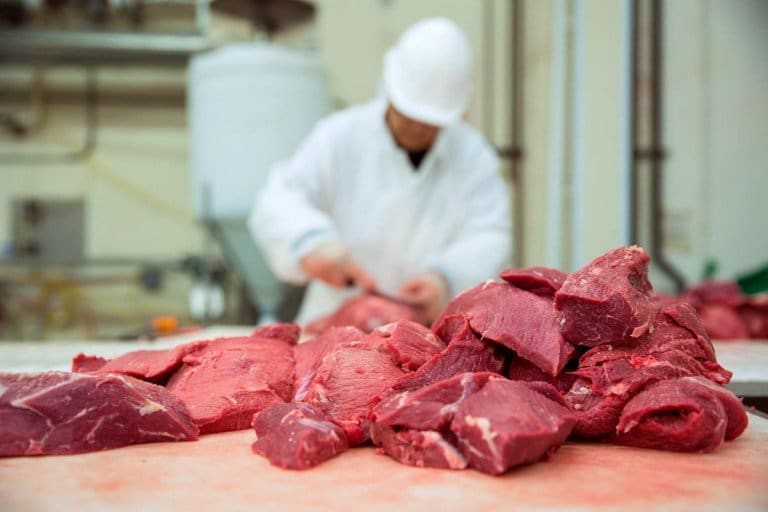
LAST week’s national beef kill reported by NLRS soared to an 11-year high, driven by high rates of turnoff being recorded in dry areas of NSW and Queensland and underlying international beef demand.
Adult cattle slaughter for the week ended last Friday, 17 April hit 164,883 head, up a whopping 34,000 head or 26 percent on the previous week, and 37pc higher than this time last year.
All five states showed dramatic week-on-week and year-on-year rises, led by Queensland (+25,100 YoY), NSW (+9300) and Victoria (+8300).
Two short working weeks in the fortnight prior due to Easter, clearly added additional impetus to last week’s numbers, but nevertheless kills of this size or higher have not been seen since the intense drought period in 2015, when frenzied kills briefly hit 179,000 head per week.
However access to labour for processing operations back then was a lot freer than it is today.
On top of the lag caused by Easter break, there’s a range of other factors involved in last week’s exceptional throughput:
- Delays to the start of seasonal cattle work in Central, Western and North Queensland due to earlier rain and flooding have seen a sudden lift in activity since Easter, with northern slaughter cattle numbers starting to arrive in volume.
- Approaching deadlines for kills qualifying for China export have also been put forward as a factor. Australia’s exports to China this year are limited by about one third on last year’s tonnage, to just 205,000t this year, before a savage 55pc tariff is applied. Processors are now racing to fill China quota before the gate closes for the year.
- Despite spiralling fuel and transport prices, southern state processors continue to press north to buy slaughter cattle, supplementing their locally-sourced stock. Some sources suggest it’s costing up to 70c/kg to get cattle sourced out of southern or Central Queensland back to sheds in southern Victoria or eastern regions of SA.
Because the weekly NLRS slaughter data collected from processors is voluntary, the reported figure is well shy of last week’s actual kill.
More accurate ABS data, which comes out about six weeks after the end of each quarter, suggests that the NLRS weekly number is about 22pc light-on for true numbers, suggesting last week’s actual national kill may have been as high as 197,859 head (one analyst’s report suggests as high as 206,000 head).
 Processor participation rates back in 2015 were considerably higher, suggesting last week’s kill may well have been an all-time slaughter record, boosted by additional capacity added in southern states over the past three years.
The ABS quarterly data for January-March is due 19 May, which may give a more a accurate (but somewhat dated) impression of recent production volumes.
Barring the previous two easter weeks, the past four full national processing weeks have averaged close to 158,000 head, based on the NLRS figures. This suggests Australia is well and truly on track to record another year of record beef production and record exports in 2026, after a record-blitzing year last year.
With most other large beef producing and beef exporting nations showing declining numbers, Australia remains strongly positioned to help fill the global protein deficient that’s in place. We’ll discuss these and other matters in an article appearing Monday, following a presentation last night in Brisbane by Stonex analyst Ripley Atkinson.
Among other things, he remains in vigorous disagreement with other analysts who have suggested in the past week that Australia’s beef herd is now entering rebuild phase. He argues that the current liquidation across northern parts of NSW and southern Queensland has completely offset any rebuild occurring in Victoria and eastern parts of SA.
FSR number looks light-on
Meanwhile, the female slaughter ratio (percentage of female cattle in overall adult cattle kill) in last week’s NLRS kill data looked surprisingly modest at just 47.53pc.
A figure of 47pc is regarded as the tipping point between herd expansion and contraction, but given the enormous numbers of cows being offered through major selling centres like Dubbo, Tamworth and Gunnedah in NSW and north to Roma and Dalby in the past few weeks, last week’s FSR number looked too low. See today’s separate discussion on cow slaughter and pricing.
An explanation may be found in the NLRS reporting protocol. Participating processors (not all choose to contribute kill data to the voluntary NLRS collection, with an estimated 22pc deficit compared with more accurate ABS figures) have the option of filling in the gender column in the weekly report.
For those who choose not to do so, they are allocated a 50/50 gender split as a default. That may be causing some distortions in weekly NLRS reported FSRs, Beef Central was told, if in fact their female kills are much higher.