
WHAT if the Australian beef industry is potentially leaving $375 million a year on the table, hidden inside carcases that nobody is measuring?
James Carter, 2025 Nuffield Scholar and Processing Manager with the Australian Agricultural Company (AA Co), spent his scholarship investigating why Australia, a world leader in beef eating quality, has never properly measured or paid for carcase yield.
“I have spent my career watching the work that goes into raising an animal, from the land my family has farmed for seven generations, through to the boning rooms I help manage today,” Mr Carter said.
“The idea that hundreds of dollars in value can be created or lost on each carcase, yet remain hidden because it is neither measured, rewarded nor fed back to the producer, is the gap I want to help close.”
Mr Carter recently published his Nuffield report after two years of research and travel centred around the need for objective carcase yield measurement and the value it could bring to the Australian beef industry.
“Allowing producers the ability to be rewarded for yield is something I think will be the biggest profit driver the industry has seen in years,” he said.
“And processors will justify a bonus to producers as it means more potential kgs, as well as more profitable kgs, arriving to the boning room to be packed into a box, for the same processing cost.”
Mr Carter presented his findings at the National Nuffield Conference in Darwin today and outlined how his travel through Australia, New Zealand, Singapore, Taiwan, Zimbabwe, Chile and across Europe allowed him to examine the technology available and how other countries measure and reward yield.
The financial case for rewarding yield
As part of the report Mr Carter conducted a bone-out trial with Murdoch University, in which 17 carcase sides, representing a wide range of weights and fat depths within a single breed, were dissected into commercial cuts and individually weighed.
Based on an average value of $10-30 per kilogram of saleable red meat, the trial showed when measured at identical carcase weight, the leanest and fattest sides differed in value by as much as $300 per side.
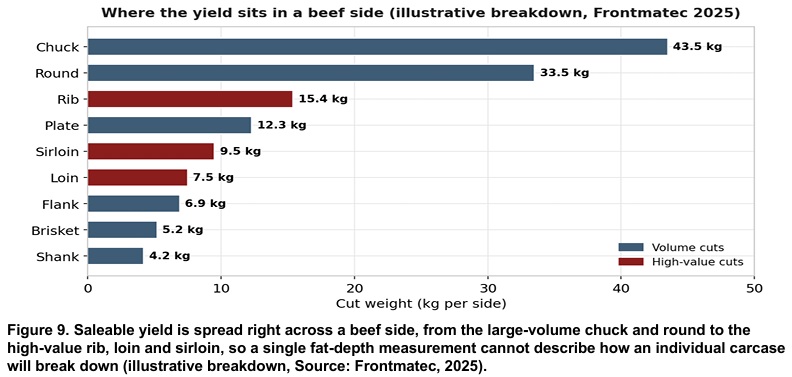
That is a $600 per head difference that carcase weight alone could simply not see, and invisible to the way Australia currently grades, measures and pays for beef.
“While it is tempting to look at a $300 swing on a single carcase and treat it as an interesting outlier. It is not. The bone-out data suggests that cumulative value differences routinely exceeded $200 per carcase,” Mr Carter said.
“Conservatively take the bone out result and put the average mis valuation to $50 per carcase, as of July 2026 the weekly kill in Australia is estimated at 150,000 animals per week, $50 per carcase totals at $7,500,000 of unrealised value each week.
 “Multiply that by 50 weeks, allowing for maintenance shutdowns, that is a potential $375,000,000 of carcase value industry could be miss valuing for yield, without the ability to objectively measure it and feed back to producers.
“Recovering even a portion of this value through improved measurement and genetic selection would have significant implications for supply chain profitability and efficiencies.”
Mr Carter said there are already examples of producers being rewarded for yield from processors around the world.
“The Irish Cattle Breeding Federation (ICBF) feedback system helps producers make better genetic selection to target the top of the objective processor grid they are paid on,” he said.
“Domestically, Gundagai Meat Processors’ in-house GLQ5+ grade rewards producers with a bonus for lamb carcases that hit the mark on yield and eating quality.
“This is proof the model works when objective measurement is linked to a transparent feedback system and incentives are in place.”
“The technology is the easy part”
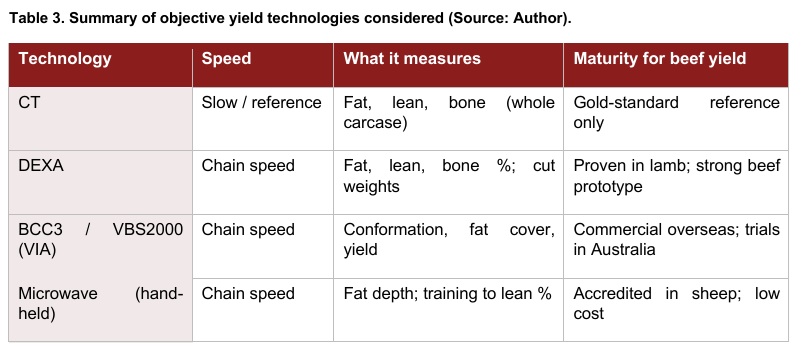
Mr Carter’s report details the four types of technology he examined internationally and domestically, which are – Computed tomography (CT), Dual energy X-ray absorptiometry (DEXA), surface imaging cameras and a hand-held microwave system.
Computed tomography: the gold standard reference
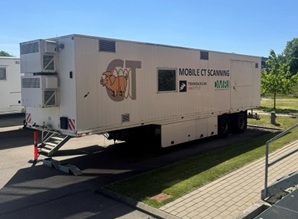
DMRI Mobile CT in Denmark. (Supplied: James Carter)
CT is the reference which every commercial device is judged against, Mr Carter’s report states.
CT is a highly precise, reliable and repeatable measure of carcase composition, however, is not a chain-speed tool, it is too slow and too expensive to put on every carcase.
“CT has been very successful in aiding the smaller stock industries like lamb and pork, as it is a lot easier to fit these carcases into the machine,” Mr Carter explained.
“In beef, it requires the carcase to be broken down, which adds a lot more time and cost.
“Throughout my study, I became convinced that CT will be fundamental in establishing the reference standard should the Australian beef industry pursue its own lean meat or saleable red meat yield trait.”
DEXA
Mr Carter said DEXA is one of the most exciting whole-carcase yield technologies available, which can be run at commercial speed.
However, due to its size, and the required infrastructure, it is not viable for a lot of processors unless they have sufficient space for installation.
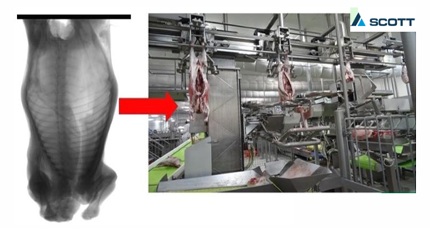
DEXA. (Supplied: James Carter)
Teys Australia’s Lakes Creek plant was the first in the Australian beef industry to install this technology and it occupies 48m².
“Most beef abattoirs don’t have that available space, without significant capital investment to accommodate,” Mr Carter said.
“There are also stringent X-ray safety requirements, although these can be managed with appropriate infrastructure and protocols.
“There are findings that DEXA may even reach into eating quality measurement eventually.
“For a processor, that raises the genuine prospect of a single rapid scan informing both yield and quality sorting on the same chain.
“This dual-purpose capability could significantly strengthen the business case for investment in the technology.”
Surface imaging cameras
The technologies most widely adopted throughout the Northern Hemisphere are surface-imaging cameras, and these are the systems Mr Carter saw most of on his travels.
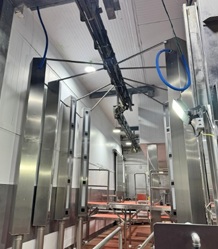
The Frontmatec BCC3. (Supplied: James Carter)
The Frontmatec BCC3 and the JBT Marel VBS2000 scanner are already in commercial use objectively grading the EUROP classification system used across Europe and the United Kingdom.
Video image analysis (VIA) captures the external shape of the carcase, including conformation and fat cover, and it can predict cut weight yield from these characteristics.
“The appeal is that a camera is comparatively cheaper, faster, safer and easy to install compared to a DEXA, with no ionising radiation and no shielding. The precision achievable from imaging is well established,” Mr Carter states in his report.
Lower-cost and complementary technologies
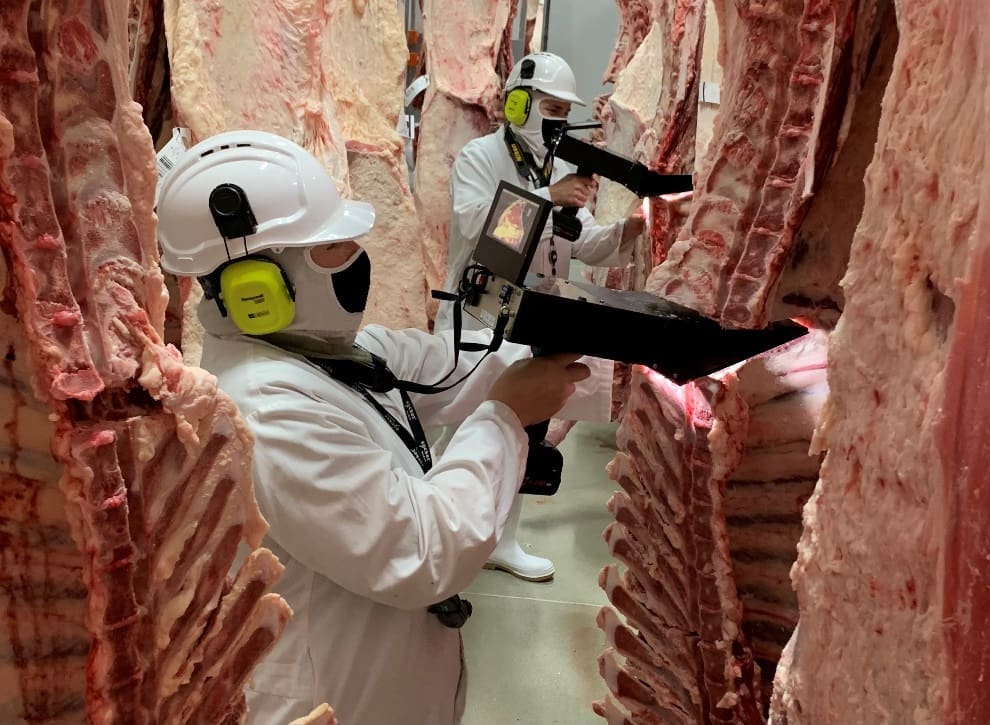
Not every plant can justify the size and expense of a DEXA tunnel, so a tiered set of options matters. A hand-held microwave system, created in Australian by Murdoch University, offers a low-cost, easily deployed measure of fatness.
It is accredited for grade-rule tissue depth in sheep, has been tested at 12 carcases per minute, and predicts fat depths in both live cattle and carcases, albeit with less precision than DEXA.
“The technology is the easy part,” Mr Carter said.
“The collaboration is the hard part, and it is this part that will determine whether this becomes paradigm shifting or just another good idea.
“MSA succeeded because processors, researchers, breed societies, MLA, AMPC and AUS-MEAT pulled together around a shared standard. A yield trait will demand the same.”
A complete carcase language: eating quality and yield together
Mr Carter argues yield should run adjacent to MSA, not instead of it or ahead of it, so that a carcase is valued on the full picture of what it delivers.
“Running the two together also resolves a tension I see every week in our Wagyu production,” he said.
“Marbling and yield can pull in different directions, however, there will always be animals that can achieve both, and the only way we will identify them is by measuring both traits objectively.
“A system that rewards only one will distort breeding and feeding decisions towards that single outcome.
“A complete carcase language, combining eating quality and yield, lets producers optimise for total carcase value rather than chasing a single number, while also enabling processors to pay for exactly what they want to be packed into a box and sold in market.”
Mr Carter explained there is also a sustainability dividend too.
“Harvesting more saleable red meat from the same animal through better muscle conformation and less waste, lowers the emissions intensity of every kilogram of beef and reduces the cost of production for both producers and processors,” he said.
“In a world where our customers increasingly ask about the footprint of their food, producing more usable protein per animal is one of the most credible efficiency stories we can tell.”
Beef industry’s next frontier
Mr Carter’s call to action is this – the technology is available, the science is settled, and the gold-standard reference methods exist, the only thing missing is the architecture and will to act.
“Processors should start installing yield technology now. Industry should anchor every device to a national CT reference standard and get a yield trait onto the AUS-MEAT trading language,” his report stated.
“Feedback and payment then need to follow the carcase back to the producer, regardless of whether it was sold over the hooks, through a saleyard, or out of a feedlot.
“The key to this being truly transformative is rewarding producers through objective feedback they can action and is how industry truly starts extracting the full value of the carcase for quality and quantity.
“Australia built exactly this architecture for eating quality through Meat Standards Australia and this measurement of carcase yield in sheep. We now need to do it again for yield in beef.”
Mr Carter’s Nuffield scholarship was supported by Northern Pastoral (AA Co, Consolidated Pastoral Company, Elders and S. Kidman and Co).
You can view the full report here.
Our aim has always been to produce prime beef that gives us the best nett return.
My cattle genetics have been performance recorded since 1965, sold directly over the hooks 1970, entered into carcass competitions and grazing trials and received premium prices since the early 1970s.
We had to upskill in breeding, finishing and marketing, to survive many decades of the fickle beef industry.
The industry has caught up to us by being a lot more objective, but there is still work to be done!
Saleable meat yield being just one area…. to provide a “fair price for a fair product”!
Hey Malcolm, I think you should read the report to get some context for this article, the link is at the end of the article. As our current single ruler measurements we use in the beef industry cannot describe the saleable red meat of a three dimensional animal, which is why we need adoption of this technology and the science proves this.