
THE starting gun has today been fired on the industry consultation process for the Cattle Transaction Levy Review, with final recommendations expected to be put to grassfed levy payers for a vote at the Meat & Livestock Australia AGM in Townsville on November 24.
A committee to oversee the first major review of the levy since 2009 was appointed in late February.
A discussion paper released today – described “as a starting point and not an end” – outlines the approach and guiding principles the committee will adopt as it conducts the review and gathers industry feedback over coming months.
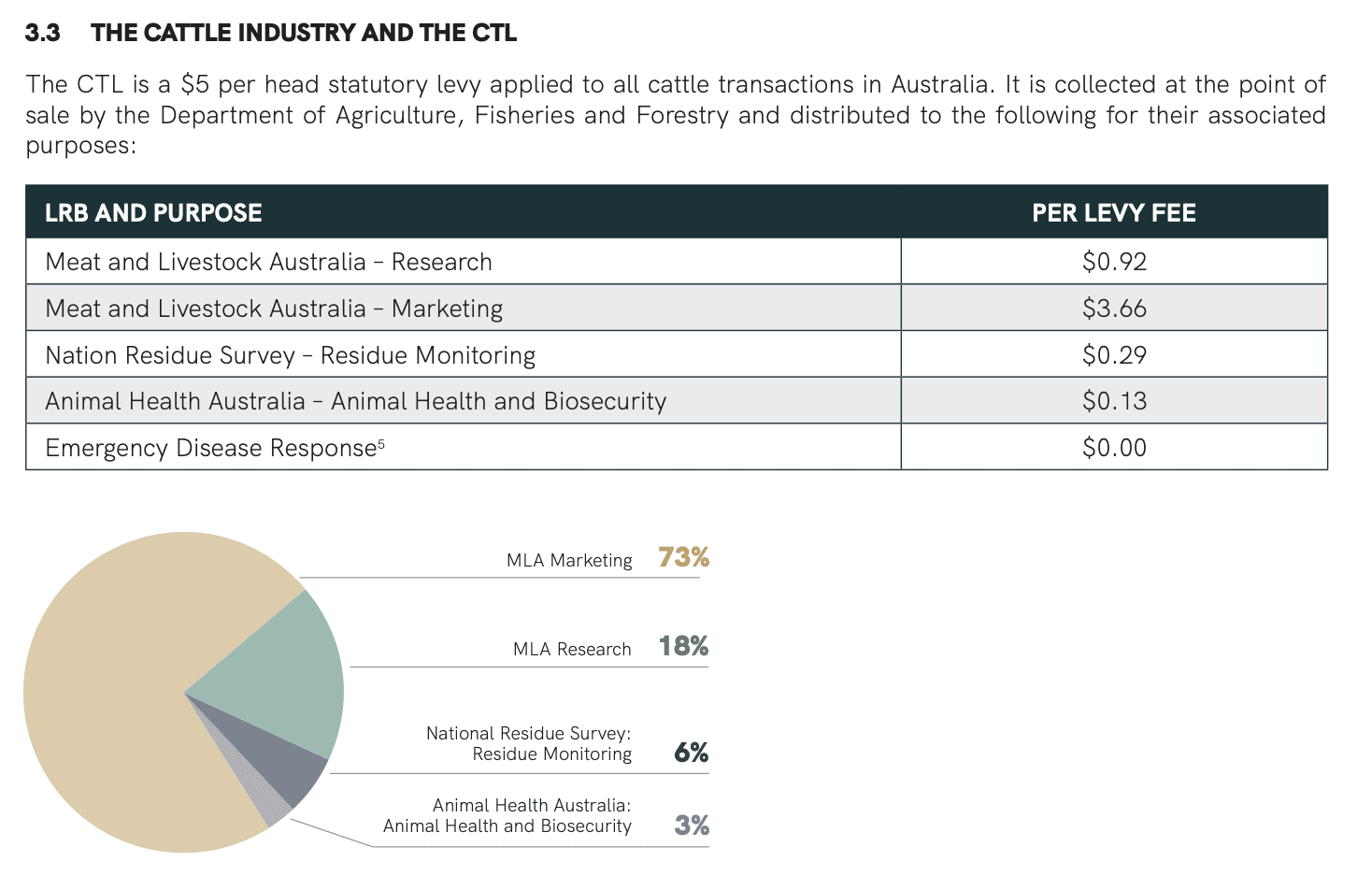
A breakdown included in the discussion paper showing how the $5/head cattle transaction levy is currently distributed. Source: Cattle Australia
The first phase of work, expected to be completed by early June, involves an independent analysis of the historical economic performance of the levy and an assessment of whether the current system is facing functional challenges due to funding limitations or other systemic issues.
The second phase will involve preliminary industry consultation regarding views on the levy, its effectiveness and areas where it could be improved.
The discussion paper also outlines principles the committee has identified as standing “as some of the more obvious functional challenges of the current levy structure” for industry consideration.
The principles are (more detail is provided in the discussion paper linked below this article):
• The system lacks flexibility for needs-based change
Moving funds between existing LRBs – even without changing the $5 total – requires expensive, time-consuming consultation. When LSD and FMD were detected in Indonesia, an additional $0.10 shifted to AHA would have generated ~$1.3m for preparedness, but the regulatory regime made that impractical. Greater flexibility within the existing envelope is worth exploring.
• Additional levy streams may be warranted
Two examples are offered for industry consideration (not as recommendations): a separate biosecurity stream, and a stand-alone stream for Integrity Systems (ISC). Both have strengths and risks. The Committee wants industry views on whether either passes the market-failure test and would deliver sufficient additional value.
• Fixed review periods should be embedded in industry practice
A fixed cycle – potentially aligned with Red Meat 2030 and the LRB five-year mid-term reviews- would let the industry health-check investment and reallocate as priorities shift. 28 years without a review of the AHA/NRS components is too long
• Industry representation capability must be adequately funded
The volunteer model that has historically supported producer input into program design, biosecurity response, integrity systems and standards is under increasing stress. Roles are more complex, more technical and more time-intensive. For a $17b sector, the current inequity – that only those who can step away from their own businesses can participate – is a structural risk. This is distinct from agri-political activity, which remains out of scope.
Feedback on these principles is also expected to be completed in early June.
The review will then move into an “extensive face-to-face and online consultation” phase with industry from June through to August.
The final stages of the review will involve presenting industry feedback to stakeholders, with any recommendations for reform to be put forward for a vote by grassfed levy payers at the MLA AGM in November 2026.
Review broader than levy rate alone
The discussion paper notes the review will not only assess whether changes are needed to the quantum of the levy — which has remained at $5 per head since 2006 — but will also examine “the overall health of the structures that exist within this system and assess whether structure changes may be required to better service the health of the grassfed beef industry”.
 “These structures are complex and inter-related, and it has been some time since an extensive assessment of their overall health has been undertaken. This Review will, at least in part, seek to undertake this work,” the paper states.
“It should be noted that agri-political activities and any related funding structures are intentionally excluded from this review and are not funded by the Cattle Transaction Levy.”
In another section, the paper reiterates that the committee is not proposing the use of levy funds for agri-political purposes.
“Rather, the focus is on whether the current system is adequately supporting the capability required to design, govern, deliver and adopt levy funded activities effectively, consistent with the legislated purposes of the levy.”
Case for the review
Cattle Australia, which is leading the process, states in the paper that the case for a review is based on the downward trend in real income for some of the key services delivered by levy recipient bodies such as MLA, AMPC and LiveCorp, while costs have continued to rise.
With the levy unchanged since 2006, much of that pressure reflects the declining real-dollar value of levy revenue over time.
However, the paper also emphasises that this does not suggest “an increase in the levy is necessarily required”.
“Different to 2009, this review is not looking at one aspect of the levy to be maintained or increased.
“Rather, this review is seeking to undertake a holistic assessment as to the health of the operating environment provided for by the levy and to look to areas in which this can be optimised to ensure maximum return for industry.
“While changes may be recommended by the committee, these are unlikely to be limited to the funds collected but are also likely to include recommendations for systemic reform, within the parameters set out in the guidelines and enabled through regulation and legislation.”
To download the full discussion paper click here and a summary here